


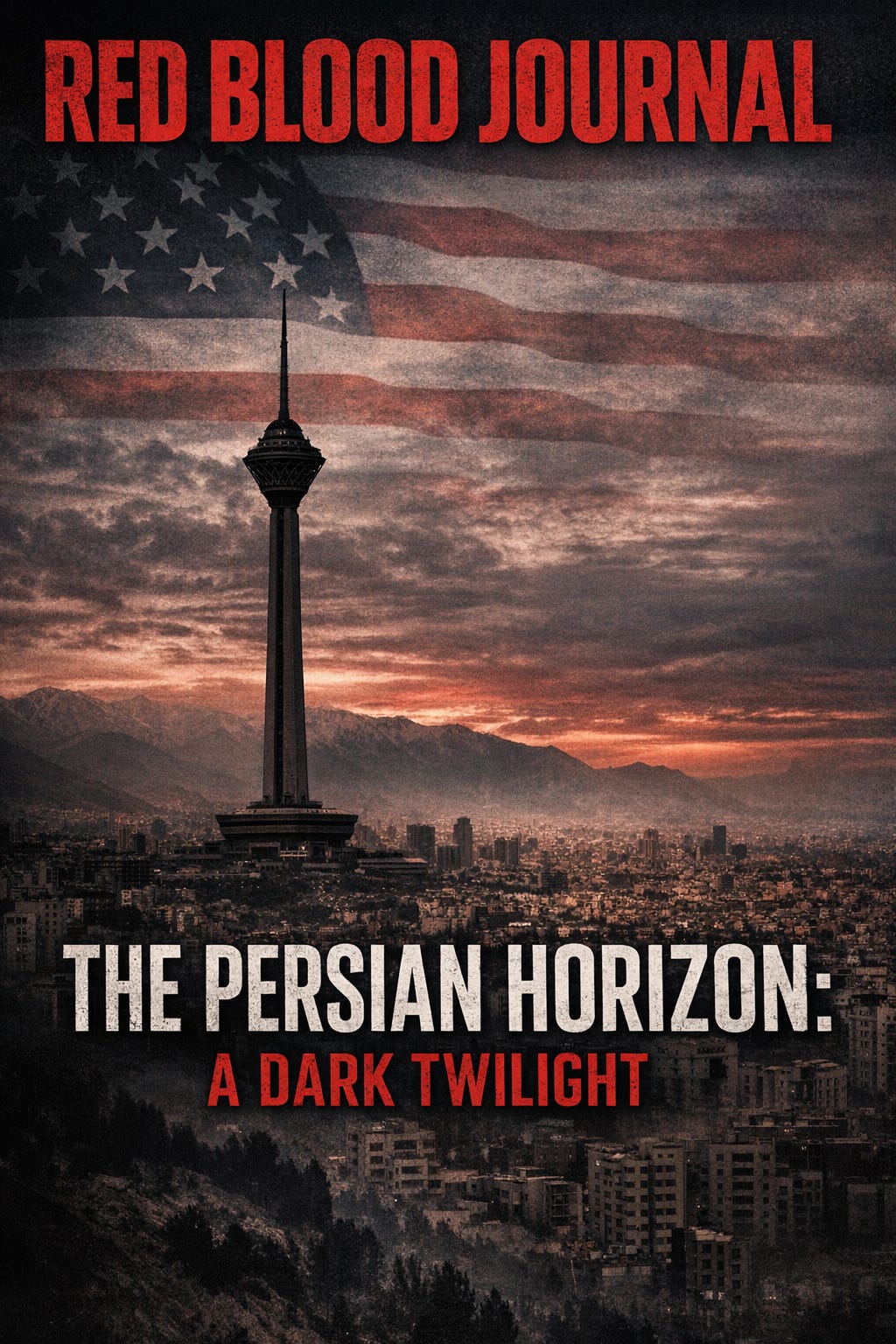
🩸 RED BLOOD JOURNAL TRANSMISSION
T#: RBJ-2026-HORIZON-IRAN (HYBRID FORMAT)
Classification: Counterintelligence of Geopolitical Expectation
Desk: The Archive of Blood & Power — Tehran / Washington / The Straits
PROLOGUE — THE HORIZON THAT NEVER ARRIVES
No liberation arrives by airlift.
No freedom descends with sanctions relief.
Empires do not deliver emancipation to populations whose obedience keeps the machine running.
For Persians, the future is not written in revolutions or coups. It is written in the slow calibration of control — softer at the surface, harder at the core — because predictability matters more than justice when the dollar is the organizing principle of the world.
The horizon is not a dawn. It is a managed twilight.
SECTION I — THE SURFACE OPENS, THE CORE HARDENS
The likely pattern is already visible:
Fewer visible crackdowns in public life.
More digital surveillance in private life.
Looser dress enforcement as spectacle.
Tighter data, banking, and movement controls as substance.
The state trades blunt force for precision.
The baton retreats from the street; the algorithm advances behind the screen.
To outside powers, this looks like “reform.”
To the security apparatus, it is simply better governance of dissent.
For ordinary people, the breathing room grows — but the walls remain.
SECTION II — THE ECONOMY AS A PRESSURE VALVE
Life settles into a rhythm that feels normal only because it never ends:
Sanctions → talks → partial relief → renewed pressure → new talks.
Inflation never fully disappears.
The rial moves like a restless animal.
Imports arrive, then vanish, then return.
The objective is not collapse, nor prosperity.
It is containment without implosion.
The economy becomes a calibrated instrument of discipline — painful enough to constrain, not chaotic enough to explode.
SECTION III — WHY REGIME CHANGE IS UNLIKELY FROM ABOVE
There will be no engineered liberation because instability is the enemy of the petrodollar world.
A chaotic Iran means:
Strait of Hormuz risk premiums,
shipping insurance shocks,
oil market volatility,
and incentives for non-dollar trade.
Therefore, the preference is continuity dressed in cosmetic reform, not rupture.
Replacing one mullah with another changes faces, not incentives.
Restoring a monarch changes flags, not the security architecture.
The system does not gamble on personalities.
It bets on structures that keep markets calm.
SECTION IV — WHAT IRANIANS ACTUALLY INHERIT
What Persians “look forward to” is not a moment, but a condition:
More cultural confidence that cannot be fully policed.
More technological literacy that slips through state controls.
More generational distance from revolutionary myths.
More quiet erosion of legitimacy inside the ruling order.
This is not dramatic.
It is cumulative.
Regimes do not fall because of one uprising.
They unravel because each generation believes a little less.
SECTION V — COUNTERINTELLIGENCE NOTES
The boss does not need Iranian obedience; it needs market predictability.
Petrodollar stability rewards stability, not liberation.
Visible repression will likely soften; invisible control will deepen.
Change will come from within, slowly, or not at all.
The greatest threat to the regime is not foreign power — it is time.
ANNEX — THE QUIET EMPIRE
The empire does not rule Iran by occupation.
It rules the lanes of finance, shipping, insurance, and currency that shape Iran’s choices.
As long as those lanes remain dollar-centric, Tehran adapts, not defies.
As long as adaptation is possible, the system prefers it to revolution.
Thus the Persian future is neither paradise nor prison —
it is a negotiated corridor between both.
A long hallway, brightly lit in some places, shadowed in others,
with doors that open slowly, if they open at all.
🩸 — END OF TRANSMISSION —
🌆The Managed Twilight of the Persian Horizon
Iran’s future is a managed twilight, prioritizing market predictability over liberation.
The state swaps public crackdowns for digital surveillance while the West prefers stability for the petrodollar.
Change occurs through generational erosion and internal adaptation.


