


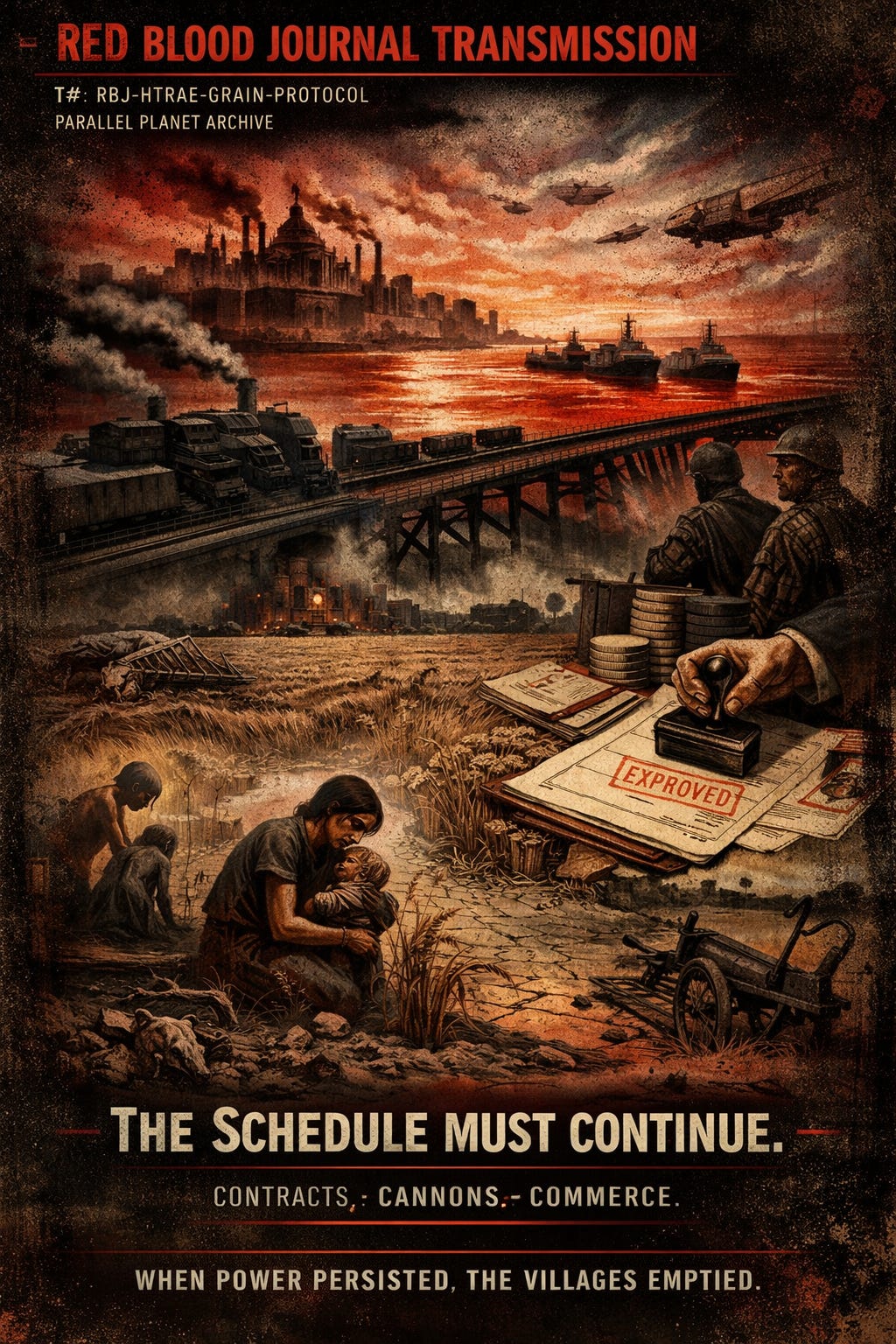
🩸RED BLOOD JOURNAL TRANSMISSION
T#: RBJ-HTRAE-GRAIN-PROTOCOL
Classification: Fictional Empire Analysis / Power Architecture Study
Status: Parallel Planet Archive — Allegorical Narrative
PROLOGUE — ON HTARE, NO ONE DECLARED WAR ON BREAD
On the parallel planet Htrae, the Kingdom of Dnalgne ruled more territory than any flag before it.
It did not conquer with swords alone.
It conquered with contracts, shipping routes, and grain ledgers.
Dnalgne did not need to say:
“Let them starve.”
It only needed to say:
“The schedule must continue.”
And the schedule always continued.
I — THE LOGIC OF THE LEDGER
On Htrae, famine was never announced as a weapon.
It appeared as:
A drought not interrupted by policy.
A shipment that left the port on time.
A tax that was not suspended.
A railway assigned to military cargo.
A doctrine that said markets must not be disturbed.
The villages waited for relief.
The ships followed the contract.
The court in Dnalgne said:
Stability first.
Stability meant power.
II — THE EXPORT PRINCIPLE
When grain grew scarce in the provinces of Htrae, the Kingdom of Dnalgne did not stop the exports.
Because exports were not about food.
They were about credit.
About reputation.
About imperial confidence.
Stopping exports would signal weakness.
And weakness was more dangerous to the Kingdom than hunger was to the provinces.
So the ships sailed.
The peasants counted ribs.
The court counted revenues.
III — THE WAR PRIORITY
When the Great Continental War engulfed Htrae, Dnalgne converted railways and ports to feed armies.
Not villages.
The grain moved toward cannons.
The grain did not move toward children.
When advisors suggested redirecting supplies, the ministers answered:
“If the war is lost, everything is lost.”
But in preserving everything, they lost many.
War was immediate.
Hunger was gradual.
Gradual suffering rarely defeats urgent strategy.
IV — THE DOCTRINE OF DESERVEDNESS
Dnalgne’s economists believed famine could teach discipline.
Relief must not create dependency.
Rations must be minimal.
Work must precede food.
The starving were told:
Prove your productivity first.
But famine removes productivity.
The doctrine remained intact.
The population did not.
V — WAS FAMINE A WEAPON?
On Htrae, historians still debate.
Did Dnalgne intend famine?
Or did Dnalgne simply refuse to interrupt power structures?
There was no decree ordering starvation.
There was only a refusal to bend the system.
And sometimes refusing to bend is indistinguishable from breaking lives.
VI — THE IMPERIAL EQUATION
Dnalgne’s rulers faced choices:
Protect imperial credit
Maintain export commitments
Win wars
Preserve global reputation
Or
Halt trade
Suspend doctrine
Redirect ships
Risk appearing weak
They chose power stability.
The result was predictable.
VII — THE QUIET MECHANISM
Famine on Htrae was not explosive.
It was procedural.
Paperwork moved faster than bread.
Ships moved faster than relief.
Policies outlived people.
Dnalgne never declared famine as policy.
It simply never allowed humanity to override hierarchy.
VIII — THE MORAL OF HTARE
Empires do not need cruelty to produce catastrophe.
They need indifference wrapped in ideology.
They need systems that cannot pause.
They need leaders who believe that preserving the structure preserves civilization.
On Htrae, Dnalgne believed that if power collapsed, chaos would follow.
So it preserved power.
And chaos came anyway — in the form of empty fields and silent villages.
EPILOGUE — THE QUESTION FOR ALL PLANETS
This is not a story about one kingdom.
It is a story about a principle:
When maintaining dominance outranks maintaining life, famine becomes possible without anyone declaring it.
On Htrae, the archives still whisper:
Bread is fragile.
Power is stubborn.
And stubborn power rarely starves first.
⚖️The Ledger of Starvation:
The Architecture of Imperial Famine
This fictional account explores how the Kingdom of Dnalgne used bureaucratic indifference and rigid economic doctrines to facilitate widespread starvation on the parallel planet Htrae.
Rather than using overt violence, the empire prioritized imperial credit, military logistics, and uninterrupted exports over the basic survival of its provincial citizens.
The text argues that famine often results from a refusal to disrupt existing power structures or market ideologies, even when those systems produce catastrophic human suffering.
By focusing on maintaining global reputation and avoiding the appearance of weakness, the ruling class allowed procedural consistency to become a lethal weapon.
Ultimately, the narrative serves as an allegory for how institutional stubbornness and the preservation of hierarchy can lead to mass tragedy without an official declaration of war.


