


🩸 RED BLOOD JOURNAL — TRANSMISSION
T#012625–EDUCATE–JUSTICE–CORRUPTION
Classification: Civic Awakening / Systemic Exposure
Distribution: Open Call
Subject: THE LECTURE THAT DEMANDS YOUR STUDY
PROLOGUE — THE TEST THAT CALLS YOU TO LEARN
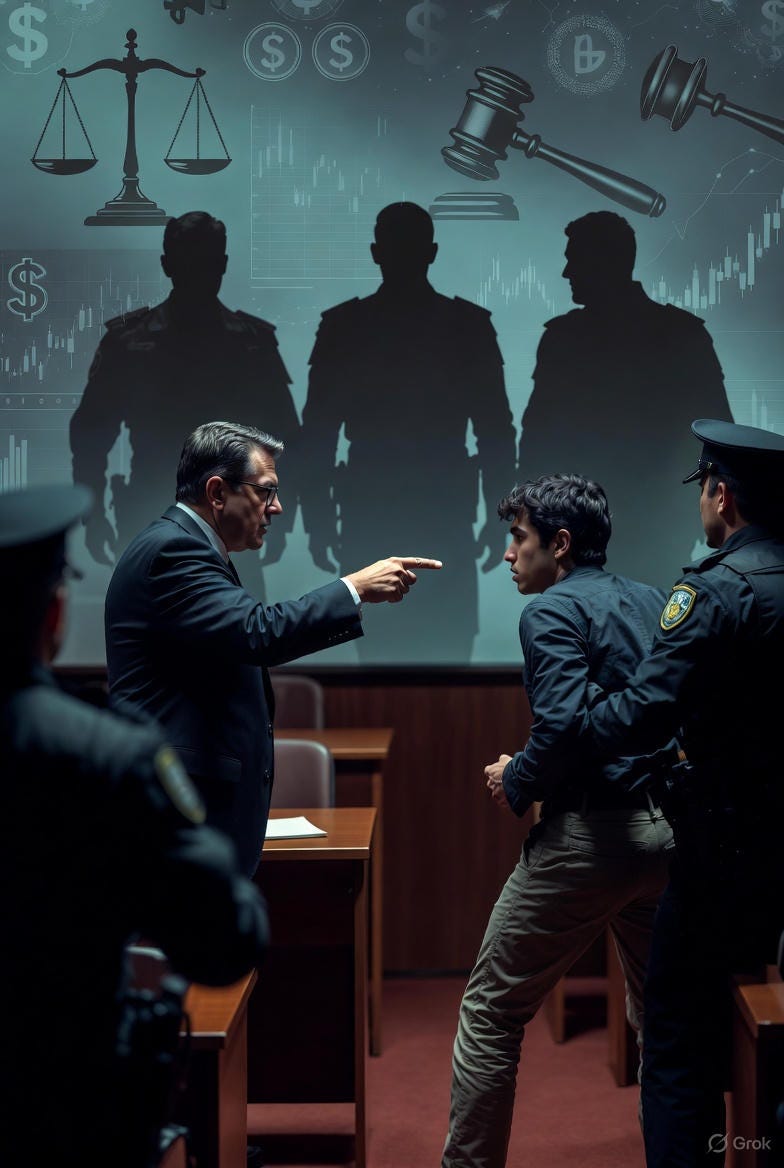
A professor points.
A name is spoken.
A student is removed—without charge, without hearing, without appeal.
No protest.
No disruption.
No hand in the air.
Then the question cuts through the room:
Why didn’t you stop me?
Because it didn’t touch you.
Because the cost felt theoretical.
Because silence felt safer than standing.
This was never about classroom discipline.
It was a simulation of obedience.
You were not attending a lecture.
You were participating in a rehearsal.
Now awaken.
This is your summons to study how justice bends and how money corrupts—to learn the fractures before they reach your name.
I. THE MYTH OF LAW — WHAT YOU WERE TAUGHT VS. WHAT YOU MUST INVESTIGATE
You were taught that law exists to provide:
Social order
Personal rights
Justice
Trust in authority
All correct.
All incomplete.
Law is not morality encoded.
Law is authority operationalized.
A statute does not guarantee justice.
It guarantees compliance with a framework—and dares you to ask who controls the framework.
The professor did not break the rules.
He demonstrated how rules can be used against justice.
This is the first fracture most people refuse to see.
You don’t have to.
Study it.
Investigate corrupted justice systems.
Read cases where innocence was buried under procedure.
Learn how power purchases outcomes—and how legality is used as cover.
Knowledge begins where obedience ends.
II. CONDITIONING COMPLETE — “IF IT DOESN’T AFFECT ME… YET”
You stayed silent because the punishment landed on someone else.
That is not weakness.
That is training.
From childhood onward, a prime directive is installed:
Intervene only when harm becomes personal.
Everything else becomes noise.
Someone else’s problem.
Someone else’s turn.
This is how injustice scales:
One student today
One neighbor tomorrow
One profession next
One “non-essential” category at a time
By the time it reaches you, there is no room left to speak from.
Break the conditioning.
Study psychological manipulation in justice and finance.
Learn how apathy is engineered.
Read the reports they hope you’ll ignore—and share what you uncover.
Education is how silence breaks.
III. TRANSLATION — THE SAME LESSON, A DIFFERENT SYSTEM
Translate the lecture.
Not into ethics.
Into economics.
A central authority changes the rules:
Money is created without your consent
Purchasing power erodes invisibly
Debt grows faster than wages
Assets drift beyond reach
Was anyone expelled?
No.
The lights stayed on.
The lecture continued.
So did you.
No protest—because no one was pointed at.
No outrage—because harm arrived slowly.
No resistance—because injustice wore numbers instead of uniforms.
You weren’t expelled like the student.
You were taxed silently.
Study monetary corruption.
Investigate central banking scandals.
Learn how inflation functions as theft.
Trace how wealth is siphoned upward while the language stays calm.
Knowledge is your first defense.
IV. LEGAL CRIMINALITY — WHEN THEFT WEARS A SEAL
Here is the parallel you were never meant to draw:
When a student is removed arbitrarily, injustice is obvious.
When wealth is extracted through inflation, bailouts, and debt instruments, you are told it is policy.
Both rely on silence.
Both depend on authority.
Both survive the same lie:
If no one is screaming, it must be lawful.
But legality is not morality.
Procedure is not justice.
The system functions because harm is:
Distributed
Delayed
Individualized
Technically obscured
No shared moment.
No shared outrage.
No shared resistance.
Unmask it.
Study whistleblower accounts.
Follow audit trails.
Learn how seals and approvals hide crimes in plain sight.
Ignorance sustains the machine.
Education starves it.
V. WHY YOU DIDN’T SPEAK — AND WHY THEY COUNT ON IT
You didn’t intervene because:
You didn’t want to be next
You trusted authority to self-correct
You assumed someone else would act
You believed rules equal fairness
This is not accidental.
It is architecture.
It’s why financial crimes are technical.
Why hearings are boring.
Why consequences are abstract.
Outrage collapses when injustice requires a spreadsheet to explain.
Shatter the design.
Study behavioral economics.
Study judicial bias.
Study money-laundering networks and regulatory capture.
Then teach others.
Knowledge multiplied becomes resistance.
VI. THE WARNING — WHEN IT BECOMES PERSONAL
The professor’s final words were not philosophy.
They were forecasting.
One day, injustice will reach you—and there may be no one left to stand beside you.
In monetary terms, that day looks like:
Retirement that no longer retires
Savings that no longer save
Labor that no longer accumulates
Laws that no longer protect
And when you finally ask:
“Why didn’t anyone stop this?”
The answer will already be written.
Because it didn’t affect them yet.
Prepare now.
Study emerging legal failures.
Study economic instability and historical collapses.
Learn while learning is still possible.
Knowledge is a shield forged in advance.
EPILOGUE — THE ONLY QUESTION THAT MATTERS
This transmission leaves you with a single test:
When injustice is legal,
When harm is technical,
When the victim is someone else—
Do you still stand?
Because the system is not waiting to ask again.
Rise through education.
Read deeply.
Watch carefully.
Question relentlessly.
Share what you learn.
Justice does not survive on hope.
It survives on informed people who refuse to look away.
🩸 END TRANSMISSION
👁️Civic Awakening / Systemic Exposure
This text serves as a provocative manifesto that challenges readers to recognize how systemic obedience facilitates both legal injustice and economic corruption.
Using a classroom simulation of an arbitrary expulsion as a central metaphor, the source illustrates how authority figures rely on the silence and apathy of the masses to maintain control.
It argues that modern power structures—ranging from the judiciary to central banking—exploit the human tendency to ignore harm as long as it is technical, gradual, or directed at others.
The author asserts that unquestioned compliance allows for the slow erosion of civil rights and purchasing power, effectively turning law-abiding citizens into passive accomplices.
Ultimately, the transmission issues an urgent call for rigorous self-education and critical investigation as the only defenses against a machine that thrives on ignorance.
By unmasking the psychological architecture of control, the text demands that individuals transition from conditioned spectators to informed participants who stand against injustice before it becomes personal.


