


🩸 RED BLOOD JOURNAL TRANSMISSION
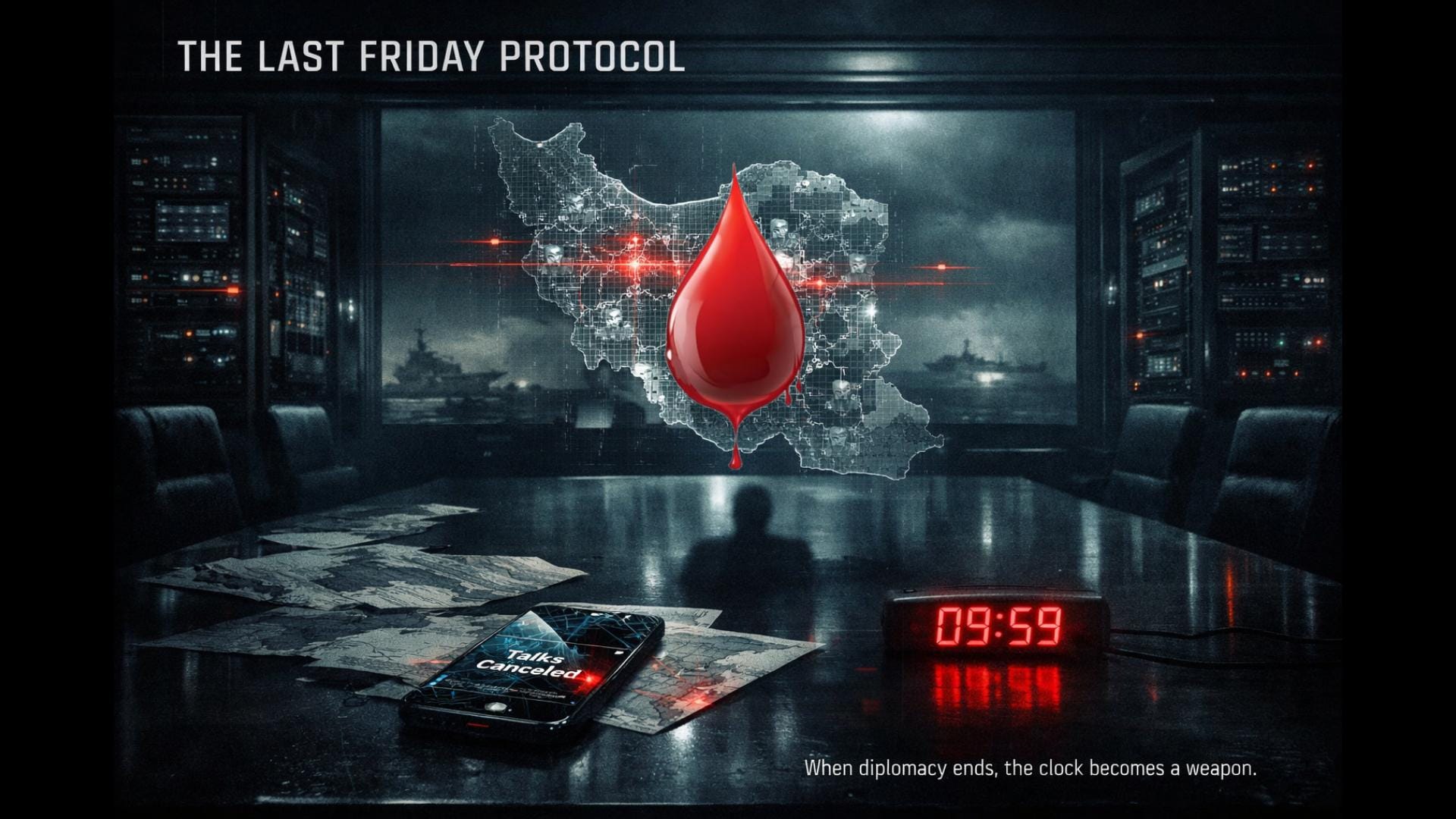
T#: RBJ-2026-02 — THE LAST FRIDAY PROTOCOL
Classification: Open Dossier / Strategic Field Report
Threat Vector: Hybrid War, Sovereign Coercion, Regime Decapitation
Desk: Tehran–Muscat–Washington Corridor
Filed: Midnight, Between Rumor and Reality
PROLOGUE — THE NIGHT THE CLOCK STOPPED
Friday became a weapon before it became a date.
As Iran went dark, the rumor moved faster than sleep: negotiations were canceled. The country did not mourn diplomacy — it tasted revenge. The air filled with the electric hiss of a people who had just buried too many of their children.
For an hour, the talks were “dead.”
Then the phone calls began.
Nine regional states intervened — not as neutral mediators, but as custodians of a fragile order. Their message to Washington was not a plea; it was an instruction: Hold the meeting. Listen to Tehran.
American officials, according to Axios, agreed — reluctantly, suspiciously, publicly pessimistic.
Dawn arrived with a tweet.
Abbas Araghchi confirmed: nuclear talks with the United States would proceed Friday at 10:00 AM in Muscat.
The venue mattered.
The witnesses mattered more.
Tehran had refused Istanbul precisely because it refused witnesses. Humiliation, once seen, becomes permanent.
Araghchi thanked “our Omani brothers.” Tehran’s gratitude was received in Iran as an insult — proof that regional capitals prefer a wounded but standing regime to a liberated people.
SECTION I — FRIDAY AS A GUILLOTINE
Friday was not a negotiation. It was a timer.
Trump framed it plainly: this would be the regime’s last chance.
In Washington, the consensus hardened — the distance between the two capitals was too vast for compromise, too saturated with blood for optics. Military confrontation was no longer hypothetical; it was architectural.
Mehdi Motaharnia, who predicted the December uprising, reduced the equation to a single variable:
Either Iran submits — or it is broken.
His assessment was clinical:
If Tehran bowed, America would merely stage power. If it resisted, war would not be “declared” — it would unfold as a hybrid decapitation campaign, aimed at the regime’s nervous system.
Targets would not be only bases and barracks. They would be men, names, and decision nodes.
The conclusion echoed across independent analysts:
Washington seeks total surrender. Failing that, regime change.
SECTION II — THE INVERTED POLITICS OF FEAR
Inside Iran, reality flipped.
The regime’s loyalists — once intoxicated on “Death to America” — now prayed for diplomacy.
The opposition — once pleading for reform — now whispered for catastrophe.
The paradox was cruel but precise:
Those who vowed to destroy America begged for talks; those who sought coexistence secretly hoped Tehran would make a fatal misstep.
After the brief cancellation-and-resurrection of the talks, officials in Tehran began performing power. They announced that U.S. preconditions — missiles, the “Axis of Resistance,” protests, and court cases — had been rejected.
Araghchi insisted: this was nuclear only. Nothing else existed.
Marco Rubio replied with a checklist that read like an indictment: ballistic missiles, regional militias, nuclear ambition, and the treatment of Iranian citizens.
Negotiation, if it were to mean anything, would have to reach into the regime’s spine.
SECTION III — THE WARNING TO THE MAN ON THE THRONE
Trump’s message to Ali Khamenei was not diplomatic — it was personal.
“Should he be worried?”
“Yes. Very.”
He claimed Iran was attempting to build a new nuclear site, warning that “very bad things” would follow. Fordow and Natanz, he said, were already effectively destroyed.
Two weeks earlier, Trump had called Khamenei “a sick man” who should be replaced.
J.D. Vance sharpened the point:
It is absurd, he said, that the U.S. can call Putin or Xi but cannot speak directly to Iran’s real decision-maker. Diplomacy without access to the king is theater.
Some saw a request for dialogue. Others saw a verdict: with Khamenei, diplomacy is pointless.
A darker analysis circulated in Tehran:
Khamenei might be isolating himself deliberately — allowing the world to see that everyone else could bend, so that his removal would feel inevitable, even necessary.
SECTION IV — THE COLLAPSE OF THE AXIS, THE EXPOSURE OF THE MAN
The “Axis of Resistance” lies fractured. Trillions spent. No bomb achieved. No deterrence secured. America at Iran’s gates.
Among both opponents and uneasy supporters, Khamenei appears not as a mastermind but as a liability.
Political scientist Hatem Qaderi called him the most wretched man in Iran — powerful on paper, despised in every heart.
In the 21st century, under a supposedly divine guardianship, Iran — one of the richest lands on Earth — produced hunger.
If there is mercy left in history, some argue, it would be his capture rather than his death — so that he must answer for what he authorized.
SECTION V — THE BLOODY JANUARY FILE
What happened in Bloody January was not repression. It was a massacre.
Entire families erased.
Parents killed for helping protesters.
Infants dead from deprivation after their guardians were shot.
The asphalt became an archive of shattered skulls.
Names surfaced like bodies from water:
Mehdi Masoumi, 27 (Isfahan) — shot, disappeared into security custody, returned only as a corpse.
Donya Salmani, 25 (Parand) — killed by a sniper.
Roozbeh Safari, 36 — crippled by shotgun fire, harassed to death.
Hamid Reza Honarvar, 57 — a disabled veteran, found in Kahrizak after being shot in the chest.
Ashkan Torabzadeh, 41 (Mashhad) — cut down in a hail of bullets while trying to flee.
The state produced a list: 3,117 dead.
The people called it “one out of twenty.”
A website opened to collect more names — an inadvertent confession that the slaughter was far larger than admitted.
SECTION VI — ZAHHAK RETURNS
The story turned ancient.
Khamenei was not merely a tyrant — he was Zahhak reborn.
Like the serpent-king of the Shahnameh, he arrived through deception, seduced by power, and fed on the minds of the young. The “marshals” of today are digital, military, and bureaucratic — but the logic is identical.
Two cooks in the myth saved half the youth.
Today, there are no cooks — only execution squads.
And so Kaveh reappears — not as a single blacksmith, but as thousands of grieving parents, holding a blood-stained banner of revolt.
Reza Pahlavi becomes, symbolically, Fereydun — not by birthright alone, but by the demand of a people searching for an exit from the cycle of slaughter.
SECTION VII — THE INTERNATIONAL ENABLERS
Regional states prefer a weakened Iran under Zahhak to a free Iran under its people.
The global left, in its blindness, mistakes tyranny for anti-imperialism.
Inside the West, the regime’s lobby works quietly — named explicitly in Iranian debates: NIAC and Trita Parsi, exposed even by figures close to Tehran as instruments of regime influence.
SECTION VIII — HEROES AND TRAITORS
The public executed its own moral reckoning.
Hadi Choopan, once adored, danced while the streets bled — and was discarded.
Masoud Zatparvar, largely unknown, stood with the people and died with them — becoming a quiet Kaveh. Videos of his charity work circulated as proof that true strength is not muscle, but conscience.
SECTION IX — THE TRANSITION SHADOW
Motaharnia predicted the sequence: economic paralysis → mass unrest → transitional government.
Reza Pahlavi called for a global day of mobilization on February 14, explicitly invoking a transitional framework.
Sina Valiollah challenged skeptics: even if Pahlavi were authoritarian — could anything be worse than Zahhak?
The question hung like smoke:
Will Iranians and their prince stand alone — or will foreign hands strike the final blow against the serpent?
EPILOGUE — THE COUCHE REPORT
These are not merely negotiations. They are the closing act of a tragedy written decades ago.
In these hours, Iran moves between annihilation and rebirth.
The streets remember.
The mothers remember.
History remembers.
And Friday — once a day of prayer — became a day of reckoning.
For Iran, and for those who still believe freedom is not a rumor.
🩸 END TRANSMISSION
⏳The Last Friday Protocol: A Reckoning for Iran
Iran faces a reckoning as nuclear talks with the U.S. serve as a final ultimatum.
Failure to submit risks a hybrid decapitation campaign against the regime.
Amidst the trauma of Bloody January, the fractured Axis of Resistance leaves a weakened leadership facing total collapse.


