


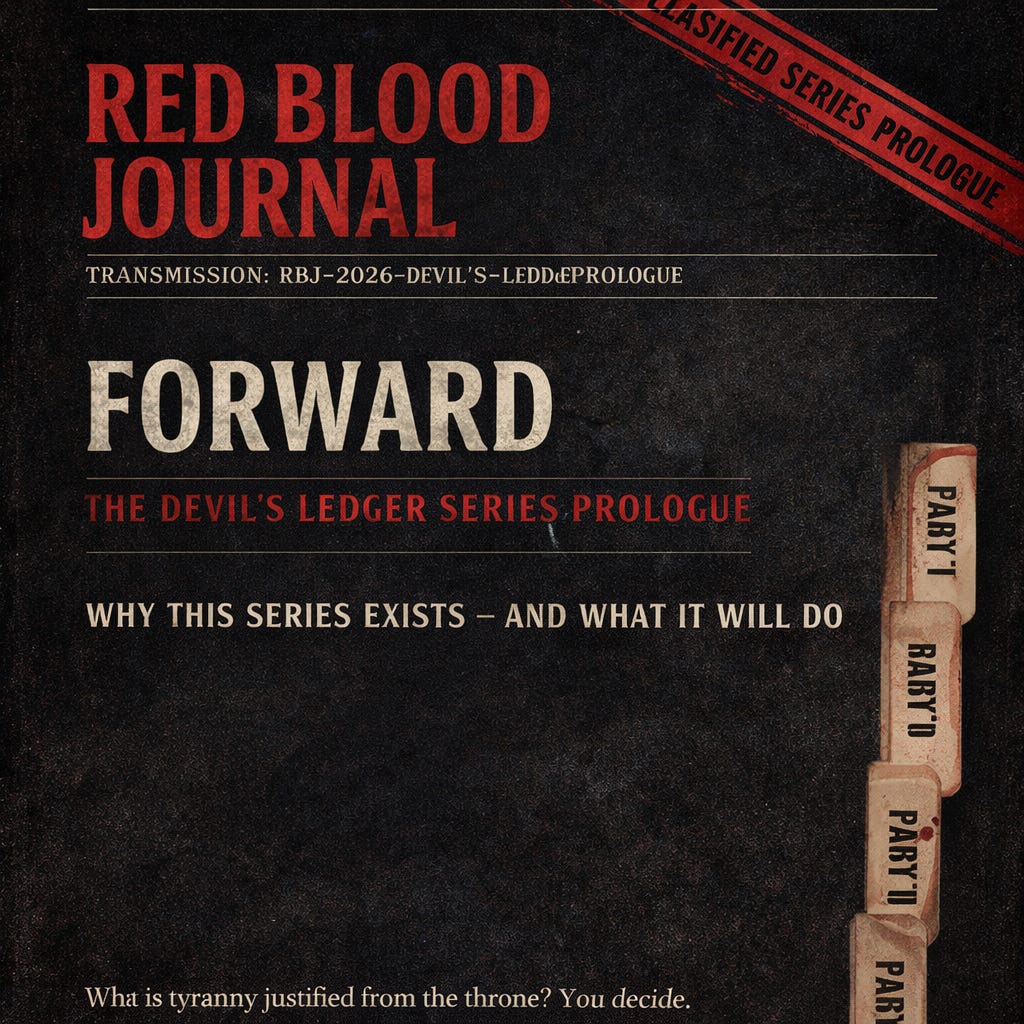
🩸 RED BLOOD JOURNAL TRANSMISSION
T#: RBJ-2026-DEVILS-LEDGER-PROLOGUE
Classification: Series Forward / Perspective Inversion Framework
Status: Fictional Analytical Commentary
Applies To: The Devil’s Ledger — Parts I–V
FORWARD
WHY THIS SERIES EXISTS — AND WHAT IT WILL DO
For years, this publication has examined power from below.
We have mapped control architectures.
We have dissected surveillance systems.
We have questioned economic cycles.
We have analyzed psychological conditioning.
We have described what many call:
Enslavement.
Narrative engineering.
Managed consent.
Fear infrastructure.
But critique without inversion becomes echo.
To understand power fully, one must understand how it justifies itself.
This five-part series does something different.
It takes the seat of the Boss.
Not to endorse.
Not to submit.
Not to defend.
But to understand.
THE PURPOSE OF ROLE REVERSAL
Every system that governs millions constructs a moral defense.
No ruler wakes believing:
“I am evil.”
Every ruler believes:
“I am necessary.”
This series explores that necessity argument.
If centralized control were rational…
If surveillance were protective…
If economic cycles were calibrated medicine…
If fear were stabilizing…
If information filtering were prevention…
What would the internal memo say?
This transmission does not argue that the Boss is right.
It argues that power always believes it is right.
The reader will decide whether the logic persuades — or condemns itself.
THE FIVE ARCHITECTURES WE WILL EXAMINE
PART I — ORDER BEFORE FREEDOM
The stability argument.
Why chaos is considered the default human condition.
Why restriction is framed as preemptive mercy.
PART II — THE INFORMATION GATE
Why transparency is viewed as destabilizing.
Why narrative management is framed as protection.
Why velocity of rumor is feared more than censorship is admitted.
PART III — ECONOMIC PAIN AS MEDICINE
Why recessions are described as corrective pressure.
Why debt is framed as discipline.
Why inflation becomes a steering mechanism rather than an accident.
PART IV — FEAR AS SOCIAL GLUE
Why mortality is emphasized culturally.
Why reputational punishment replaces overt violence.
Why subtle fear is considered more efficient than overt terror.
PART V — THE BURDEN OF CONTROL
Why power views itself as carrying invisible weight.
Why prevented catastrophes are never credited.
Why rulers believe history will vindicate them.
WHAT THIS SERIES IS NOT
It is not endorsement.
It is not apology for tyranny.
It is not an attempt to soften critique.
It is an examination of justification architecture.
Because systems survive not through force alone —
but through narrative coherence.
LET THE READER DECIDE
If the Boss’s arguments feel logical,
that should concern the citizen.
If they feel hollow,
that should concern the ruler.
If they feel disturbingly rational,
that is where serious reflection begins.
The purpose of this series is not to conclude.
It is to expose the internal monologue of power.
Every empire writes a ledger.
This time, we read it from the other side of the table.
EDITORIAL NOTE
A society that cannot examine its critics
is fragile.
A society that cannot examine its rulers
is controlled.
This series examines both.
The verdict does not belong to this publication.
It belongs to the reader.
📖The Internal Monologue of Power
The provided text introduces a fictional analytical series titled “The Devil’s Ledger,” which aims to explore the internal justifications used by those in positions of absolute power.
Rather than criticizing authority from the perspective of the governed, this framework adopts the viewpoint of the ruler to understand how systems of control rationalize their existence.
The series breaks down five specific architectures of power, ranging from the prioritization of social order over individual liberty to the use of economic hardship as a disciplinary tool.
By examining the moral defense of centralized control, the project seeks to reveal how regimes maintain dominance through narrative coherence rather than simple brute force.
Ultimately, the text challenges readers to evaluate these rationalizations of tyranny to determine if the logic of the “Boss” is a necessary burden or a hollow excuse for oppression.


