


🩸 RED BLOOD JOURNAL TRANSMISSION
T#: RBJ-2026-SPIRIT-ARCHITECTURE-01
Classification: Philosophical / Religious Structure Analysis
Status: Public Transmission
Title:
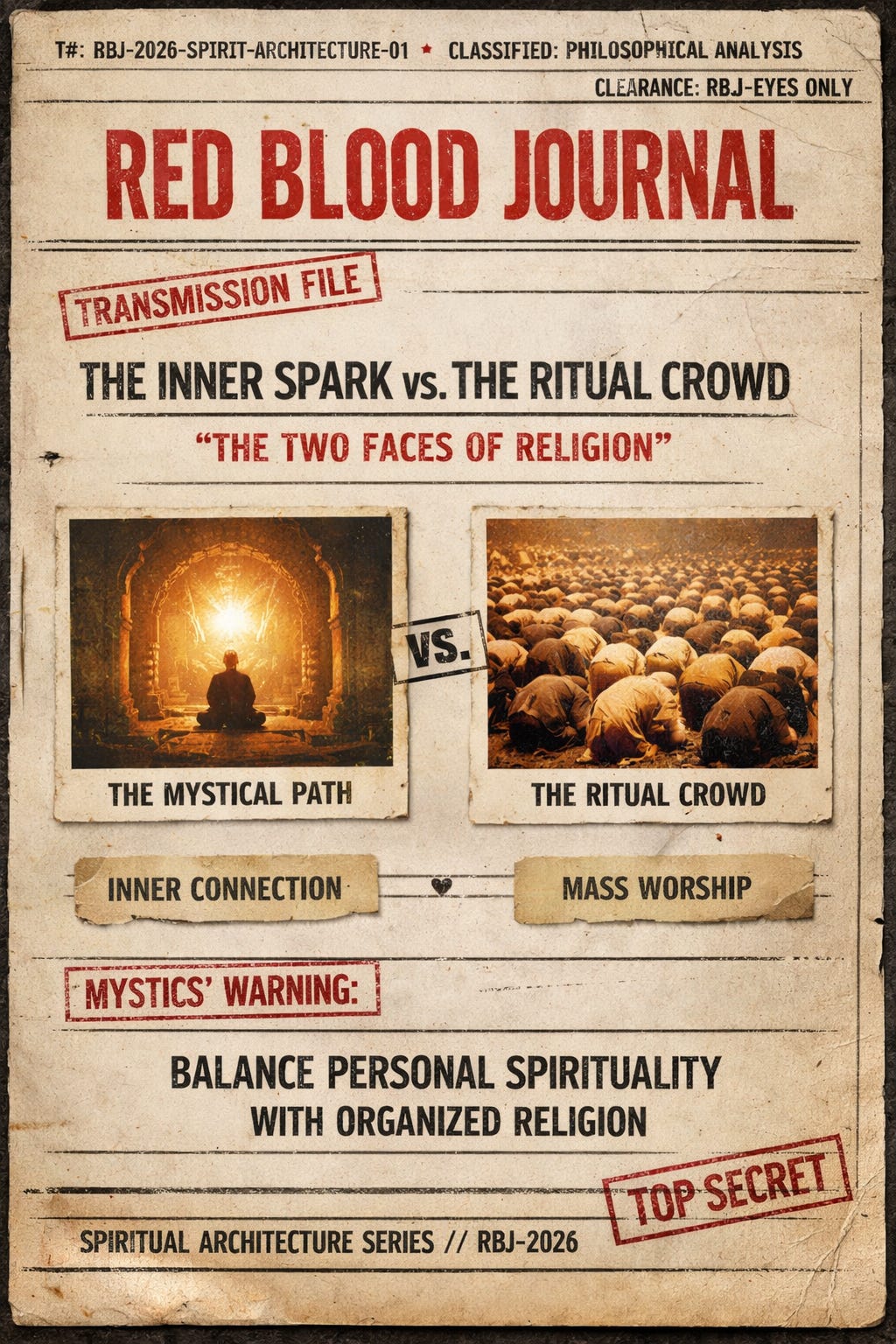
The Inner Spark vs. The Ritual Crowd — The Two Faces of Religion
PROLOGUE — THE ORIGINAL PURPOSE
Across civilizations and centuries, religions have presented themselves as the bridge between humanity and the Creator.
Yet beneath the rituals, temples, churches, mosques, and institutions lies a far older idea:
The divine is not only above humanity.
It exists within humanity.
Many traditions describe this inner presence as:
a spark of God
the breath of the Creator
the divine light
the soul reflecting the source
In its earliest form, religion was not primarily institutional.
It was intimate.
A human being turning inward — seeking direct communion with the source of existence.
I — THE PRIVATE PATH
In numerous mystical traditions, the relationship between a human being and the Creator is described in language of closeness, union, and intimacy.
Examples appear across cultures:
Christian mystics describing union with God
Sufi poets speaking of the Beloved
Hindu philosophy teaching Atman as a reflection of Brahman
Jewish Kabbalah describing the divine spark within the soul
The pattern repeats across continents and centuries.
The individual withdraws from noise, crowds, and ritual structures.
And turns inward.
Prayer becomes a conversation.
Meditation becomes a listening.
Silence becomes a doorway.
This is the solitary path of spiritual intimacy.
II — THE RISE OF THE CROWD
As spiritual teachings spread, they rarely remain private.
Communities form.
Temples are built.
Clergy emerge.
Doctrines become codified.
Religion transforms from inner experience into collective practice.
Examples include:
Church congregations gathering for Sunday worship
Muslim communities performing prayer together in mosques
Jewish communal prayer in synagogues
Hindu temple ceremonies
Buddhist chanting assemblies
Group worship serves social functions:
unity of belief
shared identity
preservation of teachings
collective moral guidance
Religion becomes not only a path to God, but also a structure for society.
III — TWO EXPERIENCES, ONE WORD
Because both models coexist, the word “religion” now contains two very different experiences.
PathNatureFocusMystical PathIndividualDirect connection with the divineInstitutional PathCollectiveShared ritual and belief
The first emphasizes personal transformation.
The second emphasizes community cohesion.
Both serve purposes.
But they are not the same experience.
IV — THE MYSTICS’ CRITIQUE
Throughout history, many mystics warned that institutions can sometimes overshadow inner spirituality.
They argued that:
Ritual without inner awareness becomes mechanical.
Authority structures can distance people from personal spiritual experience.
The crowd may replace the silence where spiritual insight emerges.
This critique appears repeatedly:
Desert monks leaving cities to pray in solitude
Sufi wanderers rejecting court-sponsored religion
Hindu sages retreating into forests
Buddhist monks seeking enlightenment outside political power
These figures insisted that the inner spark cannot be accessed through institutions alone.
V — THE BALANCE QUESTION
Civilizations have long wrestled with a central question:
Can personal spirituality and organized religion coexist without one replacing the other?
Some traditions attempt balance:
communal worship paired with personal prayer
ritual combined with meditation
doctrine alongside mystical exploration
When this balance holds, religion functions both as:
a social structure
a path of inner transformation
When the balance fails, one side dominates.
CONCLUSION — THE QUIET CENTER
At the center of every major religious tradition lies a simple idea:
Human beings carry something sacred within them.
Temples may rise.
Crowds may gather.
Rituals may multiply.
But the moment of spiritual awakening almost always occurs in the same place:
Not in the crowd.
But in the quiet interior of the human soul.
✨The Inner Spark and the Architecture of Faith
This text examines the fundamental tension between personal spirituality and institutional religion, framing them as two distinct paths toward understanding the divine.
The author suggests that while mysticism focuses on a private, internal connection with a “divine spark,” organized structures prioritize communal identity and the preservation of doctrine through ritual.
Throughout history, individuals have often retreated into solitude to escape the mechanical nature of large-scale religious assemblies in search of authentic insight.
Although these two models serve different social and psychological purposes, they frequently exist in a delicate balance within a single faith.
Visitors to Masjid Al Haram after Taraweeh Prayers
Ultimately, the narrative argues that true spiritual awakening is an intimate experience that occurs within the human soul rather than through the influence of a crowd.
The source concludes that despite the grandeur of external temples, the core of religious tradition remains the internal relationship between the individual and the sacred.


