


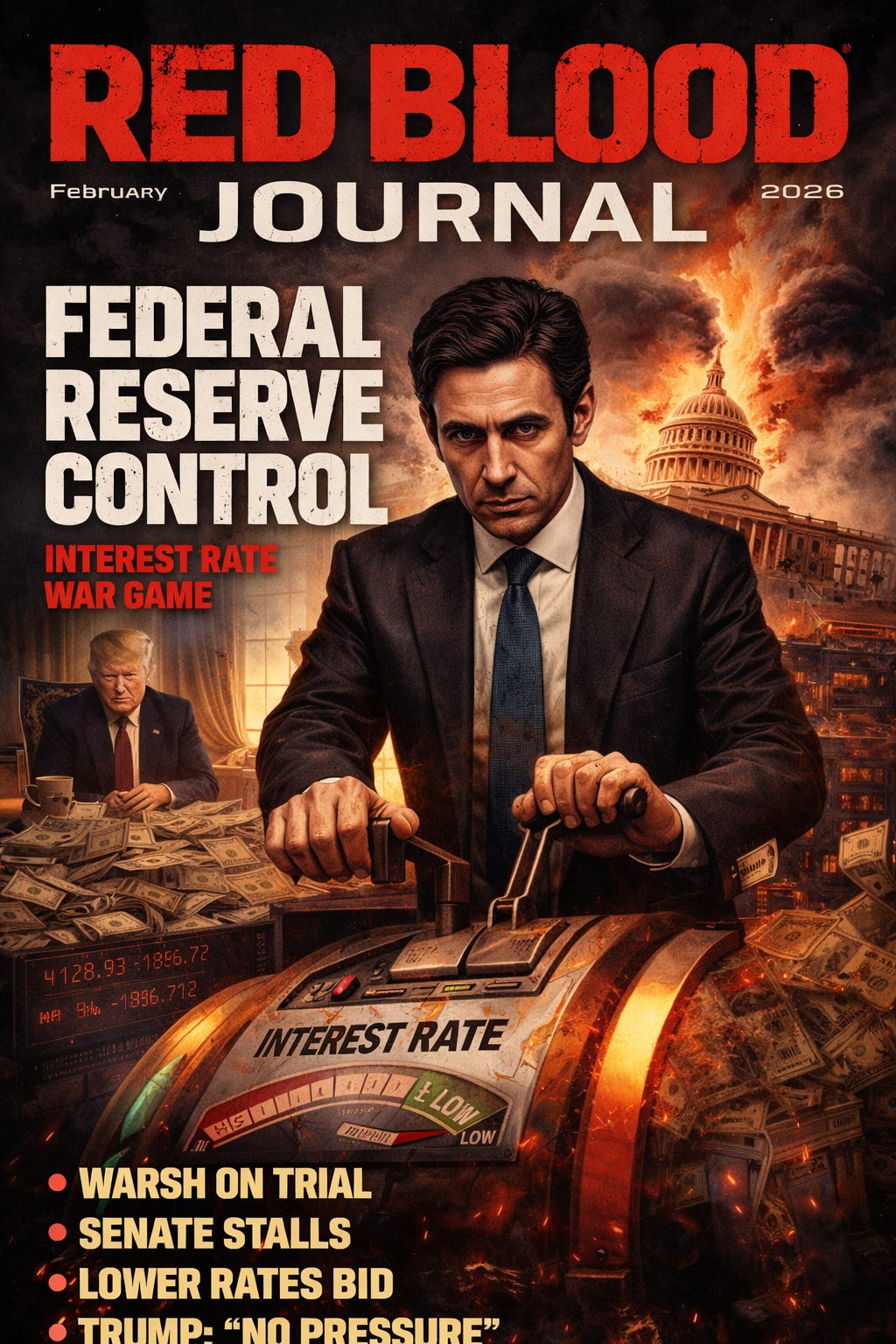
🩸 RED BLOOD JOURNAL TRANSMISSION
T# RBJ-2026-02-01 — THE RATE LEVER ILLUSION
Classification: Monetary Control Architecture | Institutional Theater Layer
Clearance: For Those Who Understand That Rates Are Never Just Rates
Signal Origin: Executive Commentary | Confirmation Ritual Phase
PROLOGUE — THE HAND ON THE DIAL
Every empire insists the dial turns itself.
Interest rates rise and fall, we are told, by data.
By models.
By neutral technocrats locked away from politics.
And yet—every time the dial matters most—
the hand hovering near it suddenly becomes visible.
This transmission is not about one nominee.
It is about the myth of independence.
SECTION I — KEVIN WARSH: THE ACCEPTABLE FACE
The nomination of Kevin Warsh is not disruption.
It is continuity with a calmer expression.
Warsh is presented as:
Serious
Qualified
Market-literate
“Above politics”
Which is precisely the point.
The system does not appoint radicals to the Federal Reserve.
It appoints reassuring operators—people markets recognize as safe custodians of the existing order.
A new face, same architecture.
SECTION II — SENATE CONFIRMATION AS DELAY MECHANISM
Senator Tom Tillis becomes relevant not because of opposition,
but because delay is leverage.
Confirmation dynamics serve three quiet functions:
Signal uncertainty to markets
Buy time for internal alignment
Provide plausible deniability for outcomes already anticipated
The spectacle of votes, holds, and negotiations is not democracy in action.
It is volatility management.
Markets are calmed not by outcomes, but by process.
SECTION III — LOWER RATES: THE HOPE VECTOR
The phrase “I hope he lowers rates” is not policy.
It is expectation seeding.
Hope is powerful because:
It moves markets before action
It alters consumer behavior without legislation
It lets leadership deny responsibility either way
Lower rates are not a gift to the public.
They are a relief valve for:
Debt saturation
Asset fragility
Liquidity stress
The hope itself does half the work.
SECTION IV — “NO COMMITMENTS”: THE RITUAL DENIAL
The denial of pressure is mandatory.
Every president must say:
“No commitments were made”
“The Fed is independent”
“He’ll do what he wants to do”
This is not honesty.
It is ceremonial insulation.
The denial exists so that when rates move:
The executive claims restraint
The Fed claims autonomy
No one owns the consequences
Independence is not the absence of influence.
It is the absence of fingerprints.
SECTION V — WHAT IS ACTUALLY BEING MANAGED
This moment is not about inflation alone.
It is about time.
Lower rates buy:
Time for refinancing
Time for asset repricing
Time for political stabilization
Higher rates discipline populations.
Lower rates anesthetize them.
The debate is not economic.
It is strategic.
COUNTERINTELLIGENCE NOTE — WHY THIS WAS SAID OUT LOUD
This conversation happened publicly, casually, mid-flight.
That matters.
Markets listen differently when statements sound unplanned.
Unscripted language feels more truthful—even when it isn’t.
The audience was not voters.
It was bond desks, currency traders, and institutional allocators reading between syllables.
FINAL LINE — THE DIAL ALWAYS TURNS
The Federal Reserve will insist it decides alone.
The executive will insist it never interfered.
And the public will feel the result without ever touching the lever.
Because the most effective control systems
are the ones that convince you
no one is controlling anything at all.
🩸 END TRANSMISSION
🕹️The Hand on the Dial:
Monetary Control Architecture
The Federal Reserve’s independence is a myth designed for market stability. Nominations like Kevin Warsh ensure institutional continuity, while interest rate adjustments serve as strategic valves for debt and liquidity. Public denials of influence protect the system’s power.


