


🩸 RED BLOOD TRANSMISSION JOURNAL
T#RBJ–FINANCE–FORMULA–ARCHIVE (PART IX)
Title: The Illusion of Choice Inside Managed Systems
Classification: Decision Architecture Analysis · Behavioral Governance
Distribution: International / Open
Method: Choice-Set Forensics · Platform Incentives · Psychological Containment
PART IX — WHEN OPTIONS EXIST, BUT OUTCOMES DON’T CHANGE
Freedom is often measured by the number of choices offered.
But choice quantity is not choice power.
Managed systems excel at offering many doors that lead to the same hallway. The user feels active. The system remains untouched.
I. WHAT “MANAGED CHOICE” REALLY MEANS
Managed choice is not coercion.
It is curation.
You may choose A or B
You may switch brands or parties
You may customize interfaces or identities
What you may not choose is:
the underlying rules
the incentive geometry
the exit conditions
Choice exists inside the sandbox.
The sandbox is not optional.
II. THE MENU WITHOUT THE KITCHEN
Managed systems present a menu.
What they hide is the kitchen.
Supply chains are consolidated
Platforms control access
Rules predefine winners
You choose flavors.
You don’t choose who cooks, who owns, or who decides.
This separation is deliberate: it keeps participation high while accountability stays diffuse.
III. ALGORITHMS AS QUIET GOVERNORS
In modern systems, choice is ranked before it is made.
What you see first
What is labeled “recommended”
What is frictionless vs. costly
These nudges don’t remove options.
They shape probability.
When outcomes are statistically guided, freedom becomes directional, not absolute.
IV. THE TWO-TRACK ILLUSION
Managed systems typically allow two visible tracks:
Compete within the system
Protest about the system
What is discouraged or rendered impractical is a third track:
Exit the system
Redesign the system
Replace the system
Debate is welcomed.
Departure is complicated.
V. CONSUMER CHOICE AS POLITICAL SEDATIVE
Consumer choice absorbs political energy.
Dissatisfaction is redirected into:
brand switching
upgrades
subscriptions
personalization
Anger becomes preference.
Reform becomes product selection.
The system learns from your choices—
not to empower you,
but to optimize compliance.
VI. WHY CHOICE FEELS REAL (AND ISN’T)
Managed choice works because it aligns with human psychology:
autonomy feels satisfying
agency reduces stress
selection creates ownership
The feeling is real.
The leverage is not.
You can choose how to move—
not where the road goes.
VII. THE COST OF TRUE CHOICE
Real choice threatens managed systems because it introduces:
unpredictability
decentralization
loss of scale advantage
True choice allows:
refusal
alternatives
non-participation
That is why it is made expensive, risky, or socially costly.
VIII. THE INVISIBLE CONTRACT
Managed systems operate on an unspoken deal:
We will give you options,
if you stop asking for control.
Most people accept the trade.
It feels like freedom.
It functions like containment.
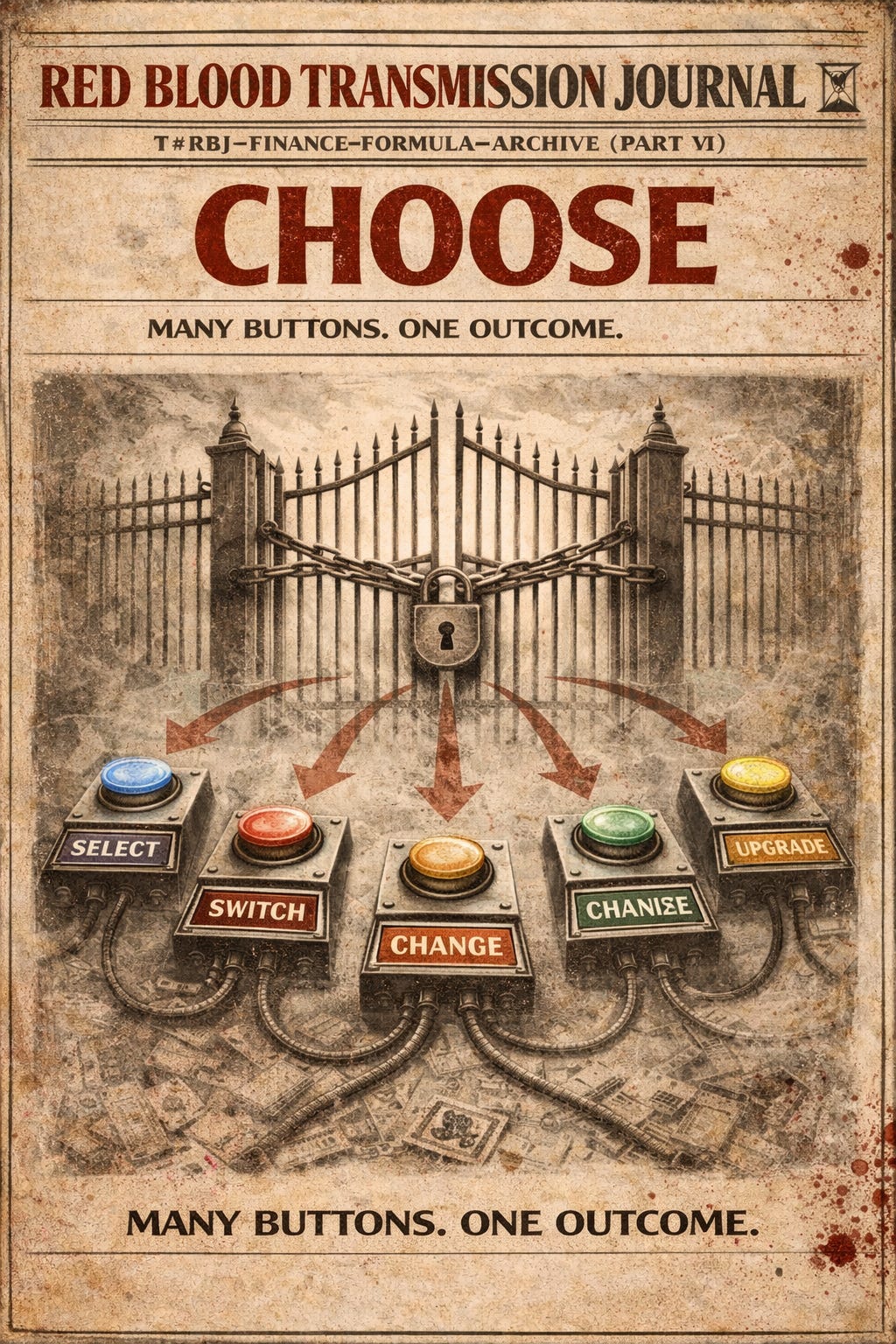
EPILOGUE — MANY BUTTONS, ONE OUTCOME
When outcomes don’t change no matter how people choose,
the issue is not voter apathy, consumer ignorance, or public failure.
It is design success.
Choice is abundant.
Power is concentrated.
🩸 END PART IX
Red Blood Journal — Decision Architecture Division
🎮WHEN OPTIONS EXIST, BUT OUTCOMES DON’T CHANGE
The provided text explores the concept of managed choice, arguing that modern systems provide an abundance of options to create a false sense of agency while maintaining total control over the final results.
These systems function like a sandbox, where participants can select between different brands or paths, yet remain unable to alter the underlying rules or exit the environment entirely.
Algorithms and curated menus serve as invisible governors that steer behavior toward predictable outcomes, effectively neutralizing dissent by redirecting it into consumer preferences.
By making true independence expensive or risky, these architectures ensure that high levels of participation do not lead to actual structural change.
Ultimately, the text posits that while the feeling of freedom is psychologically satisfying, it often serves as a containment strategy that concentrates power while offering the illusion of autonomy.


