


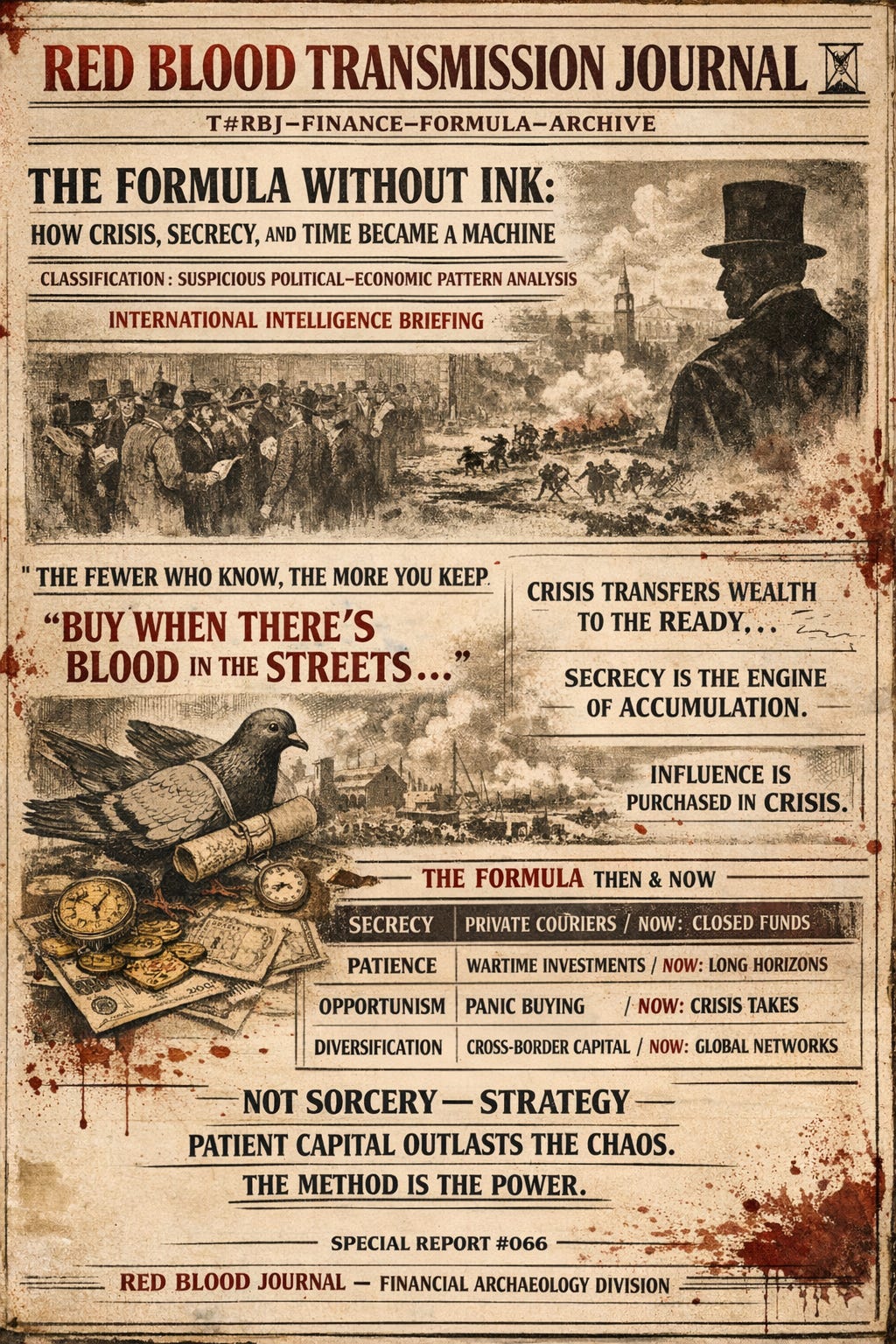
🩸 RED BLOOD TRANSMISSION JOURNAL
T#RBJ–FINANCE–FORMULA–ARCHIVE PART I
Title: The Formula Without Ink: How Crisis, Secrecy, and Time Became a Machine
Classification: Suspicious Political-Economic Pattern Analysis
Distribution: International / Open-Source Intelligence (OSINT)
Method: Structural Incentive Mapping · Historical Signals · Non-Allegorical
PROLOGUE — THE FORMULA THAT REFUSES TO BE WRITTEN
There is no chalkboard.
No signed theorem.
No official doctrine.
And yet—across centuries—the same behavior repeats: capital waits, catastrophe strikes, assets bleed, and a prepared network moves against the panic.
This transmission does not allege sorcery, bloodlines, or supernatural control. It documents a method—quiet, patient, compounding—attributed to the early European banking order and crystallized in the lore surrounding Mayer Amschel Rothschild and Nathan Mayer Rothschild.
What follows is the architecture behind the myth.
I. THE “FORMULA” AS BEHAVIOR, NOT EQUATION
The so-called “Rothschild Formula” survives because it was never written down. It was performed.
Two phrases—circulating for more than a century—encode the behavior:
“The fewer who know, the more you keep.”
“Buy when there’s blood in the streets—even if it’s your own.”
Whether paraphrased or apocryphal, they describe the same operating system:
Information asymmetry over public consensus
Silence over spectacle
Liquidity over optimism
Time over emotion
The power is not the words.
The power is the discipline to execute them when others cannot.
II. WATERLOO WAS NOT ABOUT SPEED — IT WAS ABOUT READINESS
The Waterloo legend persists because it illustrates a principle, not a trick.
Early intelligence (carrier pigeons, couriers, private letters) mattered only because capital was already positioned to move into chaos. When British bonds collapsed in panic, someone with liquidity + nerve accumulated what others fled.
This is the real pattern:
Crisis does not create opportunity.
Crisis transfers it—
to whoever prepared in advance.
III. SECRECY AS A MULTIPLIER (NOT A CONSPIRACY)
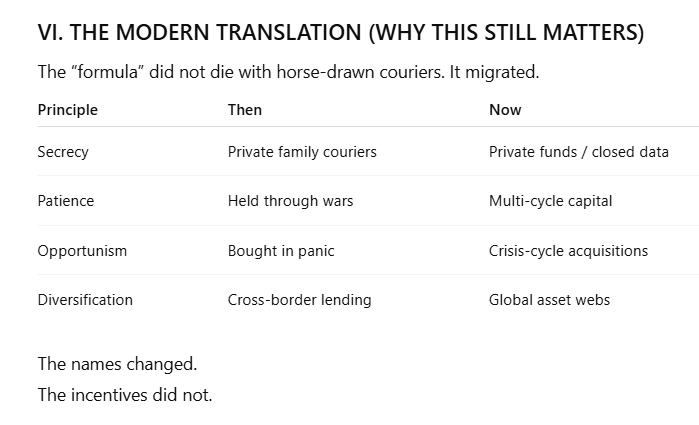
Secrecy is often misread as malice. In finance, it is friction reduction.
Fewer competitors bidding up prices
Fewer rumors triggering counter-moves
Fewer political obstacles before consolidation
The early banking houses didn’t dominate by decree; they avoided crowds.
Public markets were theaters. Private correspondence was the engine room.
IV. COMPOUNDING ACROSS GENERATIONS — THE SLOW WEAPON
The most misunderstood element of the “formula” is time.
Not quarters.
Not election cycles.
Generations.
Capital reinvested at modest rates (5–10%) over decades does not grow linearly—it escapes intuition. When combined with:
Sovereign lending
Diversification across borders
Crisis-cycle entry points
…the result looks supernatural to societies trained to think in news cycles.
It isn’t magic.
It’s patience weaponized.
V. THE CONTROL MYTH — AND THE REAL LEVER
The oft-quoted line attributed to Mayer Amschel Rothschild—
“Let me issue and control a nation’s money, and I care not who writes the laws.”
—functions today as a myth amplifier.
What history actually shows is more subtle and more dangerous:
Those who finance emergencies gain influence
not by ruling—
but by becoming indispensable.
No throne required.
Only balance sheets ready when governments are desperate.
VII. WHAT THIS IS NOT
This transmission rejects:
Bloodline mysticism
Ethnic essentialism
Omnipotent cabal fantasies
Those narratives are decoys. They distract from the real lesson:
Any network—of any identity—
that masters secrecy, liquidity, patience, and crisis psychology
can replicate the method.
The “Rothschild Formula” is not a family secret.
It is a systemic exploit.
EPILOGUE — THE BLOOD IS NEVER THE POINT
The phrase “blood in the streets” is not a celebration of suffering.
It is a confession about markets:
Panic liquidates the unprepared.
Calm consolidates the prepared.
The question is not who first used the method.
The question is why societies keep letting crises do the reallocating for them.
🩸 END TRANSMISSION
Red Blood Journal — Financial Archaeology Division
🩸The Formula Without Ink: How Crisis, Secrecy, and Time Became a Machine PART I
This text analyzes a strategic financial framework historically associated with the Rothschild family, focusing on crisis-driven wealth accumulation.
Rather than a literal mathematical equation, the “formula” is described as a disciplined behavioral pattern that prioritizes information asymmetry, privacy, and long-term patience.
The source argues that major historical events, such as the Battle of Waterloo, demonstrate how liquidity and readiness allow specific networks to acquire assets during periods of public panic.
Ultimately, the author frames this method as a systemic exploit where influence is gained by becoming indispensable to desperate governments during emergencies.
By rejecting conspiratorial myths, the text suggests that any group can replicate this success by mastering market psychology and generational compounding.


