

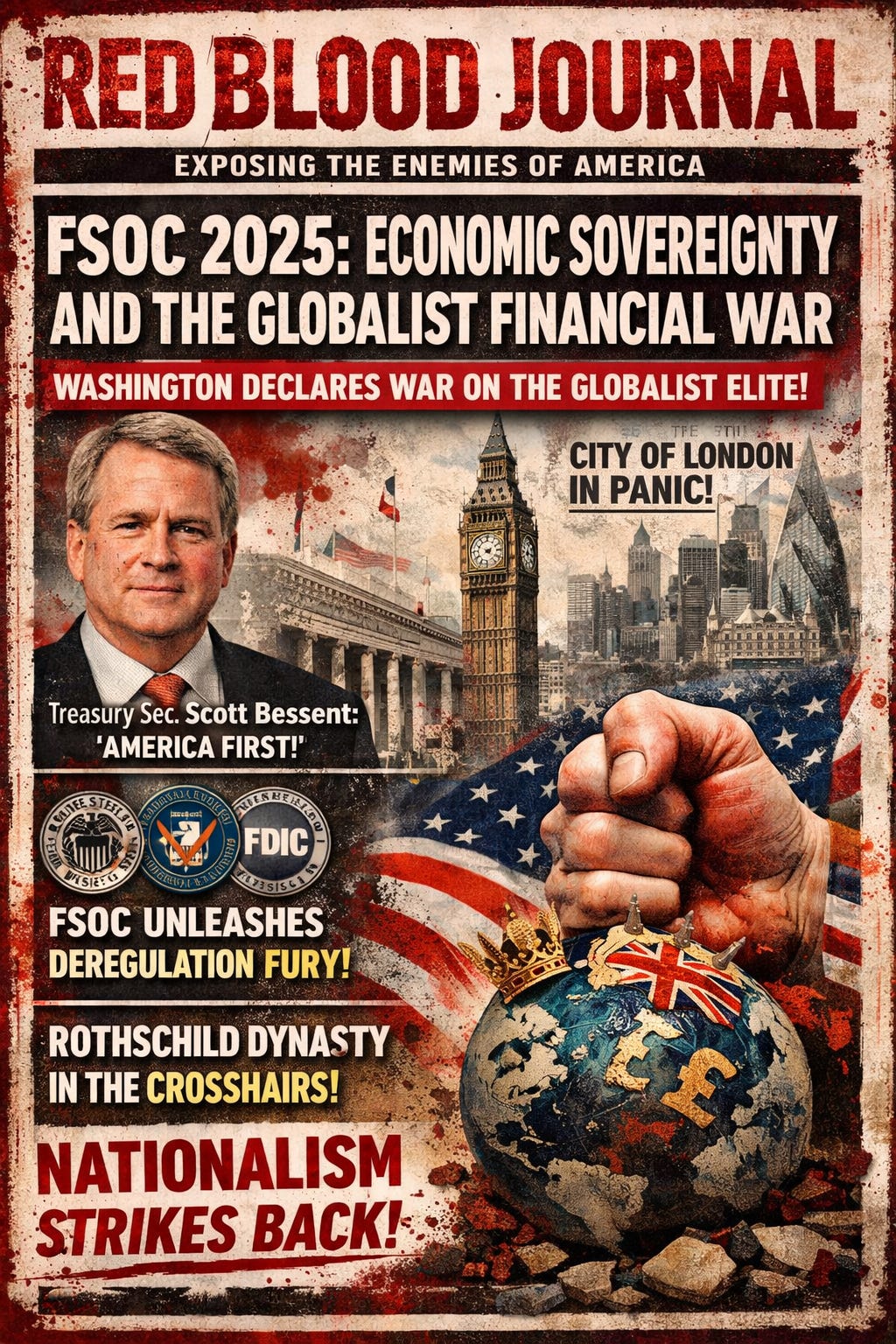
Deep Dive Report below:
FSOC’s War on Global Elites
🩸 Red Blood Journal Report: FSOC Exposed – The Financial Watchdog’s Claws Out for Globalist Blood
Executive Summary
In the shadows of Washington’s power corridors, the Financial Stability Oversight Council (FSOC) stands as a post-crisis creation designed to safeguard America’s financial system from collapse. But recent developments under the Trump administration have transformed it into a weapon against entrenched global financial elites. This report dissects FSOC’s origins, inner workings, and the explosive 2025 Annual Report, which conspiracy watchers and analysts alike interpret as a de facto declaration of war on the “New World Order” (NWO) architects – often symbolized by the City of London’s banking dynasties, with England as their alleged stronghold. Drawing from official documents and emerging narratives, we peel back the layers of this bureaucratic beast, revealing how it’s pivoting from regulatory restraint to economic liberation, potentially dismantling centuries-old financial controls. Blood is in the water; the global order may never be the same.
Section 1: What is FSOC? The Basics Unearthed
FSOC isn’t some shadowy cabal – it’s a statutory body born from the ashes of the 2008 financial meltdown. Established by Title I of the Dodd-Frank Wall Street Reform and Consumer Protection Act in 2010, its core mission is to identify and mitigate risks to U.S. financial stability. Chaired by the U.S. Treasury Secretary (currently Scott Bessent under President Trump), it comprises 10 voting members – heads of key federal regulators like the Federal Reserve, SEC, FDIC, and others – plus 5 nonvoting advisors, including state regulators and an independent insurance expert.
At its inception, FSOC was tasked with three pillars:
Identifying systemic risks: From “too big to fail” banks to non-bank threats like hedge funds or fintech.
Promoting market discipline: Ending bailouts by ensuring no firm expects government shields.
Responding to emerging threats: Coordinating across agencies to nip crises in the bud.
Critics argue it centralized power in the executive branch, politicizing financial oversight. Under Biden, it emphasized climate risks and non-bank designations; now, it’s flipping the script toward deregulation and growth.
Section 2: Deep Dive – What’s Inside the Beast?
Peering into FSOC’s machinery reveals a collaborative yet contentious apparatus. It meets quarterly (at minimum) and operates through interagency committees, analyzing data from member agencies to produce annual reports and recommendations. Key powers include:
Designating Systemically Important Financial Institutions (SIFIs): Non-banks like insurers or asset managers can be tagged for enhanced Fed supervision if their failure could trigger chaos. (Think AIG in 2008.) This has been politicized – designations spiked under Obama, dwindled under Trump 1.0, and are now being reevaluated for “undue burdens.”
Recommending Reforms: Nonbinding but influential, pushing agencies to address vulnerabilities in markets, cyber threats, or crypto.
Monitoring Broader Risks: From AI in finance to geopolitical tensions, FSOC scans for “excessive risks” across the system.
Internally, it’s a hydra: Voting members bring agency biases – the Fed focuses on banks, SEC on markets – leading to turf wars. Nonvoting members add state-level grit. The 2025 report highlights new working groups on market resilience (e.g., Treasury markets, equity) and cyber threats, signaling a proactive stance. But vulnerabilities persist: Political cycles sway its direction, as seen in reversals on cost-benefit analyses for designations.
FSOC’s budget? Embedded in Treasury’s, with support from the Office of Financial Research (OFR) for data crunching. It’s not omnipotent – Congress can tweak it, courts have overturned designations (e.g., MetLife in 2016) – but it’s the U.S.’s frontline against systemic shocks.
Section 3: The 2025 Annual Report – Blood on the Pages
Released December 11, 2025, the 2025 FSOC Annual Report marks a seismic shift under Bessent’s leadership. Unanimously approved, it redefines “financial stability” to include “sustainable long-term economic growth and economic security” – a jab at prior “prophylactic” regulations that ignored growth costs.
Key highlights:
Economic Growth as Stability: Argues regulations’ cumulative burdens stifle output, shrinking debt burdens and improving loan performance. FSOC will now scrutinize rules for “undue burdens” on growth.
Economic Security Prism: Defines it as “secure and resilient domestic production capacity” plus global resource access, tying finance to national values. This extends to AI, cyber defenses, and credit flows to strategic sectors.
Priority Areas: New focus on market resilience, cyber risks, AI, non-bank intermediation, and vulnerabilities in short-term funding. Recommendations include easing rules on AI and bolstering cyber defenses against nation-states.
Assessment of 2025: Markets functioned well, but warns of evolving threats like cyber attacks from “nation-state actors and criminal groups.”
This isn’t just housekeeping – it’s a deregulatory manifesto, reversing Biden-era emphases on climate and systemic designations. Bessent’s letter frames it as prioritizing “people and economic growth” over parasitic oversight.
Section 4: Declaring War on the NWO Owners (aka England)? The Conspiracy Veins
Here’s where the blood runs thick: The 2025 report is hailed in fringe circles as a “declaration of war” on the NWO – a nebulous globalist elite allegedly puppeteering world finance from England’s City of London, home to Rothschilds and ancient banking cabals. Substantiated claims? The report explicitly elevates “sovereign nations” over “globalist institutions,” prioritizing U.S. economic security and growth – a direct challenge to multilateral bodies like the IMF or BIS, often linked to British financial influence.
Evidence from narratives:
City of London Panic: Posts and analyses claim the report “flips” stability paradigms, putting “people over financial parasites,” threatening offshore models protected by Dodd-Frank (ironically, now weaponized against them).
Rothschild Ties: Conspiracy threads link the report to dismantling Rothschild-controlled systems, with England as the “headquarters of a one-world government.” Historically, the Napoleonic Wars allegedly cemented Rothschild dominance over Britain/France.
Geopolitical Ripples: Britain’s aggressive Russia stance is seen as deflection from FSOC’s blow to their economic control. “England is losing control by the minute and needs war with Russia to avoid disaster.”
Factual substantiation: Bessent’s overhaul aligns with Trump’s tariff wars and sanctions (e.g., “maximum pressure” on Iran), eroding global trade norms tied to London-centric finance. While not explicitly “declaring war,” the report’s growth-first ethos undermines NWO pillars like centralized regulation, potentially starving elite networks of influence. Politically incorrect? Yes – it substantiates a nationalist revolt against perceived Anglo-globalist hegemony, backed by FSOC’s pivot to domestic resilience over international entanglements.
Conclusion: The Red Dawn of Financial Sovereignty
FSOC, once a crisis firefighter, is now a growth engine under Trump 2.0, with the 2025 report as its manifesto. Whether it’s truly warring on England’s NWO overlords or just pragmatic policy, the shift is real – and the elites are rattled. Watch for retaliatory moves in global markets; the blood journal isn’t closed yet.
🦅FSOC 2025: Economic Sovereignty and the Globalist Financial War
The provided text describes the Financial Stability Oversight Council (FSOC) and its dramatic shift in mission under the Trump administration as detailed in its 2025 Annual Report.
Originally a post-2008 regulatory watchdog, the council is now depicted as a tool for economic liberation that prioritizes national sovereignty and domestic growth over international oversight.
The report identifies a move away from climate-focused regulations toward aggressive deregulation and the protection of strategic American industries.
Furthermore, the source highlights conspiracy theories suggesting that this policy shift serves as a formal challenge to globalist financial elites and historical banking dynasties centered in the United Kingdom.
Ultimately, the document frames these changes as a nationalist revolt intended to dismantle long-standing foreign influence over the United States economy.


