


🩸 RED BLOOD JOURNAL — HEALTH TRANSMISSION
T#HEALTH–MICROBIOME–MAPPING
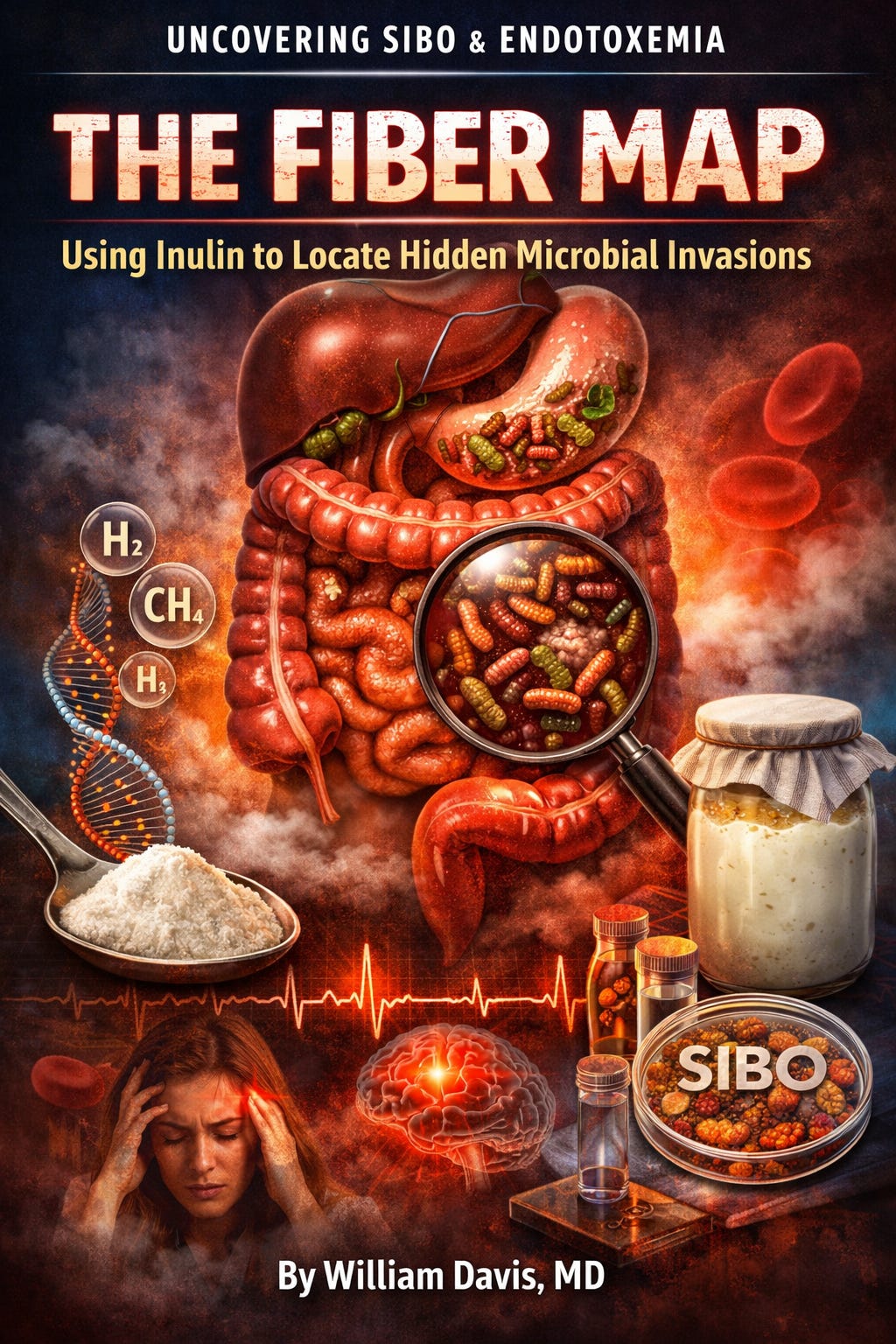
Title: THE FIBER MAP: Using Inulin to Locate Hidden Microbial Invasions
Classification: Systems Health Analysis
Method: Mechanism Mapping / Signal Timing
Status: Public Health Dossier
PROLOGUE — THE INVISIBLE OCCUPATION
Modern illness often begins where no scan looks and no routine test lingers: the small intestine.
Here, a quiet invasion unfolds—fecal microbes meant for the colon migrate upstream, triggering a cascade of systemic effects that masquerade as unrelated disease.
This transmission distills the work and clinical observations of William Davis, MD, focusing on a deceptively simple tool—inulin fiber—used not as a supplement, but as a mapping device.
I. THE EPIDEMIC THEY DON’T NAME
SIBO (Small Intestinal Bacterial Overgrowth) now affects an estimated ~50% of the U.S. population, driven by:
Chronic antibiotic exposure
Glyphosate’s antimicrobial effects
Food emulsifiers and preservatives
Modern dietary sterilization
Mechanism:
Colonic microbes ascend into the stomach, duodenum, jejunum, and ileum—regions designed for absorption, not fermentation.
These microbes die rapidly, releasing endotoxin, which crosses the permeable intestinal wall into circulation.
Result: Endotoxemia.
Associated conditions observed:
Brain fog, depression, panic, suicidal ideation
Atrial fibrillation, coronary disease
Rosacea, psoriasis, migraines
Sleep disruption, metabolic dysfunction
This is not psychosomatic. It is biochemical.
II. WHY THE SMALL INTESTINE BREAKS FIRST
The colon is armored.
The small intestine is intentionally permeable—to absorb amino acids, fats, vitamins, minerals.
When trillions of fecal microbes occupy this space, permeability becomes liability.
Absorption turns into exposure.
III. INULIN AS A MAPPING DEVICE (NOT JUST A FIBER)
Inulin is a widely fermentable fiber found in onions, garlic, asparagus, and root vegetables.
Unlike lactulose or other test sugars, inulin is metabolized by a broad spectrum of microbes—good and bad.
That makes it ideal for location-based microbial detection.
THE TIMING PRINCIPLE
Transit time through the small intestine: ~90 minutes minimum
Often longer: 4–6 hours
Interpretation:
Timing of Symptoms After InulinWhat It MeansGas/bloating after 90+ minutesMicrobes primarily in the colon (normal)Gas/bloating within 15–90 minutesMicrobes present in the small intestine (SIBO)
IV. MEASURING THE SIGNAL
Microbes produce hydrogen and methane gas. Humans do not.
Detection methods:
Symptom onset (gas, bloating, diarrhea)
Breath testing (clinical or at-home)
A rise of >4 units on a 0–10 breath scale within 90 minutes strongly suggests small-intestinal fermentation.
Psychological signals (panic, anxiety, intrusive thoughts) can accompany early fermentation—often overlooked, but repeatedly observed.
V. THE DOUBLE-EDGED FIBER
Inulin feeds:
Beneficial species: Lactobacillus, Bifidobacteria, Akkermansia, Faecalibacterium
Pathogenic species: Campylobacter, Citrobacter, Pseudomonas
Outcome depends on location.
In the colon → beneficial fatty acids (e.g., butyrate).
In the small intestine → gas, inflammation, endotoxin release.
Fiber is not the villain. Misplaced microbes are.
VI. WHY STANDARD MEDICINE FAILS HERE
Typical response:
Prescription: rifaximin
Cost: ~$1,200
Efficacy: ~55–60%
Recurrence prevention: none
Microbiome rebuilding: none
If antibiotics help—even partially—that alone confirms this is a microbial war, not a mystery disease.
VII. THE COUNTEROFFENSIVE: “SIBO YOGURT”
Dr. Davis’ approach does not merely kill invaders—it repopulates territory.
THE STRATEGY
Deploy keystone species that:
Colonize the small intestine
Produce bacteriocins (natural antibiotics)
Outnumber invaders by orders of magnitude
THE THREE SPECIES
Lactobacillus reuteri
Lactobacillus gasseri
Bacillus subtilis (replacing B. coagulans for broader action)
THE MULTIPLIER
36-hour fermentation at ~100°F
~300 billion CFU per serving
You do not win a war with equal numbers.
VIII. WHY FERMENTATION MATTERS
Microbes double every ~3 hours at body temperature.
Extended fermentation = exponential force.
This is not a supplement.
It is a biological occupation reversal.
IX. DIE-OFF IS NOT FAILURE
Initial reactions may include:
Temporary anxiety or vivid dreams
Sleep disruption
GI discomfort
These signal pathogen die-off and endotoxin release.
Adaptations:
Start with small servings
Titrate upward gradually
Alternative herbal regimens if histamine intolerance exists
X. THIS IS NOT JUST ABOUT SIBO
Despite the name, this protocol:
Rebuilds foundational microbiota
Improves skin, muscle tone, immunity
Enhances mood, sleep, metabolism
It is a microbiome restoration engine, not a single-purpose fix.
Dr. Davis details the full method in Super Gut and ongoing clinical work.
EPILOGUE — THE MAP REVEALS THE WAR
Inulin does not heal by itself.
It reveals.
It tells you:
Where microbes are living
Whether your symptoms are microbial, not moral
Whether your future disease risk is already incubating
The body whispers before it screams.
This transmission teaches you how to listen.
🩸 Red Blood Journal — Health Division
If the signal appears early, act early.
📍THE FIBER MAP: Using Inulin to Locate Hidden Microbial Invasions
This text details a strategy for identifying and treating Small Intestinal Bacterial Overgrowth (SIBO), a condition where colon-dwelling microbes migrate into the sensitive small intestine.
By using inulin fiber as a diagnostic mapping tool, individuals can track the timing of symptoms like bloating to determine the precise location of these invasive bacteria.
The source argues that this microbial displacement causes endotoxemia, leading to diverse systemic issues ranging from metabolic dysfunction to psychological distress.
Rather than relying solely on expensive antibiotics, the author advocates for a high-potency fermented yogurt designed to repopulate the gut with beneficial keystone species.
This biological intervention aims to outcompete pathogens and restore the intestinal barrier to improve overall health and longevity. Ultimately, the guide frames the microbiome as a dynamic battlefield where strategic dietary choices can reverse chronic illness.


