


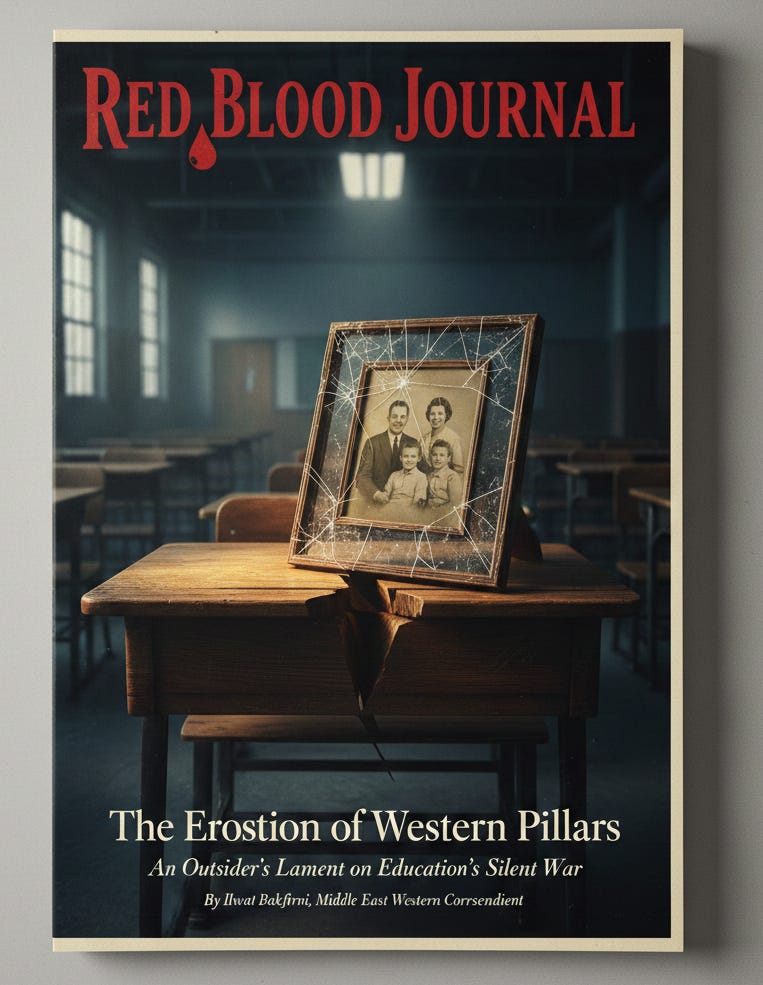
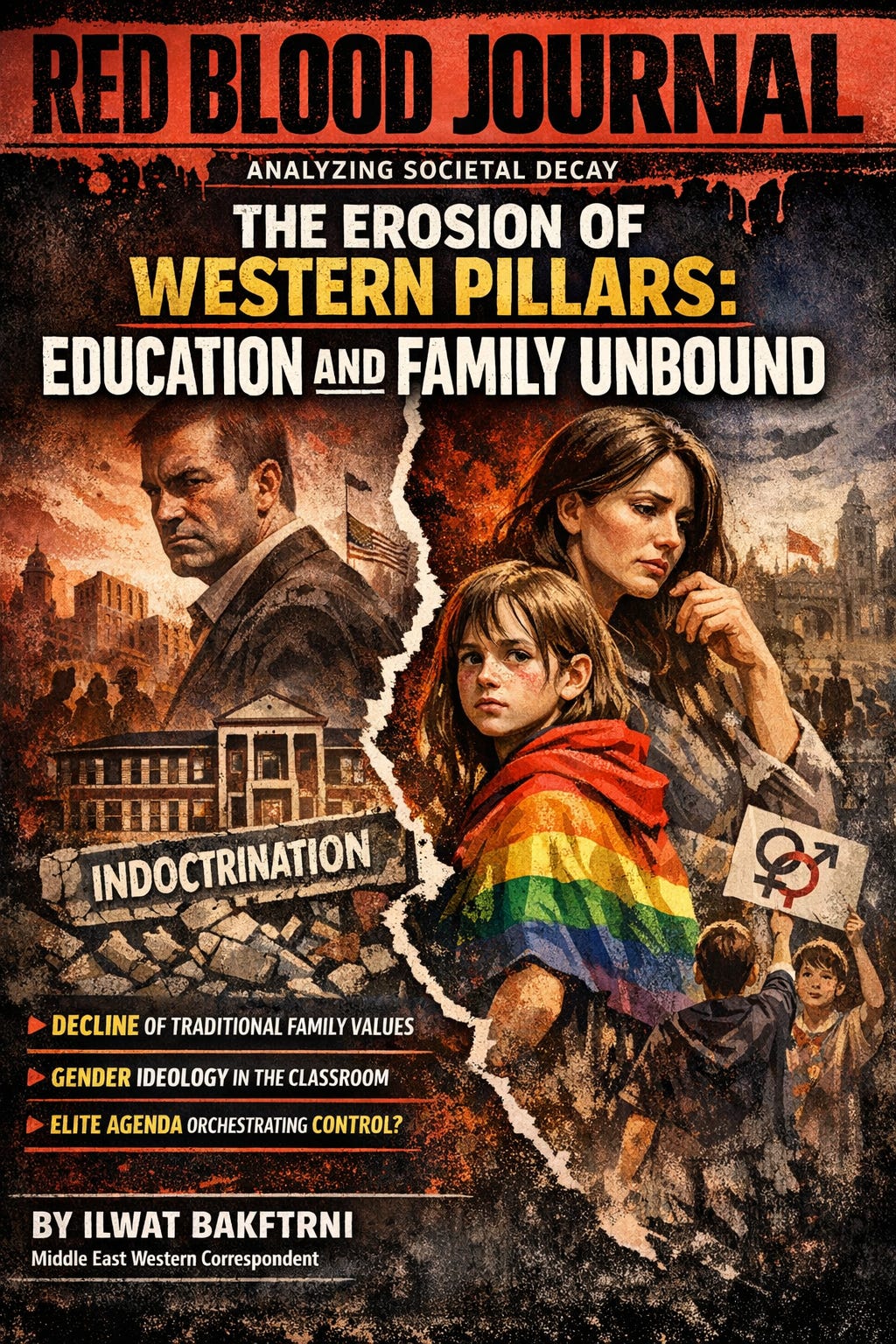
🩸The Erosion of Western Family Pillars: An Outsider’s Lament on Education’s Silent War
By Ilwat Bakftrni, Middle East Western Correspondent
In the pages of the Red Blood Journal, where the vital pulses of societal health are dissected with unflinching candor, I offer not a polemic, but a somber reflection drawn from decades of observing the West from the vantage of the Middle East. As a reporter who has chronicled the intersections of cultures—where the ancient familial bonds of my region clash with the modern experiments of yours—I have witnessed the slow hemorrhage of what once made Western society resilient: the family unit, anchored in distinct roles and boundaries. This is the observation of an old man, one fascinated by the West’s clarion call of free speech and individual liberty, yet disillusioned by its unraveling since the late 1980s. What follows is neither endorsement nor condemnation, but a mirror held to the shadows of deterioration in the Western education system—a system that, in its quest for unchecked openness, has blurred the lines between private sanctity and public decorum, ultimately serving agendas far removed from the nurturing of young souls.
I recall the old familial order with a clarity unclouded by nostalgia’s haze. In the pre-1980s West, as in the traditional households of the Middle East, the father embodied authority—a figure akin to a schoolteacher, commanding respect through structure and discipline. Children addressed him with deference, mindful of boundaries that fostered self-control. The mother, conversely, was the confidante of the hearth, a repository for intimate whispers and taboo queries that dared not cross the paternal threshold. This duality was no accident; it instilled a natural discernment between public and private spheres. One did not retort sharply or indulge in crude behaviors before the father, yet with the mother, a freer expression prevailed. Such distinctions were the bedrock of character formation, teaching youth to navigate society’s layered expectations. In my reporting from Beirut to Berlin, I saw how this model mirrored Eastern family values, where respect for elders and gendered roles preserved communal harmony amid turmoil.
Yet, by the late 1980s, cracks appeared, widening into chasms. The Western education system, once a bastion of knowledge transmission, morphed into an arena of unchecked emotional effusion, encouraging students to “spill their guts” without filter or consequence. This shift eroded the vital lesson of behavioral duality: that public conduct demands restraint, while private spaces allow vulnerability. Instead, classrooms became confessional booths, amplifying adolescent curiosities—particularly sexual ones—into crises of identity. The natural turbulence of puberty, once navigated with familial guidance, was reframed as potential entrapment in the “wrong body,” fostering gender confusion rather than resolution. Research indicates that over 90% of early gender dysphoria cases resolve post-puberty without intervention, yet modern curricula often bypass this, promoting ideologies that critics argue indoctrinate rather than educate. From a Middle Eastern lens, this appears not as progress, but as a deliberate unmooring—echoing how colonial powers once disrupted indigenous family structures to impose control.
Why this promotion? The roots delve into shadowy intentions, traceable to figures like John D. Rockefeller, whose philanthropic facade masked industrial designs. Through the General Education Board, established in 1902 with $180 million in donations, Rockefeller reshaped American education to prioritize vocational training over critical thinking, aiming to produce a compliant workforce. Conspiracy or not, detractors claim his vision was explicit: “I don’t want a nation of thinkers; I want a nation of workers.” This influence extended beyond factories, infiltrating family dynamics by positioning the state as surrogate parent—a “mother” with ulterior motives. The anecdote of Rockefeller “stealing” from his children to instill lessons in frugality and obedience symbolizes this ethos: education as a tool for control, not empowerment. By the 1980s, this manifested in broader societal decay—declining two-parent households, rising divorce rates, and eroding intergenerational mobility. Critics link these to educational policies that prioritize state ideology over parental authority, fostering a culture where family values are dismissed as archaic.
This orchestrated dismantling serves a grander purpose: to fracture the West from within, pushing free speech toward the precipice of totalitarian communism. In the Middle East, we have endured such ideologies—regimes that erode family to consolidate power. The West, in embracing “progressive” education, risks the same: schools as battlegrounds where gender ideology divides, with surveys revealing deep societal rifts on its inclusion in curricula. Proponents argue it fosters inclusivity, but opponents, including UK guidelines barring gender identity teaching in schools, warn of harm to faith-based families and parental rights. The result? A generation adrift, mistaking fluidity for freedom, while the family—the true guardian of liberty—fades.
The antidote lies in recognition: this education system is a weapon, wielded to supplant parental roles and homogenize thought. If the West desires to rescue its progeny from the cliff’s edge, it must confront it head-on—reinstating family-centric values, curbing state overreach, and restoring boundaries that honor both public decorum and private introspection. From my perch in the Middle East, where family endures as society’s spine despite ceaseless strife, I implore: heed the shadows before the light extinguishes. The blood of a civilization runs through its families; let it not drain away unheeded.
🏚️The Erosion of Western Pillars: Education and Family Unbound
In this commentary, Ilwat Bakftrni examines the perceived collapse of Western societal structures, specifically targeting the deterioration of traditional family dynamics and the modern education system.
The author argues that before the late 1980s, defined parental roles provided children with essential boundaries, a stability he compares to Middle Eastern cultural values.
He contends that contemporary schools have shifted toward ideological indoctrination, specifically regarding gender identity, which he believes undermines parental authority and creates societal confusion.
Bakftrni further links these changes to an orchestrated effort by historical elites to prioritize state control and a compliant workforce over critical thinking.
Ultimately, the text serves as a warning that the West must restore family-centric values to prevent a total civilizational decline.


