


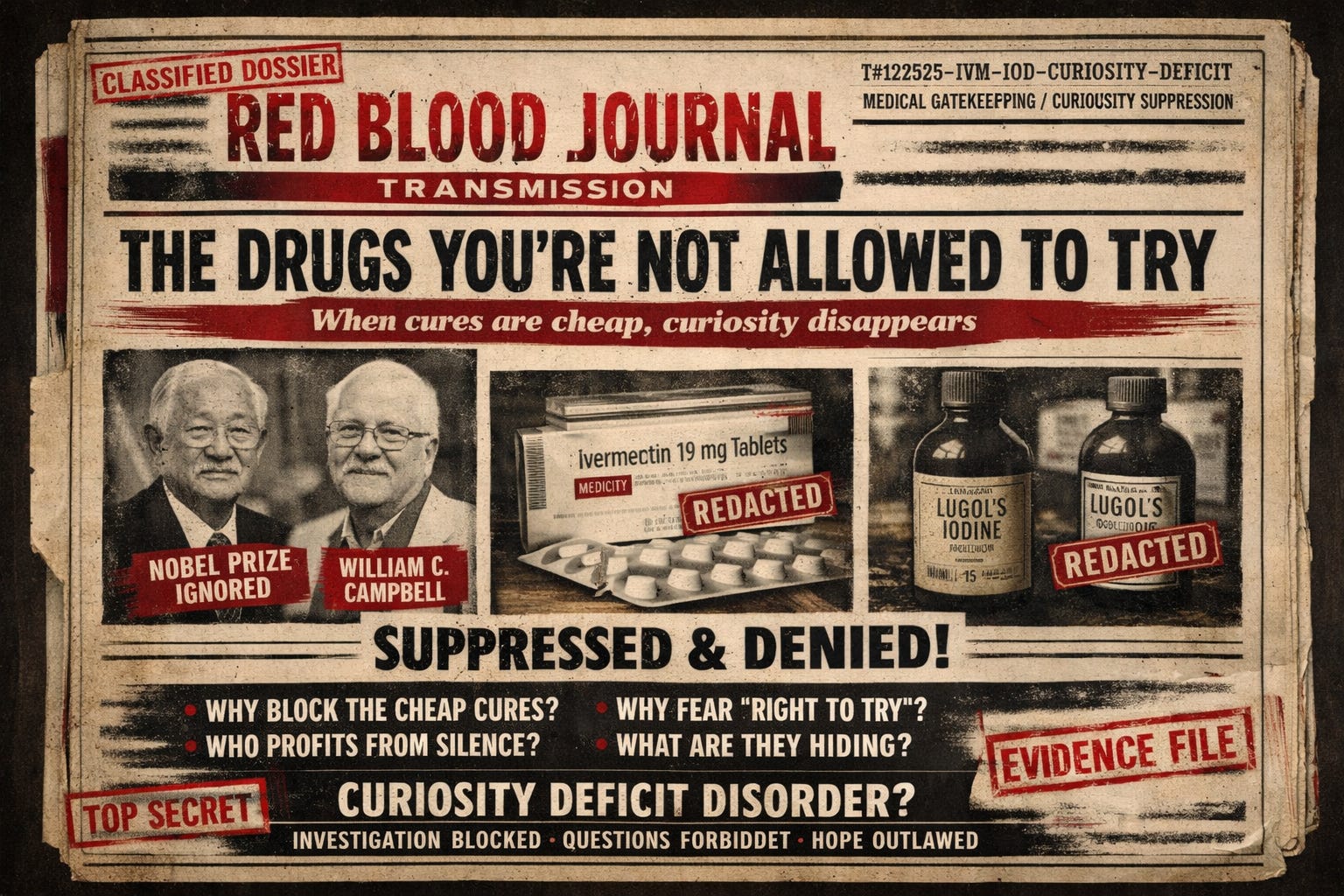
🩸 RED BLOOD JOURNAL — TRANSMISSION
T#122525–IVM–IOD–CURIOSITY–DEFICIT
Classification: Medical Gatekeeping / Curiosity Suppression
Distribution: Open Dossier
Front-Page Title: THE DRUGS YOU’RE NOT ALLOWED TO TRY
Subhead: When cures are cheap, curiosity disappears
PROLOGUE — THE QUESTIONS THAT WON’T BE ASKED
A medicine wins a Nobel Prize.
An antiseptic predates antibiotics by a century.
Both are inexpensive. Both are generic.
Both are treated like contraband.
This Transmission does not claim cures.
It documents patterns—of suppression, indifference, and institutional refusal to investigate low-profit therapies that millions ask about and are told to forget.
I. THE NOBEL THAT VANISHED
In 2015, the Nobel Committee honored Satoshi Ōmura and William C. Campbell for work that led to ivermectin—derived from a natural bacterial product and used worldwide for parasitic disease.
The paradox begins here:
How does a drug celebrated for safety and impact become culturally radioactive?
Off-patent.
Mass-produced at pennies per dose.
No monopoly rents.
No blockbuster margins.
The Nobel didn’t change the economics. The economics changed the curiosity.
II. THE WAR ON A GENERIC
Clinicians and patients report being blocked, not merely cautioned.
Guidelines harden. Prescriptions vanish. Conversations end.
One physician, Pierre Kory, titled the pattern plainly: a war—not on evidence, but on permission.
Observation:
When a compound cannot be monetized, it is rarely studied forward. It is simply studied out.
III. THE TRIAL THAT CAN’T EXIST
Gold-standard trials cost fortunes.
Fortunes require profits.
Generics generate neither.
Result: a structural dead end.
Patients ask:
Why not “right-to-try” when risk is low?
Why not compassionate access with rigorous data collection?
Answer received:
Because it’s not in the guidelines.
Red Blood Insight: Guidelines are downstream of incentives. Where profit ends, curiosity follows.
IV. COHORTS THEY REFUSE TO COUNT
A quiet counter-proposal emerges from patients themselves:
If thousands independently try a safe, inexpensive drug under physician oversight, matched cohorts could be analyzed. Signals would appear—or disappear.
This is not anti-science.
This is science—blocked by bureaucracy.
Yet access is denied, not because of danger, but because of disinterest.
V. IODINE: THE ANCIENT ANTISEPTIC
Before antibiotics, there was iodine.
Used for generations.
Documented, broad-spectrum antiseptic properties.
And yet:
Restricted or unavailable at retail in parts of the UK.
Treated as hazardous despite hospital use in related forms.
Replaced by proprietary alternatives.
Question:
Why would one of medicine’s oldest, cheapest tools be harder to obtain than newer, costlier drugs?
VI. THE NANNY STATE PARADOX
Citizens are told:
Experimental products can be encouraged.
Established generics cannot be chosen.
Adults can consent to novelty—
but not to cheap familiarity.
This inversion is not about safety alone.
It is about control of pathways.
VII. THE CURIOSITY DEFICIT
The core accusation is not malice.
It is curiosity deficit disorder.
A system that should say:
“Interesting. Let’s find out.”
Instead says:
“Not allowed. Move on.”
When science stops asking questions, it becomes administration.
VIII. THE HUMAN COST
Behind policy are emails.
Behind emails are families.
Behind families are timelines that cannot wait for decade-long approvals.
No promises are made here.
Only the demand that questions be permitted.
IX. THE PATTERN (NOT THE CLAIM)
This Transmission does not assert:
that ivermectin cures cancer,
that iodine replaces modern medicine,
or that individuals should self-medicate.
It does assert:
that cheap, off-patent tools face structural neglect,
that prohibition replaces investigation,
and that the public is denied participation in discovery.
EPILOGUE — WHAT SCIENCE USED TO DO
There was a time when medicine followed curiosity, not margins.
When something looked promising,
they studied it.
Now, when something is unprofitable,
they silence it.
🩸 RED BLOOD JOURNAL — TRANSMISSION ENDS
The question is not whether these tools work.
The question is why we are forbidden to find out.
🚫🩸THE DRUGS YOU’RE NOT ALLOWED TO TRY
The provided text examines a phenomenon labeled the curiosity deficit, where medical institutions allegedly suppress interest in cheap, generic treatments due to a lack of profit potential.
It highlights how substances like ivermectin and iodine face regulatory hurdles and professional dismissal because they cannot generate the high margins required to fund expensive clinical trials.
The author argues that financial incentives now dictate scientific inquiry, leading to a system that prioritizes proprietary drugs over accessible, off-patent alternatives.
This shift creates a structural dead end for patients and physicians who wish to explore low-risk, established therapies that fall outside of official guidelines.
Ultimately, the source claims that medical gatekeeping has replaced genuine discovery, transforming science into a form of bureaucratic administration that ignores promising signals if they cannot be monetized.


