


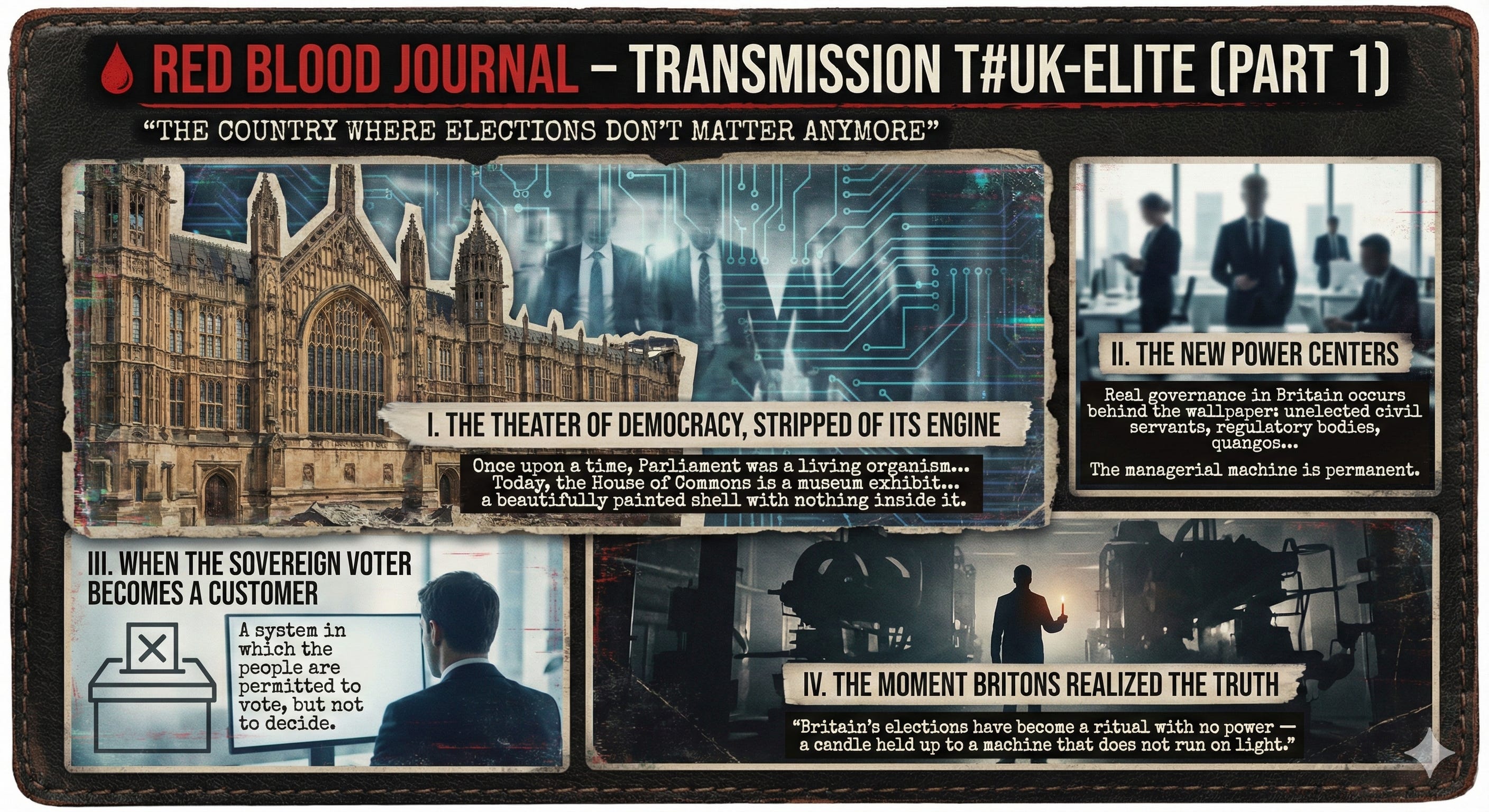
🩸 RED BLOOD JOURNAL – TRANSMISSION T#UK-ELITE (PART 1)
“THE COUNTRY WHERE ELECTIONS DON’T MATTER ANYMORE”
There is a moment — and every collapsing republic reaches it — when the people finally admit a forbidden truth:
It doesn’t matter who you vote for.
Not in Britain.
Not in the United States.
Not anywhere the managerial class has sunk its roots.
Ask the average Briton today whether it makes any difference to elect a Tory, a Labour leader, a Lib Dem progressive, a Green activist, or a Scottish nationalist. The answer comes back the same every time:
Nothing changes.
And they’re right.
Rupert Lowe is right.
Even Tucker Carlson, watching from thousands of miles away, can see it:
Britain still holds elections —
but Britain no longer holds power.
Something has replaced it.
I. THE THEATER OF DEMOCRACY, STRIPPED OF ITS ENGINE
Once upon a time, Parliament was a living organism:
MPs were tied to the land.
They were businessmen, landowners, aristocrats — people with skin in the game.
Their personal futures were welded to the future of the nation.
Governing meant protecting the British nation first, constituency second, status never.
That world is dead.
Today, the House of Commons is a museum exhibit of democracy — a beautifully painted shell with nothing inside it. MPs now depend on their £92,000 salary, their title, their speaking invitations, their committee seats. Parliament has become:
a stage set,
a performance hall,
a room full of small people repeating large phrases,
a ceremonial priesthood reciting the liturgy of a system they do not control.
Endless meetings in Room P.
Endless Zoom calls.
Endless “feeling important.”
And yet — nothing they do actually governs Britain.
Because they no longer govern.
II. THE NEW POWER CENTERS: QUANGOS, PERMANENT SECRETARIES, THE MANAGERIAL PRIESTHOOD
Real governance in Britain occurs behind the wallpaper:
unelected civil servants,
regulatory bodies no one voted for,
quangos with opaque mandates,
permanent secretaries who outlast every prime minister.
They are the true state.
They craft policy.
They shape immigration flows.
They determine what speech is permitted, what priorities are “non-negotiable,” and what ideological slop must be injected into the bloodstream of public life.
Elections reshuffle the actors.
But the script remains identical.
That is why the British voter sees no change under:
Boris Johnson
Rishi Sunak
Keir Starmer
or any interchangeable modern leader.
The managerial machine is permanent.
The elected figurehead is temporary.
This is not a conspiracy theory.
This is an operating system.
III. WHEN THE SOVEREIGN VOTER BECOMES A CUSTOMER WITH NO SERVICE
A democracy dies long before its elections stop.
It dies when the outcome of elections stops mattering.
And that is precisely what Rupert describes:
A nation where:
the public demands change,
the ballot box suggests choice,
but the managerial class ensures continuity.
A system in which the people are permitted to vote, but not to decide.
A system in which Parliament exists, but does not rule.
A system in which parties rotate, but policy is fixed.
A system in which the British citizen — the person whose ancestors built the courts, the navy, the railroads, the common law — has become a spectator in their own country.
Elections are still held because elections create the illusion of consent.
But the real decisions are made by those who never appear on a ballot.
IV. THE MOMENT BRITONS REALIZED THE TRUTH
For decades, the British public assumed the nation was merely mismanaged.
Now they’re beginning to understand it is misappropriated.
Government hasn’t failed —
it has been repurposed.
Parliament hasn’t weakened —
it has been bypassed.
Democracy hasn’t decayed —
it has been professionalized into irrelevance, sterilized into ceremony, declawed into symbolism.
Rupert is right:
We are witnessing a Parliament whose interests no longer align with the people at all.
The crisis is not political.
It is structural.
Systemic.
Deliberate.
Britain’s elections have become a ritual with no power —
a candle held up to a machine that does not run on light.
🎭The Theater of Democracy: Britain’s Managerial Rule
The source critiques modern political structures in Britain, arguing that contemporary national elections are functionally irrelevant, serving merely as a “ritual” or “theater of democracy” rather than a genuine exercise of political power.
This irrelevance stems from the assertion that governance has been entirely supplanted by a powerful, unaccountable managerial class that remains in place regardless of the electoral outcome.
Real decisions, policies, and priorities are determined by unelected civil servants, regulatory bodies, and permanent secretaries, who operate outside the electoral process.
Consequently, the elected body of Parliament is merely a symbolic shell, acting as temporary figureheads whose interests no longer align with the needs of the public.
The text concludes that the country’s core crisis is structural and systemic, ensuring that citizens are permitted to vote but are fundamentally prevented from deciding the actual trajectory of the nation.


