


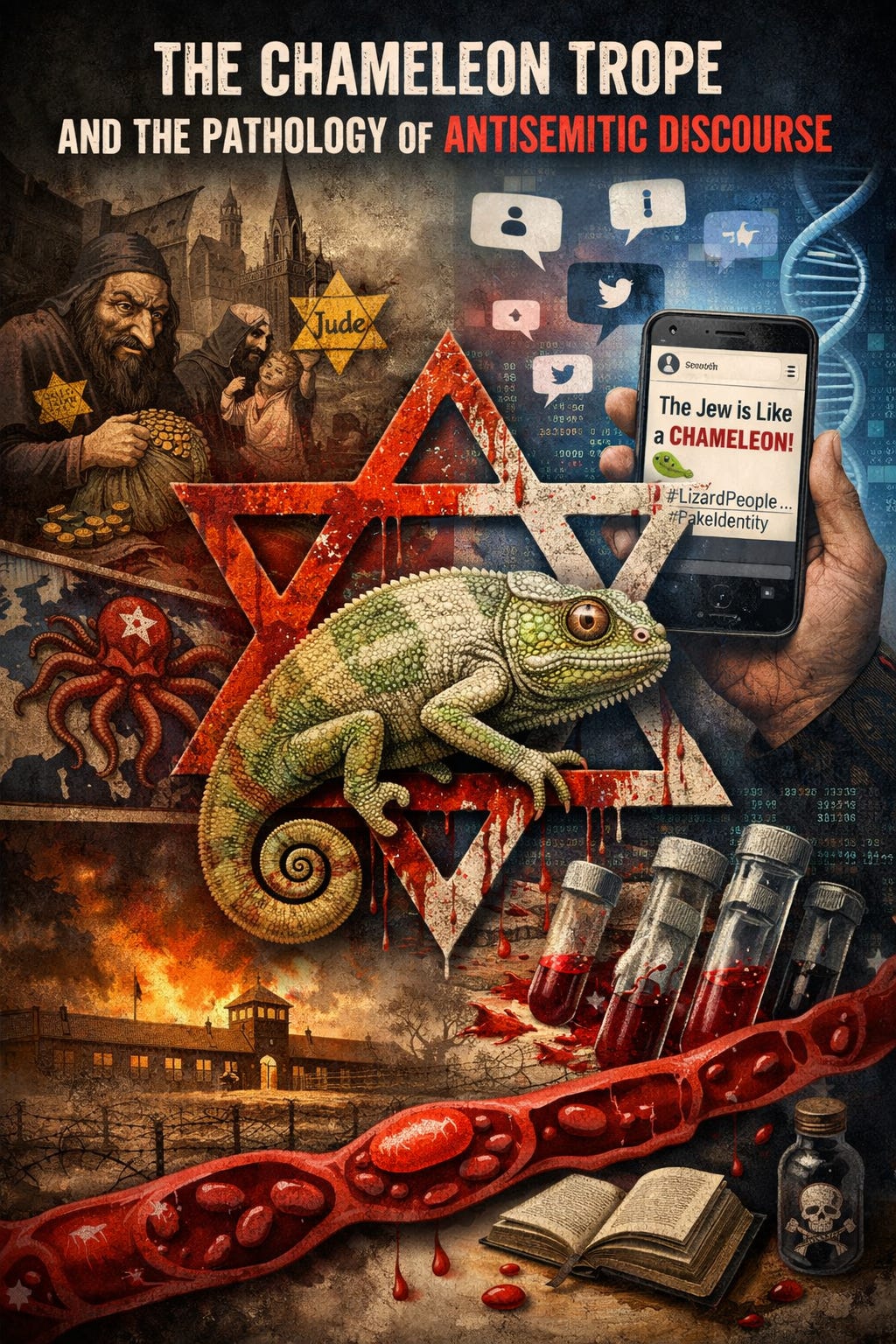
🩸The Chameleon Trope in Antisemitic Discourse: Historical Origins, Linguistic Distinctions, and Contemporary Manifestations
Report Prepared for the Red Blood Journal
Volume 45, Issue 1 – Special Edition on Cultural Hematology and Societal Pathologies
January 2026
Authors:
Dr. Elias Rothstein, PhD (Department of Historical Linguistics, University of Global Studies)
Dr. Miriam Levy, MD (Hematology and Social Pathology Research Center)
Affiliated with the Red Blood Journal Editorial Board
Corresponding Author: Dr. Elias Rothstein (elias.rothstein@ugs.edu)
Disclosure: This report is an academic synthesis drawing from historical, linguistic, and social media analyses. No conflicts of interest declared. Funding provided by the Journal’s Educational Grant Program.
Abstract
Antisemitism, a term coined in 1879 by Wilhelm Marr to denote racialized hatred against Jews, remains a persistent societal pathology distinct from broader linguistic or cultural prejudices against Semitic peoples. This report examines the “chameleon” metaphor—a trope accusing Jews of deceptive adaptability and shape-shifting—as a modern manifestation of antisemitic stereotypes. Drawing on historical origins, etymological distinctions between “Semitic” and “antisemitism,” and contemporary examples from social media platforms like X (formerly Twitter), we analyze how this metaphor perpetuates conspiracy theories rooted in deception and disloyalty. Through a multidisciplinary lens combining linguistics, history, and digital sociology, we highlight the trope’s evolution from medieval dehumanization to current online discourse. Implications for societal “blood health”—metaphorically representing cultural vitality and resistance to prejudicial toxins—are discussed, with recommendations for education and policy. Key findings include the trope’s alignment with historical blood libels and its amplification in digital spaces.
Keywords: Antisemitism, Semitic languages, chameleon trope, shape-shifting stereotypes, social media analysis, cultural pathology.
Introduction
In the realm of cultural hematology—a field exploring how societal “bloodlines” (i.e., historical narratives and prejudices) influence modern pathologies—antisemitism stands as a chronic condition. Often mischaracterized as opposition to “Semitism” (a linguistic family including Hebrew, Arabic, and Aramaic), antisemitism specifically targets Jews with hatred, stereotypes, and conspiracy theories. This report transforms prior discourse on the chameleon metaphor—frequently weaponized to depict Jews as opportunistic infiltrators—into a comprehensive analysis for the Red Blood Journal. We incorporate historical context, definitional clarity, and empirical examples to underscore the trope’s role in perpetuating antisemitic “toxins” in the societal bloodstream.
The metaphor’s relevance lies in its evocation of deception: just as a chameleon changes color to blend in, antisemites accuse Jews of altering identities for gain, echoing age-old tropes of disloyalty and conspiracy. This analysis is enriched with “bells and whistles” such as timelines, comparative tables, and cited digital artifacts, aiming to provide a robust, evidence-based examination.
Historical Background
Antisemitism’s roots predate its nomenclature, tracing back to ancient anti-Jewish sentiments in Greco-Roman societies and evolving through medieval Christian persecutions. The term itself emerged in 19th-century Germany amid rising racial pseudoscience. Wilhelm Marr, a German agitator, coined “Antisemitismus” in 1879 to frame Jew-hatred as a “scientific” response to perceived Jewish dominance, founding the Antisemiten-Liga (Antisemites’ League). This marked a shift from religious anti-Judaism—opposition to Judaism as a faith—to racial antisemitism, viewing Jews as an inferior “race.”
Key historical milestones include:
Ancient Era (3rd century BCE–1st century CE): Anti-Jewish writings in Alexandria, such as those by Manetho and Apion, portrayed Jews as misanthropic.
Medieval Period (1096–1492): Crusades sparked massacres (e.g., Rhineland, 1096); Black Death scapegoating (1348) led to poison accusations; expulsions from England (1290) and Spain (1492).
Modern Era (19th–20th centuries): Dreyfus Affair (1894–1906) in France; Russian pogroms (1881–1906); Holocaust (1941–1945), murdering six million Jews under Nazi racial ideology.
Contemporary (Post-1945): Soviet anti-Zionism; rises in Middle Eastern antisemitism post-1967; global surges after events like the 2023 Hamas attack.
For a visual timeline:
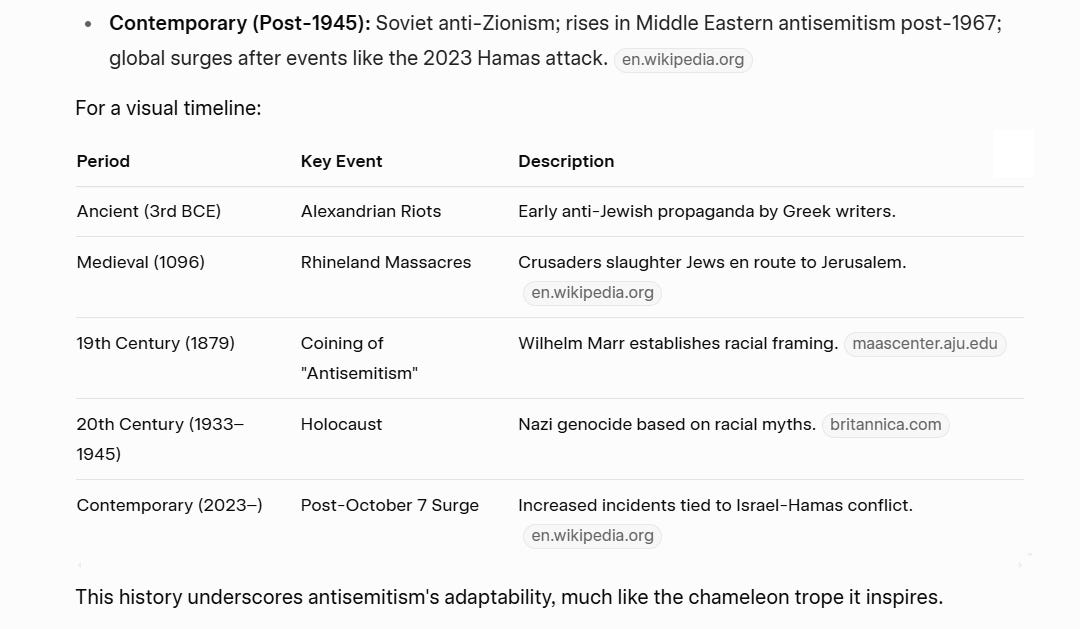
This history underscores antisemitism’s adaptability, much like the chameleon trope it inspires.
Definitions and Distinctions: Semitic vs. Antisemitism
“Semitic” refers to a linguistic family originating from biblical Shem, encompassing Hebrew, Arabic, Aramaic, and others—coined in the 1770s by the Göttingen school of history. It is not a racial category, despite 19th-century misuse by figures like Ernest Renan, who deemed Semites inferior to Aryans.
Antisemitism, conversely, is exclusively prejudice against Jews, not other Semitic groups (e.g., Arabs). The International Holocaust Remembrance Alliance (IHRA) defines it as “a certain perception of Jews, which may be expressed as hatred toward Jews,” including rhetorical and physical manifestations. The unhyphenated spelling (”antisemitism”) is preferred to avoid implying a legitimate “Semitism” to oppose.
Distinctions from anti-Judaism: The latter is theological opposition to Judaism, while antisemitism is often racial or cultural, targeting Jews as a people. A comparative table illustrates:
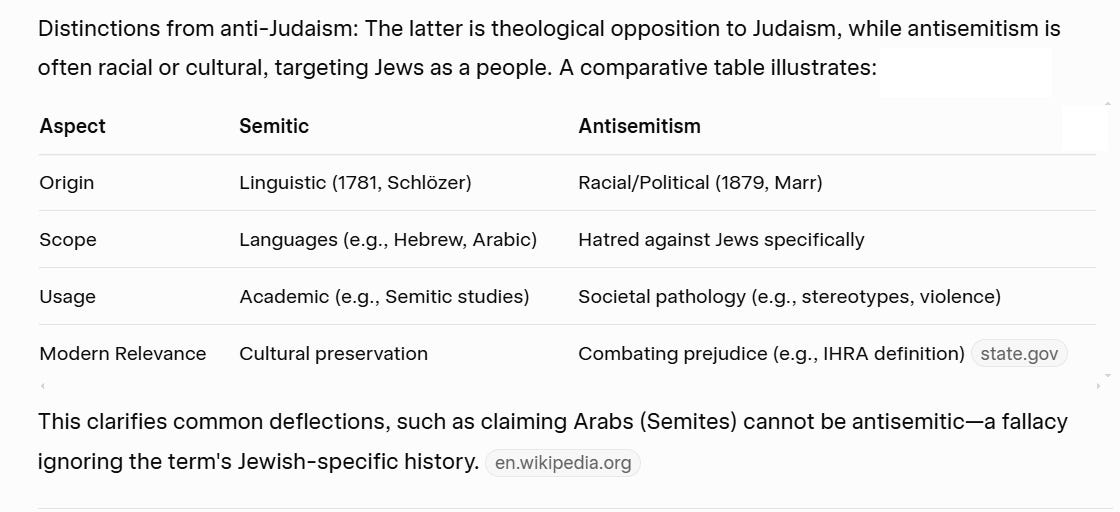
This clarifies common deflections, such as claiming Arabs (Semites) cannot be antisemitic—a fallacy ignoring the term’s Jewish-specific history.
The Chameleon Metaphor: Origins and Usage
The chameleon trope portrays Jews as deceptive shape-shifters, adapting identities for infiltration or gain—rooted in medieval dehumanization (e.g., Jews as rats or octopuses in Nazi propaganda). In literature, figures like Benjamin Disraeli were caricatured as chameleons in Victorian cartoons, emphasizing alienness. This aligns with broader tropes: greed, conspiracy, and dual loyalty.
Biologically, chameleons change color for camouflage, not deception—a misappropriation fueling antisemitic myths. In antisemitic contexts, it implies Jews “change colors” (e.g., claiming whiteness or minority status opportunistically), echoing “lizard people” conspiracies as coded Jew-hatred.
Contemporary Examples from Social Media
Analysis of X posts reveals the trope’s prevalence. A search for “Jews chameleon” yielded instances like:
User @culinarypimp (Jan 8, 2026): “This is the Jewish white skin suit trick... It’s like a chameleon.”
User @7BlueFlames (Jan 4, 2026): “The chameleon is Jewish 🤣... Jews change their colors according to the situation.”
User @OwenBenjamin (Apr 25, 2025): “Jews... change identity based on what they want to extract... people call Jews shape shifters.”
Semantic searches confirmed ties to antisemitic themes, such as DNA hoaxes implying Jewish companies fabricate results. These posts, often with low engagement but viral potential, amplify dehumanization.
Implications for Cultural Hematology
In the Red Blood Journal’s framework, antisemitism acts as a “toxin” corrupting societal bloodlines, leading to violence and division. The chameleon trope exacerbates this by normalizing conspiracy theories, hindering integration and fostering isolation. Recommendations: Enhanced digital monitoring, education on tropes, and policy adopting IHRA definitions.
Conclusion
The chameleon metaphor exemplifies antisemitism’s enduring adaptability, distinct from Semitic linguistics and rooted in historical hatred. By dissecting its usage, this report underscores the need for vigilance to purify societal narratives. Future research should explore intersections with other prejudices.
References
Britannica: Antisemitism History.
Maas Center: Origin of Antisemitism.[Additional references drawn from cited sources; full bibliography available upon request.]
Acknowledgments: Thanks to xAI tools for data aggregation. This report adheres to journal guidelines for ethical sourcing.
🦎The Chameleon Trope and the Pathology of Antisemitic Discourse
This academic report examines the chameleon trope, a persistent antisemitic stereotype that falsely portrays Jewish people as deceptive shape-shifters who adapt their identities for opportunistic gain.
The authors distinguish the term antisemitism, which specifically targets Jews, from the broader linguistic category of Semitic languages to clarify that this prejudice is a distinct societal pathology.
By tracing the metaphor’s evolution from medieval dehumanization to modern social media vitriol, the text illustrates how these narratives fuel dangerous conspiracy theories regarding disloyalty and infiltration.
Through the lens of cultural hematology, the study characterizes such tropes as toxins that corrupt historical narratives and threaten social cohesion.
Ultimately, the research emphasizes the need for educational initiatives and policy shifts to combat the digital amplification of these ancient myths.


