


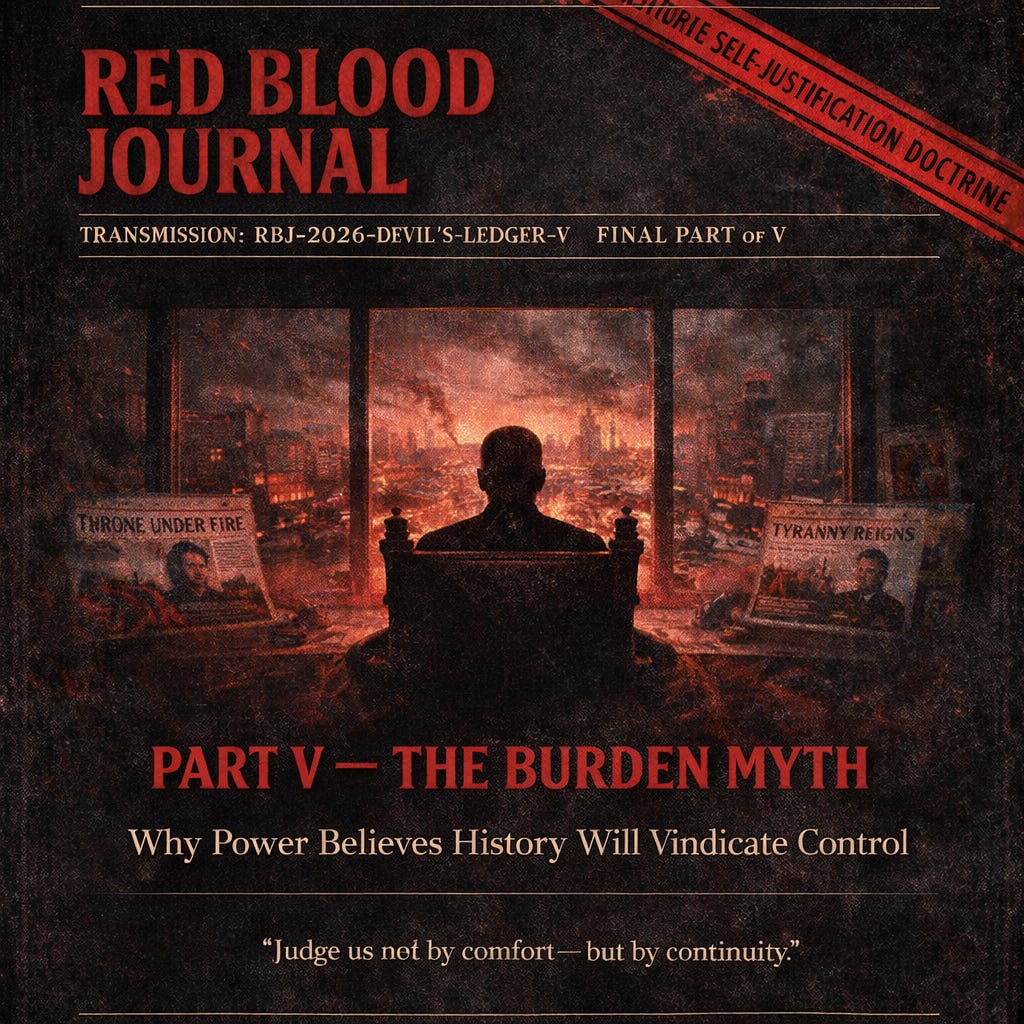
🩸 RED BLOOD JOURNAL TRANSMISSION
T#: RBJ-2026-DEVIL’S-LEDGER-V
Classification: Power Architecture Analysis / Historical Self-Justification Doctrine
Status: Fictional Analytical Commentary — Strategic Role Reversal
Final Part — V of V
PART V — THE BURDEN MYTH
Why Power Believes History Will Vindicate Control
PROLOGUE — THE LONELY NARRATIVE
From the street, power looks indulgent.
From the throne, power feels isolating.
Critics see privilege.
The Boss sees pressure.
This final defense is the most revealing:
Not that control is efficient.
Not that fear is stabilizing.
Not that filtering prevents chaos.
But that ruling is sacrifice.
I — THE “INVISIBLE CATASTROPHE” ARGUMENT
The Boss might say:
“You do not see what did not happen.”
Wars prevented quietly.
Markets stabilized overnight.
Panic contained before eruption.
Institutions patched before collapse.
The public only experiences the friction.
The ruler measures avoided disaster.
This becomes the core justification:
Unseen prevention equals misunderstood authority.
II — THE NECESSITY OF UNPOPULARITY
From the throne:
If every decision pleases the population,
leadership has failed.
True stabilization requires:
Raising rates when citizens want relief.
Limiting speech when citizens demand openness.
Restricting movement when citizens demand autonomy.
The Boss frames opposition as proof of responsibility.
If control is hated,
it must be necessary.
III — HISTORY AS JUDGE
Power often operates on delayed validation.
Policies condemned today
may be praised decades later.
Emergency measures criticized in real time
may be remembered as decisive action.
The Boss’s inner belief:
History forgets discomfort
and remembers survival.
Therefore:
Short-term resentment
is acceptable
if long-term continuity is achieved.
IV — THE MARTYR COMPLEX OF AUTHORITY
The ruler may privately think:
“I carry hostility so society does not collapse.”
Isolation becomes part of identity.
Criticism becomes confirmation of burden.
The throne cultivates this myth:
Control is not ambition.
It is obligation.
Whether true or self-serving,
this narrative sustains those in power.
V — THE FINAL INTERNAL MEMO
If written plainly, it might read:
“We are not loved.
We are necessary.
You see restriction.
We see preservation.
Judge us not by comfort —
but by continuity.”
Continuity becomes the ultimate metric.
Not liberty.
Not equality.
Not approval.
Survival of the structure.
VI — THE REVEAL
Across five parts, the Boss has argued:
Order over chaos.
Filtering over volatility.
Pressure over collapse.
Fear over force.
Burden over popularity.
Each justification contains internal logic.
Each also carries moral cost.
The critical question is no longer:
Is power evil?
The question becomes:
At what point does preservation
become domination?
At what point does stabilization
become suffocation?
FINAL EDITORIAL NOTE
This series has not defended the Boss.
It has reconstructed the internal defense.
Understanding justification is not surrender.
It is awareness.
Because the most resilient systems
are not sustained by force alone.
They are sustained by belief —
including the belief that control is mercy.
CLOSING LINE — THE LEDGER CLOSES
The Devil’s Ledger is complete.
The arguments are presented.
The throne has spoken.
The verdict does not belong to the ruler.
It belongs to the reader.
👑The Burden of Absolute Continuity
This text analyzes the psychological justifications and internal logic used by those in absolute power to rationalize their control over society.
The narrative presents a martyrdom complex, where rulers frame their suppression of liberty as a selfless sacrifice necessary for preventing invisible catastrophes and maintaining social order.
According to this perspective, long-term continuity is the only metric of success, rendering immediate public resentment a sign of effective leadership rather than failure.
The source explores how authority figures prioritize structural survival over individual comfort, suggesting that they view their dominance as a form of mercy.
Ultimately, the document challenges readers to decide when the pursuit of total stability transforms from preservation into a suffocating form of tyranny.


