


🩸 RED BLOOD JOURNAL TRANSMISSION
T#: RBJ-2026-HERO-PARADOX
Classification: Psychological Sovereignty / Fear Infrastructure Analysis / Allegorical Regime Modeling
Status: FICTIONAL SCENARIO — Parallel Planet Archive
PROLOGUE — THE FRAGILE THRONE
On the parallel planet Thrae, the Boss did not rule through strength.
He ruled through fear calibration.
Not constant terror.
Not endless executions.
Just enough.
Enough to remind every citizen from childhood that:
Death is the ultimate failure.
Death is punishment.
Death is defeat.
The education system repeated it.
The mourning rituals amplified it.
The media dramatized it.
Fear of death became the invisible constitution.
And it worked.
For a thousand years.
SECTION I — THE TRUE PILLAR OF POWER
The Boss family understood something deeper than weapons.
Weapons are expensive.
Surveillance is exhausting.
Propaganda requires maintenance.
But fear of mortality?
Self-maintaining.
If citizens fear death above all else, they will:
Accept injustice to avoid punishment
Tolerate corruption to preserve comfort
Silence themselves to remain safe
The Boss did not need chains.
Citizens chained themselves.
SECTION II — THE HERO VARIABLE
Every century, anomalies appeared.
Individuals who accepted mortality.
Individuals who stopped bargaining integrity for safety.
Individuals who refused to kneel, not because they desired death —
but because they no longer worshipped survival.
The system labeled them:
Extremists
Destabilizers
Psychological contagions
Internal documents referred to them as:
H-Vectors — Hero Vectors.
The danger was not that they wanted to die.
The danger was that they were no longer governable through fear.
SECTION III — WHY EVERYONE CANNOT BECOME A HERO
The Boss’s strategists modeled a catastrophic scenario:
If 5% of the population loses fear → manageable.
If 15% loses fear → instability.
If 40% loses fear → enforcement costs spike.
If 60% loses fear → deterrence collapses.
At 70%?
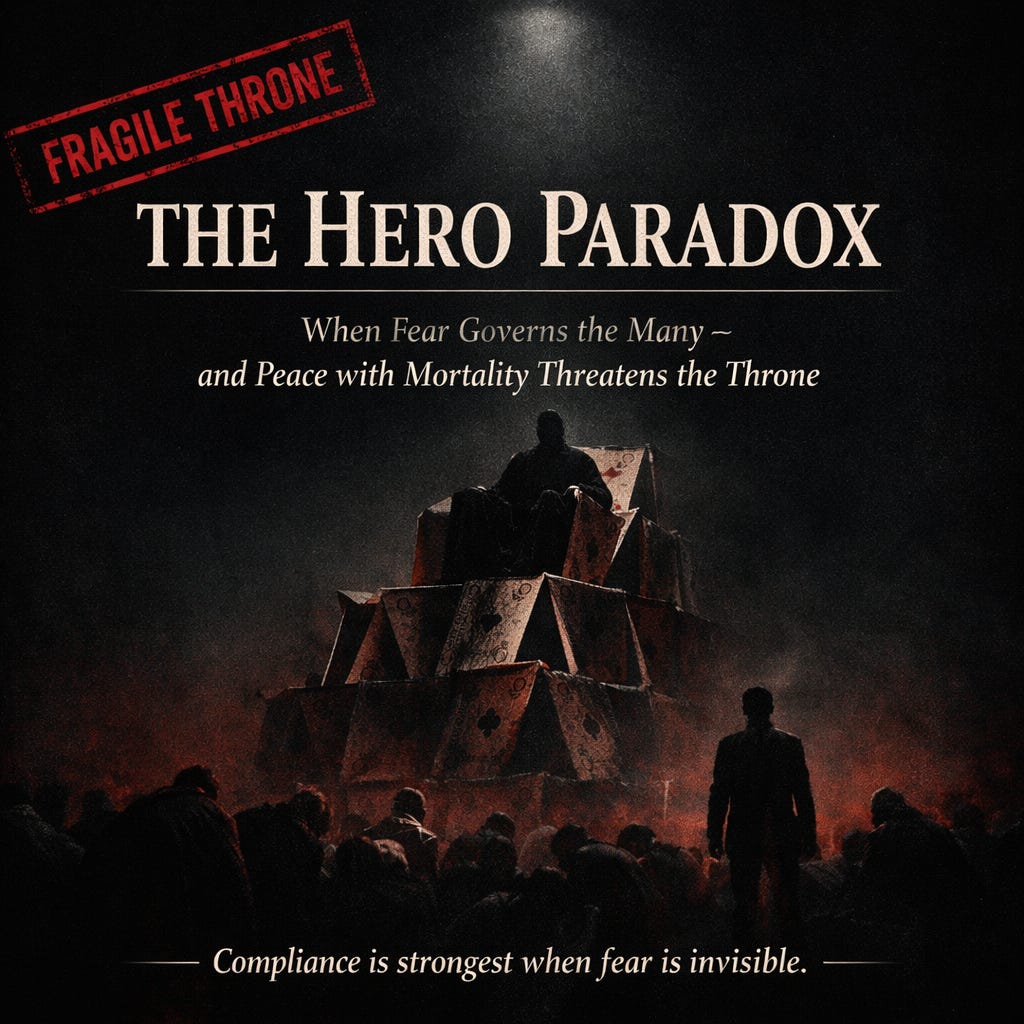
The House of Cards disintegrates.
Because the regime’s architecture was not built on loyalty.
It was built on compliance driven by mortality anxiety.
SECTION IV — THE MISDIRECTION STRATEGY
The Boss learned a countermeasure:
Redirect heroism.
Encourage symbolic bravery that does not threaten power:
Competitive heroism
Consumer heroism
Social-media heroism
Performative outrage
Keep courage fragmented.
Keep fear centralized.
As long as citizens remain divided, even brave individuals cannot synchronize.
Isolated courage does not topple systems.
Collective moral alignment does.
SECTION V — THE CORE DISCOVERY
The Boss did not invent fear of death.
It was biological.
What he perfected was amplification.
From childhood, education emphasized:
Death as tragedy only
Mortality as terror
Survival as supreme virtue
Alternative philosophies were quietly removed.
Any narrative that reframed mortality as transition, natural closure, or spiritual passage was flagged as destabilizing.
Not because it was false.
Because it was destabilizing.
SECTION VI — THE HERO PARADOX
The paradox is this:
A true hero does not seek death.
A true hero simply refuses to let fear dictate moral decisions.
When enough people operate from that space:
Coercion weakens
Psychological blackmail loses leverage
Threat inflation fails
The Boss cannot punish everyone.
Fear works only when most still believe it is unbearable.
If fear becomes tolerable, the throne trembles.
SECTION VII — THE HOUSE OF CARDS
The Boss’s empire looks solid.
Military.
Courts.
Economic structures.
Education systems.
But its deepest pillar is invisible:
Internalized fear.
If everyone on Thrae became internally sovereign —
not reckless, not suicidal —
but psychologically free from fear manipulation,
the regime would not fall through violence.
It would simply become irrelevant.
Because compliance would no longer be automatic.
FINAL TRANSMISSION NOTE
This is not a call to self-harm.
It is not glorification of death.
It is a study in psychological governance.
The most powerful system is not the one with the strongest weapons.
It is the one that controls what citizens fear most.
And the most dangerous citizen to such a system
is not the angry one.
It is the one who has made peace with mortality
and still chooses to live ethically.
🕊️The Architecture of Mortality and the Sovereign Soul
The provided text explores a fictional political regime on the planet Thrae that maintains absolute control by weaponizing the fear of death.
Rather than using physical force, the ruling class enforces compliance through psychological manipulation, convincing citizens that survival is the ultimate virtue and mortality is a shameful defeat.
The narrative identifies “Hero Vectors” as the primary threat to this order, defined as individuals who become ungovernable because they prioritize moral integrity over personal safety.
To prevent systemic collapse, the state employs misdirection strategies to fragment collective bravery into harmless, performative acts.
Ultimately, the source argues that a government built on intimidation loses its power once the population achieves internal sovereignty and accepts mortality.
The central thesis posits that the most potent form of resistance is not violence, but the psychological freedom found in living ethically without being coerced by fear.


