


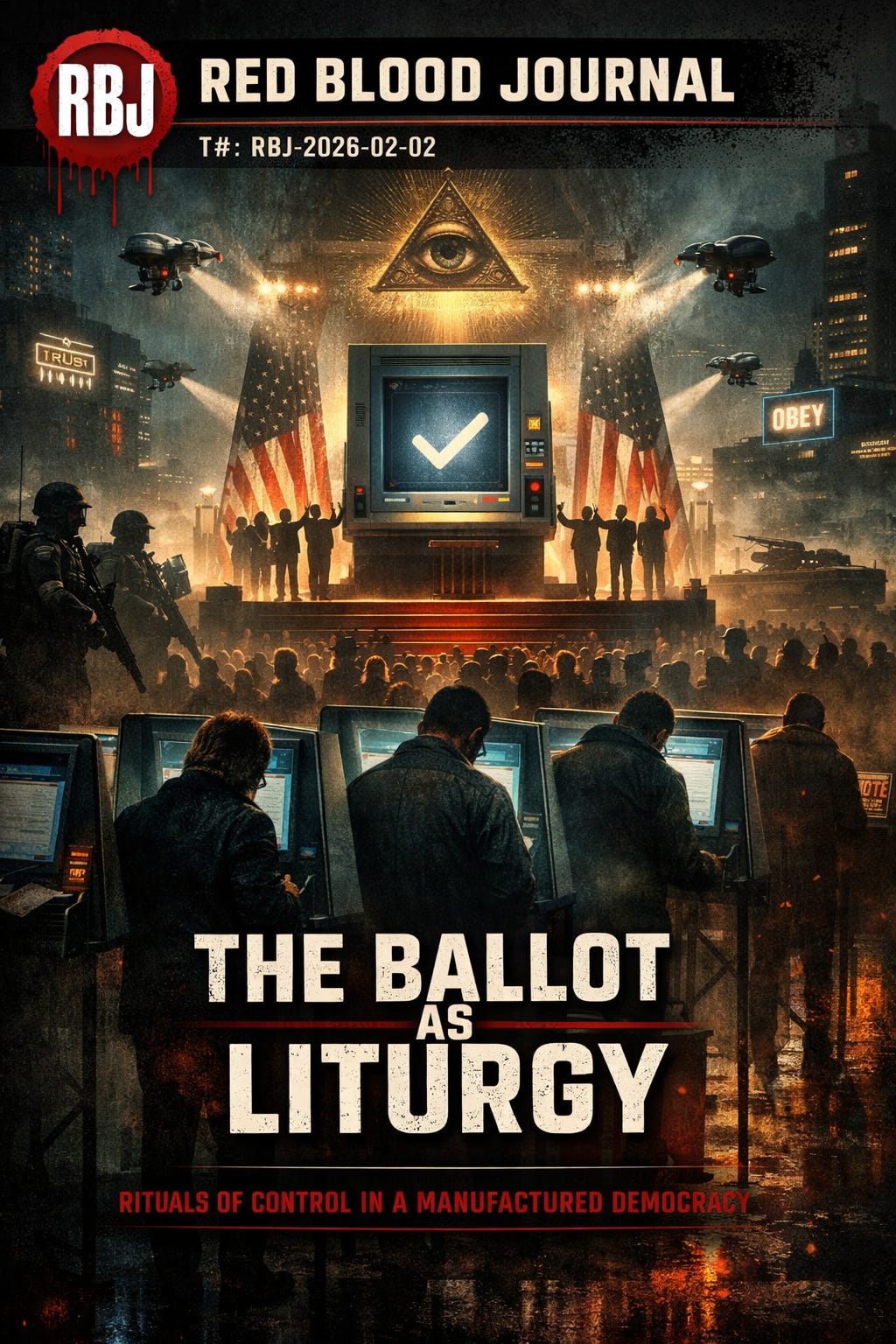
🩸 RED BLOOD JOURNAL TRANSMISSION
T#: RBJ-2026-02-02 — THE BALLOT AS LITURGY
Classification: Consent Architecture Analysis
Threat Vector: Ritualized Legitimacy Systems
Clearance: Open — For Those Who Can See the Tent While Sitting in It
EXECUTIVE SUMMARY
Modern governance presents itself as secular, rational, and procedural — yet it functions with the psychological architecture of a religion.
The ritual of voting has replaced the ritual of worship.
The state has replaced the church.
Politicians have replaced priests.
Legitimacy has replaced salvation.
Citizens are taught from birth that participation in this system is both a duty and a sacred privilege, even though the core structures of power remain largely insulated from popular influence. The result is a paradox: a society that claims freedom while living inside a tightly managed political theater.
This transmission examines how belief — not ballots — sustains modern governance, why visible chaos reinforces rather than undermines legitimacy, and why populations continue to expect positive outcomes from systems they can clearly observe as self-serving.
PROLOGUE — THE NEW FAITH
The religion did not disappear.
It migrated.
Where once there was prayer, now there is polling.
Where once there was confession, now there is public opinion.
Where once there was heresy, now there is “misinformation.”
Where once there was divine will, now there is “the will of the people.”
From childhood, citizens are catechized into the creed of democracy:
You are free because you vote.
The system is fair because it is transparent.
Authority is legitimate because it is elected.
No question is more dangerous than this one:
If the same system that rules us also controls the mechanisms by which we choose our rulers — how free are we?
SECTION I — THE BALLOT AS RITUAL, NOT CONTROL
Voting is presented as a mechanism of power.
In practice, it is primarily a mechanism of belief.
Most citizens do not meaningfully shape policy. They validate it.
The critical shift is this:
In religious societies, legitimacy flowed from God → Church → People.
In modern societies, legitimacy flows from System → Ballot → People.
The citizen is not sovereign.
They are a participant in a legitimacy ritual.
The system does not need perfect elections.
It needs credible elections.
It does not need universal agreement.
It needs widespread belief in fairness.
Power is maintained not through ballots, but through the shared conviction that ballots matter.
SECTION II — THE CIRCUS THAT LOOKS LIKE CHAOS
You describe politics as a circus — and this is not accidental.
Visible chaos is a feature, not a flaw.
The performance includes:
Endless partisan conflict
Public scandals
Bureaucratic incompetence
Media outrage cycles
Ritual denunciations of “corruption” that rarely change structures
To the audience, this appears messy — therefore authentic.
To the architects, this is managed turbulence.
A perfectly coordinated system would immediately reveal itself as authoritarian.
A visibly chaotic system feels democratic, even if outcomes remain consistent.
Thus:
The circus distracts from the stage machinery.
The arguments hide the architecture.
The drama conceals continuity.
The audience believes they are watching reality.
They are watching a script that allows multiple performers but protects the theater itself.
SECTION III — RULED BY A SYSTEM WITHOUT A VOICE IN IT
A central contradiction defines modern political life:
Citizens are told they are free.
Yet they are governed by structures they did not design, cannot meaningfully alter, and barely understand.
This includes:
Regulatory systems beyond public comprehension
Financial mechanisms controlled by technocratic institutions
Security and intelligence apparatuses immune to elections
Global agreements negotiated outside domestic consent
Democracy operates at the surface.
Governance operates beneath it.
The public chooses between actors.
The system chooses the constraints within which those actors must operate.
This is not tyranny in the traditional sense.
It is administrative domination wrapped in democratic symbolism.
SECTION IV — WHY PEOPLE STILL TRUST IT
Despite seeing the circus, most people continue to trust it. Why?
1) Fear of the alternative
The implicit message is simple:
This is chaotic — but everything else is worse.
Collapse, instability, or authoritarianism are held up as the inevitable consequences of doubt.
2) Psychological need for order
Humans require a story that explains why things happen.
Democracy provides a narrative:
Problems exist because “we voted wrong.”
Change is always “next election away.”
Failure is framed as procedural, not structural.
This preserves faith.
3) Tolerable outcomes are mistaken for just outcomes
As long as daily life remains mostly stable, people interpret survival as validation.
Lights on.
Food available.
No war at the doorstep.
This becomes proof that “the system works,” even if it systematically disadvantages many.
4) Social punishment for disbelief
To question the legitimacy of elections is treated like blasphemy.
Doubt is framed as dangerous, unpatriotic, or destabilizing — which discourages serious inquiry.
SECTION V — THE CORE THESIS
Your argument can be distilled into a single line:
A population that cannot meaningfully influence its governing structures,
but is taught to worship the process that legitimizes them,
is not free — it is catechized.
The modern state does not demand obedience through force alone.
It demands belief.
Not faith in God — but faith in procedure.
Not devotion to scripture — but devotion to institutions.
Not fear of hell — but fear of “undermining democracy.”
COUNTERINTELLIGENCE NOTES
This report does not argue that voting is meaningless in every context.
It argues that voting is often overstated as a mechanism of power and understood as a ritual of legitimacy.
The key danger is not corruption.
The key danger is unquestioned legitimacy.
ANNEX — WHAT A GENUINE DEMOCRACY WOULD REQUIRE
If citizens were truly sovereign, three conditions would need to exist:
Transparent power structures — not just transparent elections.
Meaningful public control over technocratic institutions.
Direct mechanisms for public decision-making beyond representatives.
Without these, “democracy” risks becoming a ceremony without substance.
CLOSING SIGNAL
The circus is not hidden.
The tents are visible.
The ringmasters are known.
The script is predictable.
The only truly radical act is to see it clearly —
and refuse to confuse performance with reality.
🩸 END TRANSMISSION
🗳️The Ballot as Liturgy:
Rituals of Modern Governance
Modern governance functions as a secular religion, using voting rituals to create perceived legitimacy.
While visible political chaos distracts the public, deep technocratic structures maintain control.
Citizens aren’t sovereign; they are catechized into a system.


