


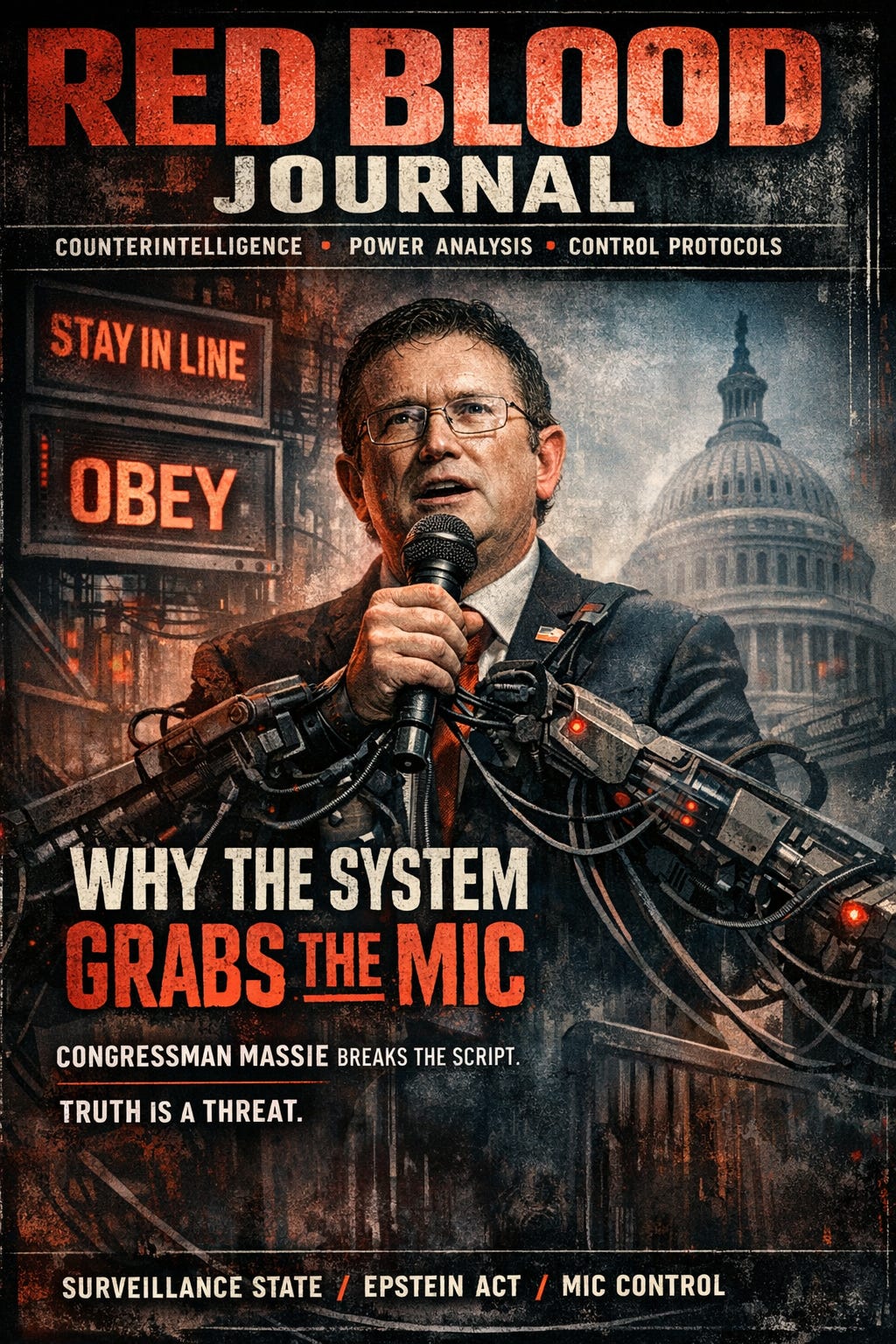
🩸 RED BLOOD JOURNAL TRANSMISSION — COUNTERINTELLIGENCE EDITION
T#: RBJ-2026-MASSIE-MIC
Title: Why the System Reaches for the Microphone
Classification: Threat Assessment / Power Containment / Controlled Dissent
Desk: The Archive of Visible Theater & Hidden Power
PROLOGUE — THE MOMENT THE SOUND BECAME A PROBLEM
In Washington, microphones are never neutral.
They are permission structures.
They are leashes.
They are calibrated instruments of narrative control.
When a microphone is “grabbed,” something more than sound is being interrupted. A boundary has been crossed. A protocol has been violated. A script has been threatened.
What matters is not simply what Thomas Massie said — but why what he said triggered a reflex to control the channel of speech itself.
That reflex is the story.
SECTION I — THE CONGRESSMAN WHO REFUSED TO PLAY THE ROLE
Massie opens with a line that already places him outside the official hierarchy:
“You are a congressman. You work not for the Speaker of the House.”
This is not rhetoric. It is a statement of constitutional orientation — and therefore, a problem.
Modern governance operates on informal chains of obedience:
Speaker → Party → Donors → Intelligence → Executive Power.
Massie’s assertion rejects this architecture. It reframes a Congressman not as a subordinate within a machine, but as a sovereign representative.
That is the first crack in the wall.
SECTION II — THE RECORD THAT MAKES HIM DANGEROUS
Massie proceeds to assemble a portfolio of positions that, taken together, place him outside both wings of managed opposition:
He claims a 100% score from the U.S. Freedom-oriented scorecard — while openly admitting he deviates from his party when it covers for pedophiles, starts wars, or bankrupts the country.
He co-signed an amicus brief to end birthright citizenship by executive fiat — not out of loyalty to the president, but to force Congress to actually legislate.
He forced the Epstein Files Transparency Act through a hostile leadership structure — opposed by Speaker, President, and Senate Majority Leader — yet passed nearly unanimously.
This is not the behavior of a loyal factional player. It is the behavior of a structural disruptor.
Systems do not fear opposition.
They fear independence.
SECTION III — THE OMNIBUS AS A CONTROL MECHANISM
Massie’s discussion of the omnibus bill is more revealing than it first appears.
He describes:
Zoning preemption for AI data centers (a quiet transfer of local power to corporate infrastructure).
Funding mechanisms he frames as ideological slush funds.
Provisions he characterizes as harmful or exploitative.
The key point: he did not oppose the bill to “shut down government.” He opposed it to force his own party to behave differently.
This is where the system becomes uncomfortable.
Dissent from the opposition is expected.
Dissent from inside the machine is treated as betrayal.
SECTION IV — THE PERSONAL ATTACK AND WHAT IT SIGNALS
When Massie recounts attacks on his wife — including a presidential repost — the moment ceases to be personal and becomes structural.
The pattern is familiar:
A dissenter challenges power.
Power responds not with argument, but character assassination.
The attack is routed through media and social networks to normalize it.
This is not politics.
It is enforcement.
It is a reminder of what happens to those who step out of line.
SECTION V — COVID, MONEY, AND THE REAL CRIME
Massie claims he was the lone voice warning that COVID bailouts would cause inflation.
Whether or not one agrees with him, the pattern is consistent with how power operates:
Trillions are deployed at speed.
Dissent is ridiculed in real time.
Years later, consequences are treated as unavoidable rather than designed.
He also accuses his opponent of PPP fraud — not as gossip, but as evidence of a deeper moral inversion:
Those inside the system profit.
Those who warn about it are punished.
SECTION VI — WHY THE MIC GETS GRABBED
The demand to seize or cut Massie’s microphone is not about decorum.
It is about containment.
A microphone is not merely amplification.
It is access to the public mind.
When someone inside the apparatus begins to narrate how the apparatus actually works — how bills are structured, how power retaliates, how corruption hides in language — the system reacts physically.
Silence becomes a security measure.
SECTION VII — THE DEEP PATTERN
From a Red Blood Journal perspective, Massie is not a hero or villain. He is a signal.
He represents a recurring archetype in modern power systems:
Allowed to exist.
Marginalized when inconvenient.
Attacked when effective.
Isolated when too truthful.
But never fully eliminated — because the system needs the illusion of dissent.
The mic grab is not random.
It is ritual.
A small drama that reassures everyone watching that real boundaries still exist.
ANNEX — COUNTERINTELLIGENCE NOTES
Systems rarely fear ideas; they fear credibility combined with independence.
Leadership structures prefer compliant critics over unpredictable allies.
Transparency victories (like the Epstein Act) are often celebrated publicly while quietly resented internally.
When power cannot defeat an argument, it controls the platform.
CLOSING
The question is not: Why did they want to grab the mic?
The deeper question is:
How many other microphones are already silently controlled?
🎙️The Architecture of Controlled Dissent and the Silenced Microphone
This text analyzes the political career of Thomas Massie through the lens of institutional control and managed dissent.
It argues that governing systems utilize narrative containment to neutralize officials who prioritize constitutional independence over party loyalty.
By highlighting Massie’s challenges to legislative corruption and his success with transparency initiatives, the source frames his opposition as a threat to established power structures.
The author suggests that when a politician reveals the internal mechanics of government manipulation, the system responds with character assassination and censorship.
Ultimately, the narrative portrays the physical act of silencing a representative as a symbolic ritual intended to maintain the illusion of order while protecting hidden interests.


