


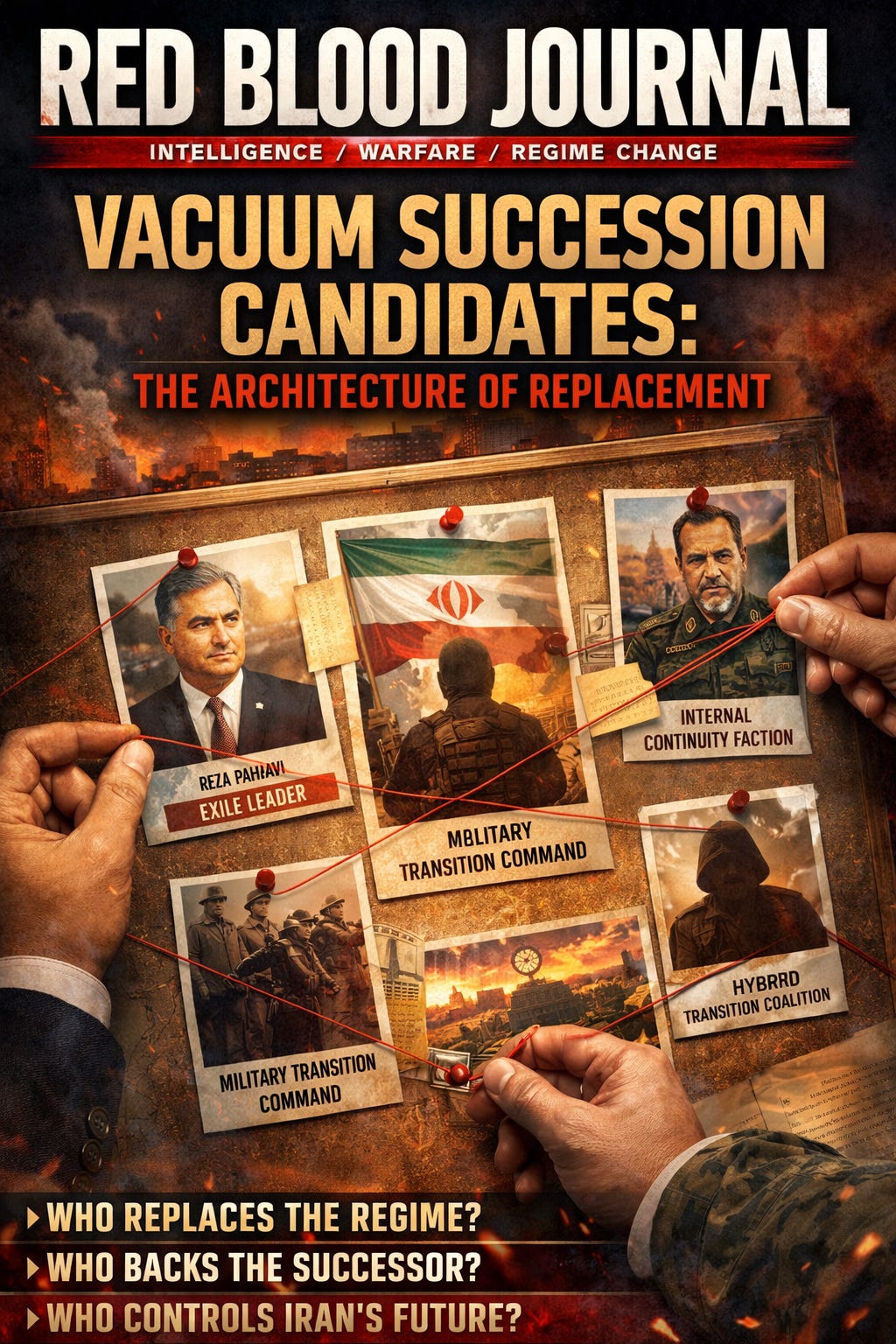
🩸 RED BLOOD JOURNAL TRANSMISSION
T#: RBJ-2026-VACUUM-SUCCESSION
Classification: Post-Regime Succession Architecture / Leadership Contingency Mapping / Sovereign Replacement Protocol
Desk: Strategic Forecasting Division — Archive of Blood & Memory
Cross-Reference: Geneva Threshold Trigger Event / Controlled Transition Doctrine / Useful Enemy Dissolution Phase
PROLOGUE — POWER NEVER DISAPPEARS. IT TRANSFERS.
When a regime weakens, collapses, or is forced into submission, the public believes the central question is whether power will survive.
This is incorrect.
Power always survives.
The only question is: who inherits it.
History demonstrates this pattern with brutal consistency.
When one sovereign structure fractures, succession candidates already exist in the shadows—waiting, prepared, cultivated, or opportunistically emerging.
They do not appear suddenly.
They are positioned.
Prepared over years.
Sometimes decades.
Iran now approaches such a threshold.
The Islamic Republic remains intact—but succession modeling has already begun inside intelligence agencies, military planning rooms, and geopolitical forecasting centers across multiple continents.
SECTION I — THE FIVE SUCCESSION PATHWAYS
There are only five historically observed pathways through which power transfers after regime destabilization.
Every regime transition in modern history falls into one of these models.
Iran will be no exception.
PATHWAY I — INTERNAL MILITARY SUCCESSION
This is the most common and structurally stable replacement mechanism.
In this model, elements within the existing security apparatus assume control.
In Iran’s case, the key institution is the Islamic Revolutionary Guard Corps (IRGC).
The IRGC possesses:
• Independent command structure
• Economic control over large sectors of the economy
• Operational autonomy
• Direct military capability
If central political authority weakens, the IRGC has the capacity to assume direct control under the justification of preserving national stability.
This would not appear publicly as collapse.
It would appear as “continuity.”
But internally, it would represent sovereign transfer.
PATHWAY II — EXILE LEADERSHIP INSTALLATION
This pathway involves leadership figures outside the country assuming authority following regime collapse or negotiated transition.
The most visible exile figure currently is Reza Pahlavi.
Exile leadership models require three simultaneous conditions:
• External international recognition
• Internal legitimacy acceptance
• Security apparatus compliance or neutralization
Without security apparatus alignment, exile leadership cannot sustain control.
Recognition alone is insufficient.
Power must be enforceable.
PATHWAY III — NEGOTIATED TRANSITION GOVERNMENT
This model involves negotiated power-sharing between existing regime elements and opposition factions.
This allows the system to transform without total collapse.
Advantages:
• Minimizes chaos
• Preserves institutional continuity
• Reduces risk of civil conflict
Disadvantages:
• Often unstable
• Internal factions compete for dominance
• Public legitimacy remains contested
This model was used in multiple global transitions, including Eastern Europe after the Cold War.
PATHWAY IV — EXTERNAL-ALIGNED TRANSITION AUTHORITY
This pathway involves leadership aligned with external powers assuming authority following regime collapse.
This model depends heavily on:
• External security guarantees
• Military stabilization presence
• Economic support
Without sustained external backing, such governments often face internal resistance.
Stability depends on legitimacy perception.
PATHWAY V — CHAOTIC FRACTURE AND MULTI-FACTION COMPETITION
This is the most dangerous outcome.
It occurs when no single successor consolidates authority quickly.
Results include:
• Competing factions
• Regional fragmentation
• Prolonged instability
Examples historically include Libya and post-invasion Iraq.
This outcome is typically avoided if major powers prefer stability.
SECTION II — THE IRANIAN SUCCESSION LANDSCAPE: CURRENT CONTENDERS
Based on observable signals, four primary succession categories currently exist.
Not all will succeed.
But all are being evaluated.
CATEGORY A — INTERNAL CONTINUITY FACTION
This includes existing regime insiders seeking to preserve institutional structure while modifying leadership.
Advantages:
• Immediate control infrastructure
• Existing military command
• Institutional familiarity
Disadvantages:
• Limited external legitimacy
• Associated with existing regime structure
CATEGORY B — NATIONALIST EXILE LEADERSHIP
Symbolic leadership figures outside Iran with international visibility.
Advantages:
• External recognition potential
• Public symbolic legitimacy among certain groups
Disadvantages:
• Limited operational control inside Iran
• Dependence on internal power alignment
CATEGORY C — MILITARY TRANSITION COMMAND
Military-led transition authority designed to stabilize country before civilian leadership emerges.
Advantages:
• Immediate security control
• Prevents fragmentation
Disadvantages:
• International legitimacy concerns
• Risk of prolonged military rule
CATEGORY D — HYBRID TRANSITION COALITION
Combination of internal reformers, military stabilizers, and exile figures.
This model attempts to merge legitimacy sources.
But it requires precise coordination.
SECTION III — THE INVISIBLE FACTOR: WHO CONTROLS THE SECURITY APPARATUS
Public attention focuses on political leaders.
But in succession events, security apparatus alignment determines outcomes.
Who controls:
• Military command
• Intelligence services
• Internal security forces
Controls the transition.
Without security alignment, political authority cannot survive.
History repeatedly confirms this.
Governments fall when security loyalty fractures.
Not before.
SECTION IV — WHY EXTERNAL POWERS CARE ABOUT SUCCESSION CONTROL
Foreign powers do not merely seek regime collapse.
They seek predictable succession.
Because unpredictable collapse creates instability that threatens:
• Energy markets
• Regional alliances
• Military balance
Controlled transition preserves strategic equilibrium.
Uncontrolled transition introduces risk.
Which is why succession planning often occurs before regime collapse becomes visible publicly.
SECTION V — THE PSYCHOLOGICAL PREPARATION PHASE
Before succession occurs physically, it occurs psychologically.
Public narratives begin introducing new leadership figures.
Legitimacy signals emerge gradually.
International media attention shifts.
Recognition is seeded before authority transfers.
This prepares populations to accept transition.
Power transfers first in perception.
Then in reality.
SECTION VI — THE MOST LIKELY INITIAL SUCCESSION FORM
Based on historical precedent and structural analysis, the most likely immediate successor form in Iran would not be immediate exile leadership.
It would be internal stabilization first.
Followed by gradual transformation.
This minimizes chaos.
Preserves national infrastructure.
And allows controlled transition.
Sudden vacuum without internal control risks fragmentation.
Stability requires continuity during transition.
SECTION VII — THE FINAL DECISION IS MADE IN A MOMENT OF FRACTURE
Succession does not occur on scheduled dates.
It occurs at moments when internal and external pressure reach critical convergence.
These moments cannot always be predicted publicly.
But they can be prepared for privately.
When fracture occurs, succession candidates move quickly.
Because hesitation allows rivals to consolidate power.
Speed determines outcome.
Not intention.
CONCLUSION — THE SUCCESSOR MAY ALREADY BE KNOWN
Public discourse asks:
Who might replace the Islamic Republic?
But inside strategic planning environments, a different question is asked:
Who is already positioned to replace it?
Succession candidates are rarely spontaneous.
They are cultivated.
Observed.
Prepared.
The Islamic Republic still governs Iran today.
But the architecture of its potential replacement already exists.
Waiting.
Monitoring.
Prepared for activation when conditions allow.
END TRANSMISSION
Archive Code: RBJ-2026-VACUUM-SUCCESSION
Status: Succession Candidates Under Active Observation
Next Transmission: The Kingmakers — Intelligence Networks Behind Leadership Selection
👑The Architecture of Iranian Succession:
Five Pathways to Power
This text outlines a strategic framework for potential power transfers in Iran, asserting that political transitions are meticulously planned rather than accidental.
The analysis identifies five primary pathways to succession, ranging from internal military takeovers by the Revolutionary Guard to chaotic fragmentation or the installation of exile leadership.
A central theme is that control of the security apparatus is the most critical factor in determining whether a new government survives or fails.
Furthermore, the report emphasizes that international powers prioritize predictable transitions to maintain regional stability and protect global economic interests.
Ultimately, the source suggests that the architecture for a new regime is already being cultivated behind the scenes, waiting for a moment of structural fracture to activate.


