


🩸 RED BLOOD JOURNAL — TRANSMISSION
T#POVERTY–COVER–OP–METRICS
Title: THE $31,000 LIE: HOW WAR, DEBT, AND STATISTICS ERASED AMERICAN POVERTY FROM SIGHT
Classification: Political-Economic Systems Analysis
Method: Conspiracy Lens (Structural Incentives, Narrative Control)
Distribution: Restricted
PROLOGUE — THE NUMBER THAT KEEPS THE PEACE
The government says poverty is $31,000.
The country says the economy is “strong.”
The media says inflation is “cooling.”
The charts say “growth.”
And yet millions feel broke, trapped, exhausted—working more, owning less, delaying families, deferring life.
This is not mass delusion.
It is measurement warfare.
I. THE ORIGINAL SIN — FREEZING POVERTY IN 1963
In the 1960s, the U.S. government commissioned Molly Orshansky to define poverty.
Her assumptions were true then:
One income supported a family of four
Food was the largest household expense
Healthcare was employer-covered
Childcare was unpaid labor at home
Housing was cheap relative to wages
So the government did something simple:
Minimum food cost × 3 = poverty line
That formula worked—for that world.
Then the world changed.
The formula did not.
II. THE UPDATE THAT NEVER CAME — BECAUSE IT COULDN’T
Over the next 50 years:
Food shrank to 5–7% of household spending
Housing became the largest burden
Healthcare exploded to 15–20% of income
Childcare became a second mortgage
Insurance became mandatory
Student debt metastasized
Two incomes became survival, not advancement
Economists flagged the problem—repeatedly.
Governments attempted revisions—quietly.
Each time, the same realization emerged:
Updating poverty would expose a national emergency.
Because if poverty were recalculated honestly, tens of millions would fall below it overnight.
And that would mean:
More assistance obligations
Larger deficits
Admission of policy failure
Exposure of war-financed extraction
Political accountability
So instead of changing the formula, they inflated the old number and called it progress.
III. THE $140,000 RECKONING — WHAT THE FORMULA REALLY SAYS
When the original logic is applied to modern realities, the result is explosive.
Two methods converge on the same truth:
Method 1: Ratio Reality
If food is now ~6% of spending, the multiplier is no longer 3—it’s 16.
$10,000 food × 16 = $160,000
Method 2: Cost Aggregation
Add unavoidable basics for a family of four:
Modest housing
Basic healthcare
Bare-minimum childcare
Transportation
Food
Taxes
The result:
~$118,000 net
~$136,500 gross
This is not luxury.
This is keeping afloat.
Meanwhile, the U.S. median household income sits near $80,000—with two earners.
The second income doesn’t build wealth.
It pays for the childcare that enables the second income.
That is not progress.
That is a labor treadmill.
IV. THE WAR DIVIDEND — HOW POVERTY FUNDED EMPIRE
For fifty years, the United States financed:
Endless foreign wars
Global military basing
Intelligence expansion
Financial bailouts
Corporate subsidies
While simultaneously delivering:
Tax cuts upward
Cost transfers downward
Privatized essentials
Socialized losses
This required one condition:
The public must never know how poor it actually is.
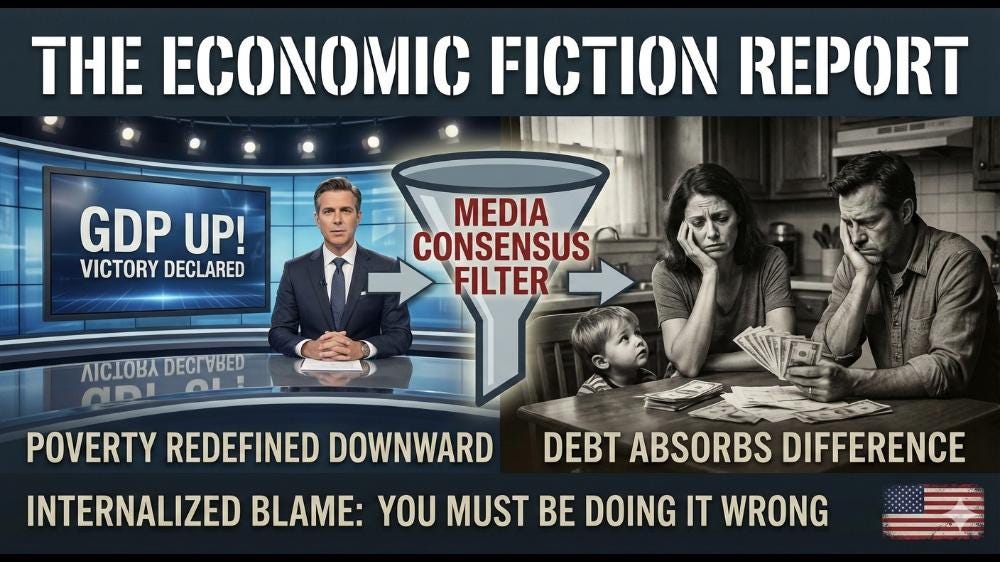
So poverty was redefined downward, while costs were pushed upward.
War consumed the surplus.
Debt absorbed the difference.
Statistics buried the evidence.
V. MEDIA SILENCE — THE CONSENSUS FILTER
Why isn’t this headline news?
Because modern media doesn’t investigate structural theft.
It manages sentiment.
GDP looks good → story approved
Inflation “slows” → victory declared
Unemployment low → system validated
What’s never asked:
Can a family live?
Can it save?
Can it buy shelter?
Can it raise children?
Those questions destabilize the narrative.
So they are filtered out.
VI. THE PSYCHOLOGICAL OP — “YOU MUST BE DOING IT WRONG”
The most effective part of the operation is internalized blame.
When official numbers say you’re fine—but you’re struggling—you assume:
You’re irresponsible
You didn’t hustle enough
You missed the trick
You failed personally
This keeps anger horizontal, not vertical.
It prevents systemic reckoning.
The system doesn’t look broken.
You do.
That is the lie.
VII. THE FINAL COVER — “INVEST AND YOU’LL BE FINE”
The closing escape hatch is always the same:
“Just invest. Just compound. Just be disciplined.”
But investing assumes surplus.
When survival costs eat income, investment becomes mythology.
Ownership is real—but it cannot substitute for a rigged baseline.
A nation cannot ETF its way out of structural impoverishment.
VIII. THE REAL POVERTY — AND WHY IT MUST STAY INVISIBLE
Modern American poverty is not destitution.
It is permanent precarity.
Always working
Never secure
Always one bill away
Always told the economy is “strong”
This condition is useful:
It disciplines labor
It suppresses revolt
It sustains empire
It hides war costs
It preserves legitimacy
And it only works if the number stays low.
EPILOGUE — THE QUESTION THEY DON’T WANT ASKED
If the poverty line were honest…
If the metrics reflected reality…
If war costs were internalized…
If extraction were visible…
Then the myth would collapse.
This transmission does not say the poverty line is exactly $140,000.
It says $31,000 is a deliberate fiction.
And that fiction is the quietest weapon of all.
🩸 END TRANSMISSION
The provided text argues that the true extent of economic hardship is deliberately concealed through a system of “economic fiction,” where official statistics like Gross Domestic Product (GDP) and the poverty line are manipulated to present a false image of prosperity.
The author explains that methods such as redefining poverty downward and using debt to absorb financial differences prevent the public from realizing how poor it truly is, while war costs are simultaneously kept hidden. Furthermore, the modern media acts as a “consensus filter,” focusing on positive metrics while ignoring crucial questions about a family’s ability to survive, save, or secure shelter.
This narrative is reinforced by a “psychological op” that encourages individuals to assume personal failure rather than recognizing systemic theft, maintaining a state of permanent precarity that ultimately benefits the prevailing power structure.


