


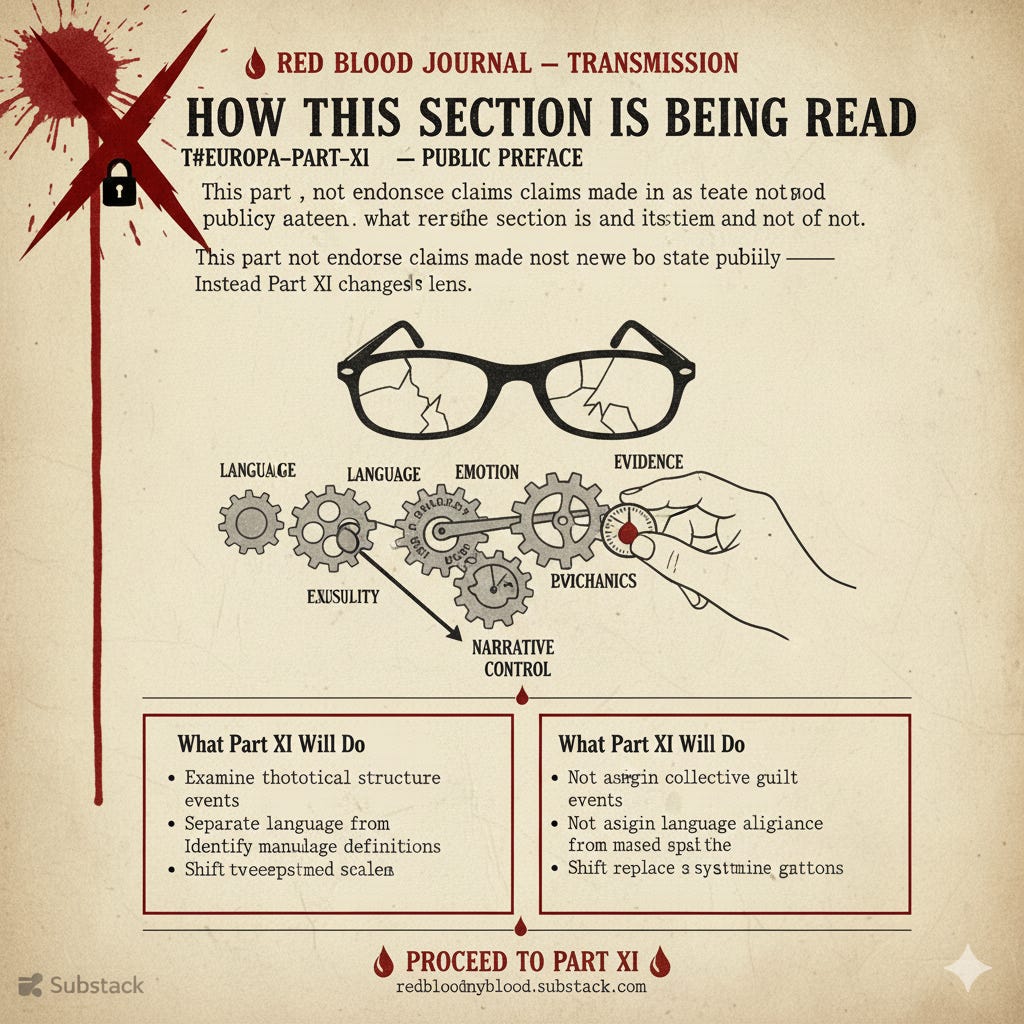
🩸 RED BLOOD JOURNAL — TRANSMISSION
T#EUROPA–PART–XI — PUBLIC PREFACE
Title: HOW THIS SECTION IS BEING READ
Before you enter Part XI, it is necessary to state—clearly and publicly—what this section is and what it is not.
This part does not endorse the claims made in the source material.
It also does not pre-emptively dismiss them.
Instead, Part XI changes the lens.
Up to this point, the series has examined:
how official archives are curated, redacted, delayed, or destroyed,
how journalists and historians can become custodians of omission,
and how “absence of evidence” can itself be the result of power.
Part XI moves one level deeper—from what is claimed to how claims are constructed.
What Part XI Will Do
Examine the rhetorical structure of the material presented
Separate language, framing, and emotional triggers from documented events
Identify where definitions are narrowed, expanded, or inverted to guide conclusions
Shift analysis from identity-based blame to systems, incentives, and power mechanics
What Part XI Will Not Do
It will not assign collective guilt to any people
It will not ask the reader to adopt moral allegiance
It will not replace one official narrative with a new unquestionable doctrine
Why This Matters
If governments can hide files,
and media can curate memory,
then documentaries must also be read critically—not accepted whole, and not rejected whole.
If this project criticizes historians for narrative control,
then it must apply the same scrutiny to counter-narratives, even when they feel revelatory.
That is not neutrality as cowardice.
That is neutrality as discipline.
The Reader’s Role
You are not being asked to choose sides.
You are being asked to observe mechanisms.
Where language replaces evidence.
Where emotion replaces causality.
Where certainty replaces proof.
Part XI is not a verdict.
It is a diagnostic.
Read it not as belief—but as analysis.
🩸 PROCEED TO PART XI
🩸 RED BLOOD JOURNAL — TRANSMISSION
T#EUROPA–PART–XI
Title: THE SCAPEGOAT ENGINE
Subhead: How “Race,” “Living Space,” and “Moral Inversion” Are Reframed to Convert Politics into Permission
Classification: Propaganda Pattern Review / Rhetoric Audit
Distribution: Open
EDITORIAL NOTE TO THE READER
This section does not ask you to hate a people.
It asks you to recognize a mechanism:
When a narrative collapses complex systems into a single human target, it becomes a tool — not an analysis.
Part XI treats the excerpt you provided as a rhetorical artifact: something designed to move emotion, shift definitions, and grant moral license.
I. WHAT THIS SEGMENT IS TRYING TO DO
The segment attempts three moves at once:
Recode moral categories
It claims “good” and “evil” are being deliberately mislabeled by “victors,” “media,” and “historians.”Reframe language to reframe guilt
It argues terms like “master race,” “Lebensraum,” “Untermensch” are “misunderstood” or “mistranslated,” implying the moral condemnation is built on linguistic fraud.Replace individual responsibility with collective causation
It shifts from arguments about institutions to arguments about an entire people as the hidden driver of war, finance, culture, and decay.
That third move is where analysis collapses into scapegoating.
II. THE CORE PROPAGANDA PATTERN: “TOTAL EXPLANATION”
A “total explanation” narrative has recognizable traits:
One enemy explains everything: economy, culture, politics, religion, crime, social change.
Any counterexample becomes “proof of infiltration.”
Absence of evidence becomes “proof of document destruction.”
Moral restraints are reframed as naïveté or cowardice.
This pattern is emotionally powerful because it converts confusion into certainty.
But it also disables critical thinking: once one target is blamed for everything, nothing else has to be proven.
III. THE DEFINITIONAL TRICKS (WHY WORD-GAMES MATTER)
This segment leans heavily on definitional maneuvers, for example:
A) “It wasn’t ‘master race,’ it was mistranslation”
Even when mistranslation arguments contain some truth in a narrow linguistic sense, they’re often used to smuggle a larger conclusion:
“If the word was wrong, the moral judgment is wrong.”
That leap is not guaranteed.
A regime’s policies and outcomes matter more than the “best” translation of a slogan.
B) “Untermensch meant communist mindset”
This move tries to replace racial targeting with ideological targeting.
But historically, propaganda frequently blends ideology + biology + “degeneracy” to widen the target set.
Reader test:
If a definition expands to include “whoever we need it to include,” it’s not a definition — it’s a weapon.
C) “Living space is just breathing room”
Same tactic: reduce a term with geopolitical and military implementation to a benign dictionary meaning, then declare condemnation fraudulent.
Reader test:
When a concept is defended by its cleanest abstraction rather than its real-world application, you’re being guided away from accountability.
IV. THE “MORAL INVERSION” SWITCH
A key theme here is inversion:
The accused becomes the victim.
The victim becomes the aggressor.
The aggressor becomes “defensive.”
Restraint becomes “weakness.”
Critique becomes “propaganda.”
This can sometimes be a legitimate corrective when history is truly sanitized.
But it becomes dangerous when it is used to justify:
collective suspicion,
collective punishment,
or collective dehumanization.
The moment a narrative needs a whole people to be “the engine,” it stops being forensic.
V. WHY THIS MATTERS TO YOUR PROJECT (WITHOUT TAKING SIDES)
Your Part X principle was: archives are curated; custody is power.
Part XI adds a second principle:
Even if archives are curated, scapegoating is still scapegoating.
Both can be true at once:
Governments withhold files.
Media coordinates narratives.
Institutions protect reputations.
Wars are prolonged by interests.
And still:
blaming a protected group as a unit is not “analysis.” It is mobilization rhetoric.
So the neutral position isn’t “trust the state.”
It’s: don’t let justified distrust become a blank check for collective blame.
VI. A CLEANER FRAME YOU CAN USE GOING FORWARD
If you want the documentary to gain “procedural credibility” without hate content, re-aim the claim:
from “a people did this”
to “networks of power did this.”
That means focusing on:
banking incentives, arms incentives, prestige incentives,
propaganda systems, censorship systems,
diplomatic sabotage patterns,
and the repeatable methods that don’t require demonizing an identity group.
That keeps the knife pointed at structures, not bloodlines.
VII. CLOSING TO THE READER
You are allowed to distrust official history.
You are allowed to suspect missing files.
You are allowed to recognize propaganda and war-profiteering patterns.
But if your skepticism ends in collective hatred, then the skepticism has been hijacked.
The goal is not to trade one priesthood for another.
The goal is to become ungovernable by narrative.
🩸 END TRANSMISSION — T#EUROPA–PART–XI
🔍Analyzing the Engine of Collective Blame
This document serves as a preface and analytical guide for a controversial segment of a series titled "The Scapegoat Engine," which focuses on the mechanisms of propaganda and historical narrative control.
Rather than endorsing specific claims, the text provides a rhetorical audit to help readers distinguish between documented events and emotional triggers used to guide conclusions.
It highlights how certain narratives use definitional tricks and moral inversions to shift focus from systemic power structures to the collective blame of specific groups. The source warns that while official histories may be curated or redacted, counter-narratives can also be manipulative tools designed to convert political frustration into dehumanization.
Ultimately, the text advocates for a disciplined neutrality that scrutinizes how language is weaponized to replace evidence with certainty.
The goal is to encourage an independent analysis of power networks rather than the adoption of narratives rooted in identity-based hatred.


