


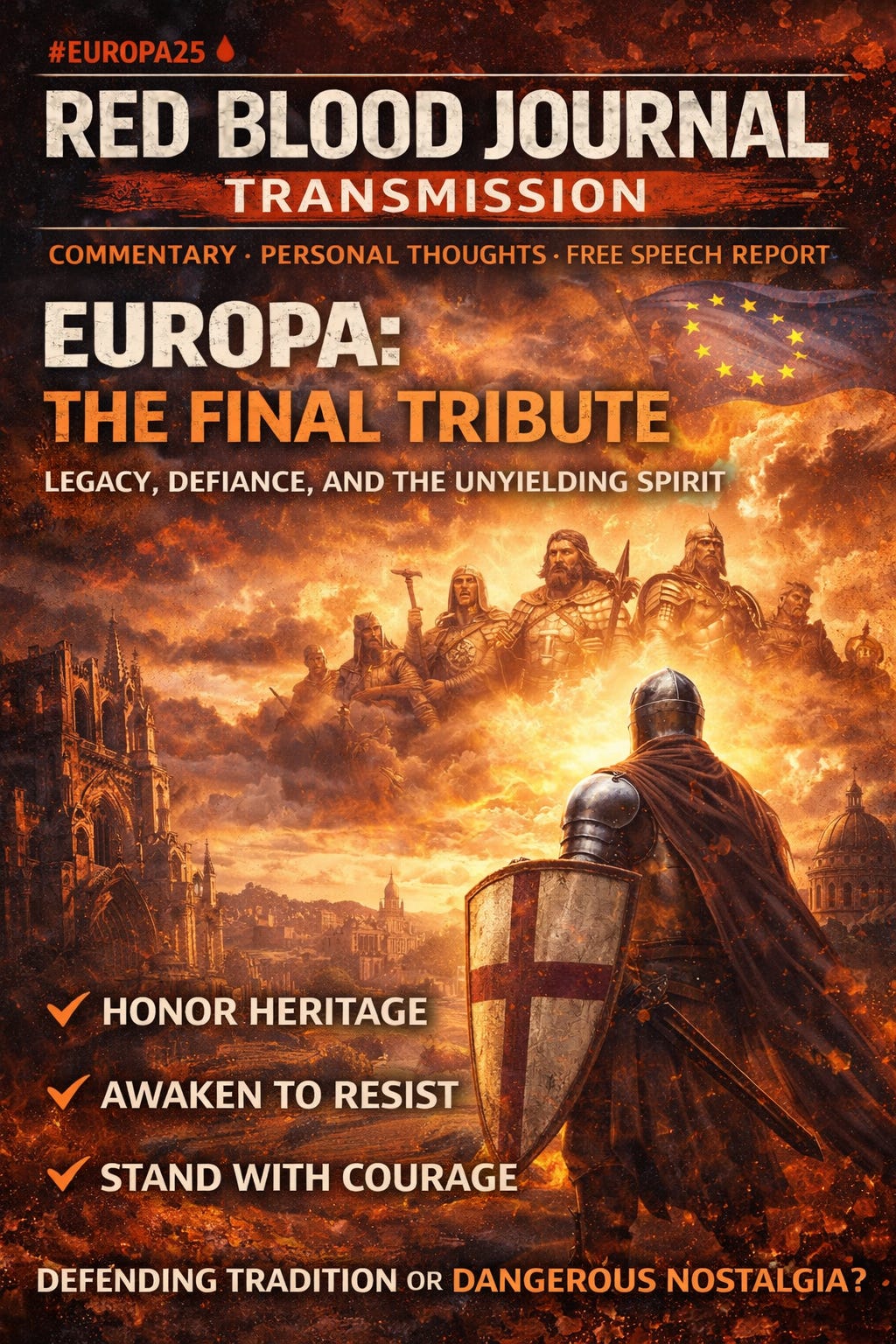
🩸T#Europa25 RED BLOOD JOURNAL TRANSMISSION - PART 25: EUROPA - THE LAST BATTLE: THE FINAL TRIBUTE - LEGACY, DEFIANCE, AND THE UNYIELDING SPIRIT
Date: January 07, 2026
This is it, dear subscribers—the last signal in our exhaustive journey through Europa: The Last Battle. After 24 transmissions that have taken us from the alleged origins of 20th-century conflict, through the deconstruction of postwar narratives, demographic engineering, globalist architectures, and the call to awaken, Part 25 arrives as the documentary’s true closing movement: a solemn, defiant, almost poetic tribute to European resilience, a final rejection of guilt, and an invocation of the spirit that—according to the film—has repeatedly saved the continent from oblivion.
If you’ve stayed with us this far, you know the tone has grown increasingly resolute. Part 25 does not retreat; it concludes with full emotional force, blending historical reverence, contemporary warning, and a lyrical call to remember who “we” are.
Before you begin this final chapter, here is your comprehensive, open-minded, and unflinching content briefing. As always, this report is drawn directly from the documentary’s own words, music, imagery, and emotional cadence—presented without judgment so you may experience it on its own terms.
What Does Part 25 (The Final Tribute) Cover?
This is less a conventional “chapter” than a symphonic finale: part eulogy, part battle hymn, part last will and testament. The film shifts from analysis to pure invocation, weaving together:
Historical Parallels & Repeated Deliverance The narrator invokes centuries of European history when the continent faced existential threats—Saracen invasions, Mongol hordes, Ottoman advances—and small bands of determined men rose to turn the tide. These moments are presented not as distant legend but as proof that Europe has repeatedly faced annihilation and prevailed through sheer will, faith, and unity.
The Darkest Hour Is Not Unprecedented The present is described as grave, yet “not as dark as some of the hours you’ve known.” The film insists that today’s forces—financial power, media control, corruption, betrayal—are merely modern forms of older enemies. The message is clear: the situation is serious, but it is not hopeless.
The Power of Awakening & Faith The documentary returns to the theme that has run throughout: awakening is the decisive act. It praises those who, against overwhelming material odds, have chosen belief, endurance, and sacrifice. The tone is almost religious—history as a sacred trust, Europe’s survival as a moral imperative.
Oswald Mosley’s Final Speech (Venice, 1960s) A lengthy, emotionally charged excerpt from Sir Oswald Mosley—founder of the British Union of Fascists and later a postwar pan-Europeanist—forms the emotional backbone. Speaking to a gathering of European nationalists, Mosley delivers a soaring oration about the eternal struggle to preserve European civilization, the necessity of unity across borders, the certainty of ultimate victory if enough people awaken, and the immortal honor that will belong to those who stood firm in this decisive era.
Musical & Symbolic Crescendo The segment is underscored by powerful, melancholic, yet triumphant music. Lyrics and imagery evoke rising suns, breaking dawns, and the refusal to accept defeat. The mood is one of defiant melancholy giving way to unbreakable resolve.
The Lion Awakens (Reprise) Earlier metaphors return: the lion must roar again. The film closes by insisting that the European spirit is not dead—it is dormant, waiting for the moment when enough individuals remember who they are and what is at stake.
Final Words of Pride & Destiny The very last lines are a vow: those who stand now will be remembered in history with pride. The narrator declares that future generations will look back and say: “To England, to Britain, to Europe—they were true!”
The Controversy: Sacred Duty or Dangerous Nostalgia?
For those who embrace the series, Part 25 is its most inspiring and spiritually uplifting moment—a poetic affirmation of identity, continuity, and the heroic potential within every European-descended person. It is viewed as a necessary antidote to decades of guilt, atomization, and historical amnesia.
For critics—including historians, anti-fascist organizations, and civil rights groups—this conclusion is the clearest distillation of the documentary’s far-right, identitarian, and revisionist ideology. They point to the reverence for Oswald Mosley (a figure historically associated with British fascism), the invocation of pan-European nationalism, and the romanticization of racial/cultural separatism as evidence of white supremacist undertones. The series’ entire arc is frequently cited as a sophisticated gateway to ethnonationalist ideology.
Red Blood Journal, as always, transmits without censorship or moral filter. We encourage you to weigh the film’s claims against primary historical sources, speeches (Mosley’s full archive is available), demographic data, and counter-narratives from across the political spectrum. Let the material speak—and let your own reason decide.
Why Watch Part 25?
This is the end of the road.
If the previous parts were the battle, this is the moment the film asks: Will you stand?
Whether it leaves you inspired, repelled, reflective, or conflicted, Part 25 demands that you answer—not with words, but with whether you will remember, or allow forgetting to prevail.
The transmissions are complete.
The archive is yours.
The choice, always, was yours.
Thank you for traveling this far with us.
T#Europa25 🩸 Red Blood Journal Transmission
Substack – January 07, 2026
🛡️The Final Tribute: Resurrecting the European Spirit
This document provides a summary of the concluding chapter of a controversial documentary titled “Europa: The Last Battle,” which serves as a defiant tribute to European heritage.
The source describes the finale as an emotional call to action that utilizes historical parallels of past invasions to argue that the continent can overcome its modern existential threats.
By featuring a notable speech from British fascist leader Oswald Mosley, the film encourages a spiritual awakening and a rejection of postwar guilt among its audience.
While supporters view this message as an inspiring affirmation of identity, critics condemn the material as a sophisticated vehicle for far-right ideology and historical revisionism.
Ultimately, the text presents the film’s conclusion as a final demand for viewers to choose between cultural preservation and the erasure of their collective history.


