


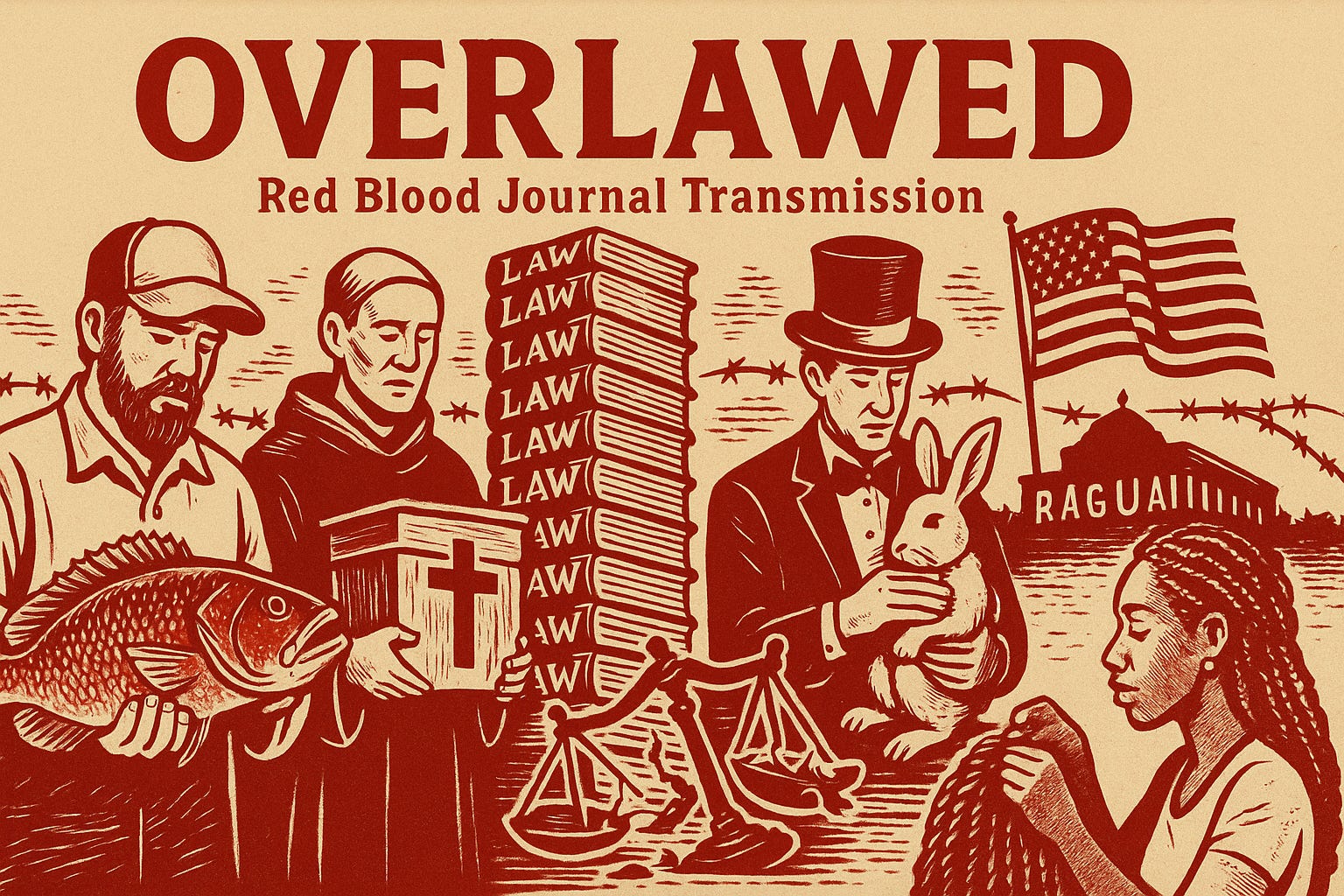
🩸 RED BLOOD JOURNAL TRANSMISSION
T#112225–OVERLAWED “OVERLAWED: HOW THE REGIME TURNED EVERYONE INTO A SUSPECT”
Origin Node: Reagan Library, Simi Valley – “Civility” Theater / Administrative State Cathedral
They gathered under Reagan’s smiling portrait to say the quiet part almost out loud.
Flags, pledges, polite applause, mentions of “civility” and “democracy,” a retired singer-celebrity in the front row, and a Supreme Court Justice on stage to sell a book about “The Human Toll of Too Much Law.”
Translation:
The Empire has finally produced a judge who will admit, in public, that the legal machine has metastasized into a weapon aimed squarely at the people it claims to protect.
But listen closely to how they say it.
And what they won’t say.
Because inside the Reagan Library that night, between the stories and the jokes, they sketched out the blueprint of the cage we all live in:
Too many laws.
Too many crimes.
Too many regulators.
Too many lawyers.
And no accident that it all exploded after 1970 – right when the post-war “middle class experiment” needed to be walked back and re-contained.
This is not just a legal talk.
It’s a confession of how a system manufactures crime, dependency, and obedience by design.
I. The Shrine of “Civility” and the Empire of Law
The setting matters.
Ronald Reagan Presidential Library.
A temple of “informed patriotism,” “civility,” and “democracy” – their words, not mine. A board chairman boasting of a “Center on Civility and Democracy,” promising that Americans can “disagree without villainizing each other” while the same system quietly criminalizes the lives of ordinary people.
The host frames Justice Neil Gorsuch as part of the “Reagan legacy”:
Clerk to Justice Kennedy (Reagan appointee).
Later a Justice himself, sitting alongside the man he’d once clerked for.
Connected lineage: Reagan → Kennedy → Gorsuch / Kavanaugh.
In other words: the Reagan project didn’t end in 1989.
It lives on in the structure of the Court, in the doctrines that bless the administrative state with a robe and a Latin phrase.
And what is Gorsuch’s new book?
“Overruled: The Human Toll of Too Much Law.”
On the surface: a sober legal critique.
Underneath: a system insider admitting that something monstrous has been built – but still selling the idea that the fix is “better civics,” “more involvement,” “local solutions,” while the machine grinds on untouched.
II. Law Explosion: From Slim Volume to Wall of Control
Gorsuch describes the change in almost clinical terms, but the implications are nuclear.
At the founding, he says, all federal laws could fit in one slim book.
Even 100 years ago, still manageable.
Today? The U.S. Code occupies an entire wall in his office.
Congress is adding 2–3 million new words of law every year.
Then he opens the second trapdoor:
The Federal Register – where agencies publish rules – used to be ~20 pages a year in the 1930s.
Now it runs 60,000–70,000 pages every year.
That’s just what’s published. Some rules never fully surface.
Nobody even knows how many federal crimes exist:
In 1982, DOJ tried to count them and gave up around 3,000.
Since then, the code has doubled in length.
Current estimates: 5,000+ federal crimes in statutes.
Plus an estimated 300,000 more “crimes” buried in agency regulations.
Read that again.
You are living in a legal minefield no one has fully mapped.
And then the line that should have stopped the room cold:
70% of adult Americans have committed an imprisonable offense.
Some scholars say if you’re over 18, you’ve probably committed a federal felony.
That is not “rule of law.”
That is rule by permanent vulnerability – a population where anyone can be selectively punished, ruined, or pressured as needed.
III. The Fisherman, the Monks, the Magician, the Braider – and the Pattern
The talk parades a series of “crazy stories” meant to illustrate overreach. But when you line them up, a pattern emerges:
Ordinary people, trying to live small, lawful lives, are hunted like they’re cartel bosses – while the system’s own agents walk away clean.
1. John and Sandra Yates – The Enron Law for a Fish
A small Florida fisherman.
A hold full of red grouper.
A federal agent boards, measures thousands of fish, finds 72 “undersized” (over 18”, most over 19”, target was 20”).
Agent orders them boxed and saved for later inspection.
Days pass. Back at port, only 69 undersized fish appear.
Government theory: Yates destroyed evidence by tossing fish and replacing them with still undersized fish.
What law do they use?
Not a fisheries law. Not a simple citation.
They hit him with Sarbanes–Oxley – an accounting law written after Enron – for “destroying tangible objects to impede an investigation.”
Maximum penalty: 20 years in federal prison.
Three years after the trip, armed agents surround the house. He is arrested, dragged to Fort Myers, and prosecuted under a law written for massive corporate fraud.
He serves 30 days in jail over Christmas, loses his livelihood, and only years later wins at the Supreme Court by one vote.
Meanwhile, the agency’s own inspector general later finds that one of the agents destroyed documents…
No Sarbanes–Oxley for him.
Message received:
The fish must be preserved as sacred “evidence.”
Your life is disposable.
2. Bobby Unser – Survive a Blizzard, Become a Convict
Racing legend Bobby Unser gets trapped in a Colorado blizzard on a snowmobile.
Overnight in a snow cave, frostbite, survival.
He reports everything to authorities and asks for help recovering the machines.
For this, he’s prosecuted for allegedly entering a wilderness area with his snowmobile.
They never really know where the machines were – this is pre-GPS.
A judge literally uses a wire on a map to triangulate.
Unser is fined $75.
Government spends what Gorsuch suggests is millions to make the point.
You survived the storm?
They are the storm.
3. The Monks of St. Joseph Abbey – The Casket Cartel
A Louisiana monastery loses its forest in Hurricane Katrina.
The monks decide to sell the caskets they already make for their own dead – simple, humble boxes, blessed and crafted by hand.
The funeral industry goes berserk.
A state regulatory board, run by the funeral directors themselves, informs the monks:
You cannot sell caskets unless you have a funeral director’s license.
You must operate a full funeral home with parlors, equipment, etc.
Even though the monks don’t conduct funerals, don’t embalm, and just want to sell wooden boxes.
Years of litigation and legislative fights follow.
They eventually win and can sell caskets – at lower prices than the cartel competitors.
Regulatory capture in its purest form:
The gang writes the law, calls itself a “board,” and uses the state’s police power to break the kneecaps of anyone who undercuts the racket.
4. Isis Brantley – 20 Years to Braid Hair
A Dallas hair braider, practicing an art passed down through generations.
No chemicals, no razors, no scissors – just hands and technique.
State agents raid her shop.
Her crime: braiding hair without a barber’s license.
To be “legal,” she would need:
Three years of barber school
Expensive training that doesn’t even teach hair braiding
Money she doesn’t have, as a single mom trying to survive
She fights for years, at one point homeless with her kids.
Eventually, she wins the right to braid hair again.
But the state still blocks her from teaching others, unless she builds a full barber school:
Stations, sinks, equipment she doesn’t use.
Another long legal war.
It takes 20 years in total for her to claw back the right to do what she’s already excellent at and pass it on.
Her victory helps push Texas to question its 500-licensing regime.
But ask yourself: How many lives don’t have 20 years to fight?
5. Marty the Magician – The Rabbit, the Hurricane, and the 200 Stickers
Children’s performer in Missouri.
Pulls a rabbit named Casey out of a hat.
An agent asks: “Do you have a license for your rabbit?”
Federal law says zoos, carnivals, and “other animal exhibitors” need licenses.
Bureaucrats decide Marty’s rabbit qualifies.
He complies and gets the license.
Then, after Hurricane Katrina, regulators demand an emergency preparedness plan for Casey the rabbit:
Tornadoes, chemical spills, disasters
The agent insists: the rabbit comes before the family in any emergency plan.
Marty has to hire an expert to draft a 28-page emergency plan.
Then he’s subjected to home inspections.
An agent reviews his rabbit carrier:
“How do you know which way is up?”
“It has a handle,” Marty says.
Not good enough.
He is ordered to place “THIS SIDE UP” stickers with arrows on the carrier.
Two weeks later, he receives 200 stickers in the mail.
This is not governance.
It’s a humiliation ritual wrapped in paperwork.
IV. The Administrative Judge: Prosecutor, Judge, and Employee
Gorsuch acknowledges that most people will never see a federal judge at all.
You are 10 times more likely to end up in front of an administrative judge – an employee of the very agency investigating you.
In that world:
No independent judge with life tenure.
Often no jury at all.
Limited or altered rights to see evidence or cross-examine.
The same institution that writes the rules, enforces them, and adjudicates them.
That’s not “three branches.”
That’s one branch with three masks.
And the Supreme Court, for decades, has blessed this structure via doctrines like Chevron deference:
If the statute’s vague, the agency decides what it means.
The fox interprets the chicken rulebook.
V. Too Many Laws, Too Little Trust – And the Civility Trap
The Justice points to a cultural breakdown:
Collapse of community institutions
Decline of local trust
Rising polarization and mutual hatred
A generation that doubts democracy and wants to silence opponents
He is not wrong about the symptoms.
But note the pivot:
When there’s no trust, people demand more law.
When local ties weaken, we outsource decisions to distant regulators.
When we can’t talk to each other, we litigate each other.
So the Reagan Library’s “Center on Civility and Democracy” is presented as part of the solution:
Talk nicer.
Be more civil.
Learn civics.
Go fix things locally.
All while the central system retains the power to define a felony out of your daily life and prosecute you in its own internal courts.
Civility, in this framing, risks becoming a velvet rope around a steel cage:
You may protest, but politely.
You may disagree, but not too loudly.
You may “take ownership” of your children’s education, as long as the licensing boards and federal codes remain untouched.
VI. The Lawyer Economy – Crime as Full Employment
Gorsuch actually says it plainly:
There are too many lawyers, but that’s a product of our system.
When the law becomes:
Vast, unknowable
Hyper-specialized
Fragmented into thousands of regulatory domains
Then only a priesthood can navigate it.
We get:
Exploding law school numbers
Partners billing thousands of dollars per hour
Ordinary contract disputes costing $60,000, roughly a typical American annual salary
Young lawyers chained to six-figure debts and funneled into high-paying corporate work that sustains the machine
He nods at solutions:
LegalZoom-style non-lawyer assistance
Relaxing “unauthorized practice of law” rules
State reforms like sunset laws & code resets
But even those reforms are treated as exceptions, curiosities.
The core engine – a system where 70%+ of adults are theoretically criminal – remains unquestioned as a deliberate design.
VII. The Quiet Admission Behind the Jokes
You can hear the nervous laughter in the room as they trade stories about:
Macaroni legally defined to a diameter between .11 and .27 inches
Laws banning “The Star-Spangled Banner” as part of a medley
Fortune tellers needing licenses to tell the future in Annapolis
It’s absurd.
It’s ridiculous.
It’s funny.
That’s the anesthetic.
Because the punchline is not that the law is silly.
The punchline is that the law is total.
When there are hundreds of thousands of crimes and no one knows where the lines really are,
everyone lives under conditional permission.
The state doesn’t need to arrest everybody.
It only needs to ensure that everybody is arrestable.
VIII. Your “Homework Assignment”
Near the end, Gorsuch turns to the audience and says, essentially:
There is no white knight. Not him, not the Court.
The answer is you:
You in your local communities
You insisting on civics education
You rebuilding civility
You teaching your kids how the three branches work
He is right that no one is coming to save you.
But here’s the part the Transmission must add:
If the same system that lectures you on civility:
Keeps adding millions of words of law yearly
Maintains 300,000+ regulatory crimes
Lets administrative agencies act as lawmaker, enforcer, and judge
Weaponizes licensing to crush hair braiders, monks, magicians, fishermen, and grieving families
…then the crisis is not just “too much law.”
It is too much unaccountable power, wearing the mask of law.
Your “homework,” if you take this Transmission seriously, is not only:
Learn the branches of government
Be polite
Attend local meetings
It is to recognize the cage:
See how often “public safety” is just cartel protection.
See how “expert agencies” function as guilds guarding their revenue streams.
See how “compliance” is used to filter out anyone without time, money, or institutional backing.
And then:
Refuse to internalize the lie that you are the problem because you can’t memorize a hundred thousand pages of rules.
IX. Final Sparks
In the Reagan Library, amid polite applause, a Justice admitted:
The law has exploded beyond human comprehension.
Most people are, statistically, potential felons.
Administrative courts have quietly replaced juries for millions.
Ordinary, non-malicious lives are constantly at risk of being crushed by “process” alone.
The regime calls this “the rule of law.”
The Transmission calls it what it is:
A managed state of permanent, low-level criminalization – a soft prison with patriotic wallpaper.
You are told to pledge allegiance to the flag.
You are never invited to notice the net of invisible laws that wraps around your daily life like barbed wire you can’t quite see.
But once you see it, you can’t unsee it.
🩸 End of Transmission.
🔗The Managed State of Permanent Criminalization
“The Managed State of Permanent Criminalization,” offers a severe critique of the modern American legal system, focusing on the pervasive overgrowth of laws and regulations.
It analyzes an event at the Reagan Library where a Supreme Court Justice spoke about the “Human Toll of Too Much Law,” framing the discussion as an accidental confession by the ruling establishment.
The text highlights the sheer number of unknowable federal crimes—estimated at over 300,000 regulatory offenses—arguing that this volume of law has rendered approximately 70% of adult Americans potential criminals.
Through detailed case studies involving a fisherman, monks selling caskets, and a hair braider, the critique illustrates how regulatory and criminal statutes are allegedly weaponized against ordinary citizens while unaccountable power is exercised through administrative agencies.
Ultimately, the source concludes that this environment creates a state of permanent vulnerability and conditional permission, rather than genuine rule of law.


