


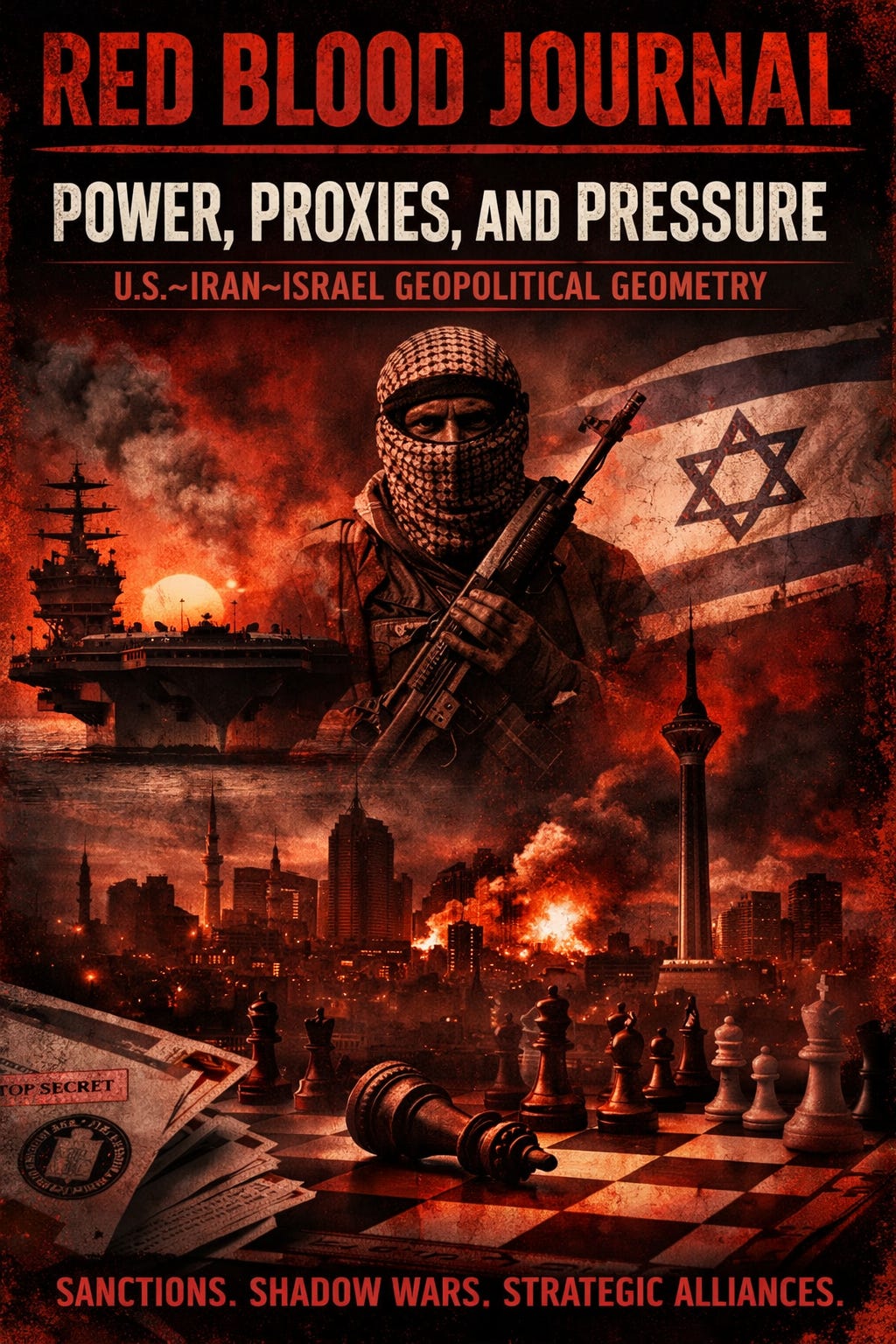
🩸 RED BLOOD JOURNAL — ANALYSIS FILE
Title: Power, Proxies, and Pressure
File ID: RBJ-FORECAST–US–IRAN–GEOMETRY
Classification: Geopolitical Pattern Analysis
Format: Red Blood Journal (Analytical Edition)
PROLOGUE — POWER RARELY MOVES ALONE
Great powers seldom act in isolation. They operate through alliances, partners, legal frameworks, economic systems, and sometimes regional security actors whose interests partially align with their own. In modern geopolitical analysis, Israel is sometimes described as a regional extension of U.S. strategic posture in the Middle East, while others stress Israel’s sovereign pursuit of its national security interests—which align with or diverge from Washington’s at different times. A Red Blood Journal analysis treats this as a hypothesis to examine empirically through historical patterns of cooperation, divergence, and convergent outcomes.
SECTION I — THE REGIME-INFLUENCE TOOLKIT
Historically, U.S. foreign policy—often coordinated via the Central Intelligence Agency alongside diplomatic, economic, and military institutions—has employed layered tools:
Political influence, funding, and election interference
Information/media shaping and propaganda
Support for opposition factions or armed proxies
Sanctions, financial isolation, and asset freezes
Cyber and technical disruption (e.g., Stuxnet precedents)
Proxy or partner-based pressure (including intelligence sharing and joint operations)
Direct military intervention or air/missile strikes
Backchannel diplomacy and negotiations
Modern projection frequently blends these in parallel, favoring indirect leverage where possible to minimize domestic political costs and long-term entanglement.
SECTION II — THE HISTORICAL LANDSCAPE
Widely documented U.S. involvement in influencing or changing regime outcomes spans decades, ranging from covert operations to overt interventions. Key examples include:
1950s
Iran (1953): CIA- and MI6-orchestrated coup (Operation Ajax/TP-AJAX) overthrew democratically elected Prime Minister Mohammad Mossadegh after oil nationalization; Shah Mohammad Reza Pahlavi was reinstated. Motives centered on oil interests and anti-communist containment.
Guatemala (1954): CIA Operation PBSuccess toppled President Jacobo Árbenz over land reforms affecting U.S. corporate interests (United Fruit Company).
1960s–70s
Cuba (Bay of Pigs 1961 attempt; ongoing embargo and covert actions)
Vietnam (major military intervention and regime support dynamics)
Chile (1973 coup against Salvador Allende, with U.S. encouragement of opposition)
Congo (support for Mobutu against Lumumba-aligned forces)
1980s
Afghanistan (proxy support to mujahideen against Soviet-backed regime)
Nicaragua (funding Contras against Sandinistas)
Panama (1989 invasion to remove Noriega)
Grenada (1983 invasion)
1990s–2010s
Iraq (1991 Gulf War; 2003 invasion and regime change)
Serbia (1999 NATO bombing/Kosovo intervention)
Haiti (multiple interventions, including 1994 restoration of Aristide)
Libya (2011 NATO-led intervention contributing to Gaddafi’s fall)
Syria (support for opposition amid civil war)
These cases illustrate a spectrum: some succeeded in short-term objectives but often produced long-term instability, backlash, or unintended power vacuums (e.g., post-2003 Iraq, post-2011 Libya). Direct U.S. actions number in the dozens to over 100 depending on definitions (covert/overt, successful/attempted), concentrated in Latin America, Middle East, and Cold War hotspots.
VISUAL SNAPSHOT OF THE ERA
Timeline of selected interventions (1953–2010s): Cold War peak covert actions → post-Cold War shift toward overt coalitions and sanctions-heavy approaches. (Exact visual omitted; patterns show declining preference for large occupations after Iraq/Afghanistan.)
SECTION III — WHERE ISRAEL FITS IN THE STRUCTURE
RBJ identifies three observable layers:
Strategic Alignment Deep, institutionalized U.S.-Israel military, intelligence, and technological cooperation (e.g., annual FMF aid ~$3.3B, joint missile defense, QME commitments, intelligence sharing). This creates synergies where Israeli capabilities reinforce U.S. regional posture, especially against shared threats like Iran.
Independent Agency Israel has pursued unilateral actions based on its security doctrine, sometimes without full U.S. coordination or against preferences. Notable examples: 1981 Osirak reactor strike (Iraq), 2007 Syrian reactor strike, and various targeted operations against Iranian proxies or nuclear-related targets.
Converging Interests vs. Proxy Theory Labeling Israel a simple “proxy” or “long arm” oversimplifies. Actions often reflect strategic convergence: sovereign decisions that align effects (e.g., pressure on Iran’s nuclear program, counterterrorism) without a command chain. Divergences occur (e.g., settlement policy, Gaza operations timing). RBJ frames this as partnership within a broader architecture, not ownership.
SECTION IV — PATTERN RECOGNITION
Across decades:
Direct large-scale invasions/occupations are costly, politically risky, and often counterproductive long-term.
Indirect leverage (proxies, sanctions, cyber, partners) is preferred for deniability and lower commitment.
Sanctions/financial isolation and information narratives dominate modern toolkits.
Regional partners (e.g., Israel, Gulf states via Abraham Accords dynamics) amplify reach without sole U.S. footprint.
Post-Cold War and post-Iraq/Afghanistan, geopolitics favors pressure systems, containment, and calibrated strikes over nation-building or prolonged occupation.
SECTION V — IRAN FORECAST THROUGH THIS LENS
Iran is a high-resilience state with strong internal security (IRGC, Basij), adaptive sanctions-evasion economy (shadow fleet oil exports to China ~1.5M bpd despite discounts), historical memory of 1953 and other interventions, and regional alliances/proxies (though degraded by 2024–2025 setbacks to Hezbollah, Hamas, Assad regime).
Most Likely Pressure Channels
Economic/legal isolation and “maximum pressure” sanctions (oil revenue hit via discounts/risk premiums, but volume resilient via evasion networks).
Diplomatic containment and failed/stalled nuclear talks (e.g., post-2018 JCPOA withdrawal, 2025 negotiation breakdowns).
Deterrence signaling, intelligence sharing, and partner-based operations (U.S.-Israel convergence on nuclear threats).
Cyber/technical disruption and targeted strikes (historical Stuxnet precedents; recent direct/indirect actions against facilities).
Regional security cooperation with partners to counter proxies and contain influence.
Least Likely
Full-scale ground invasion.
Direct externally imposed regime change.
Long-term occupation (history of high costs, backlash, and limited success in similar contexts).
Recent escalations (2024–2025 Israel/Iran exchanges, U.S. strikes on nuclear sites, 2026 tensions/threats) reinforce preference for calibrated pressure over decisive invasion, though thresholds remain fluid.
CONCLUSION — THE GEOMETRY OF POWER
RBJ’s analytical conclusion: Modern regime influence is rarely one actor pulling strings. It is networks of pressure, alliances, converging interests, and adaptive resilience. The U.S.–Israel relationship is a strategic partnership—not a simple proxy command chain—within a broader architecture. Iran’s trajectory will likely be shaped primarily by:
Internal political dynamics and legitimacy challenges.
Economic sustainability under sustained sanctions.
Regional security balance (proxies degraded but adaptable).
Diplomatic openings or miscalculations.
More than by any single external actor or decisive external imposition. Patterns favor endurance tests over quick victories.
♟️The Geometry of Power:
US-Israel Strategy and Iran Analysis
This document analyzes the geopolitical architecture of the Middle East, specifically examining the strategic partnership between the United States and Israel in their efforts to contain Iran.
It highlights how modern global power is projected through indirect leverage such as cyber disruptions, economic sanctions, and intelligence sharing rather than large-scale military invasions.
By reviewing a historical timeline of interventions from the 1950s to the present, the text illustrates a shift toward calibrated pressure and regional alliances.
The analysis rejects the idea that Israel is a simple proxy, instead framing the relationship as a strategic convergence of sovereign interests.
Ultimately, the report suggests that Iran’s future will be determined by its internal resilience and the endurance of these multifaceted external pressure networks.


