


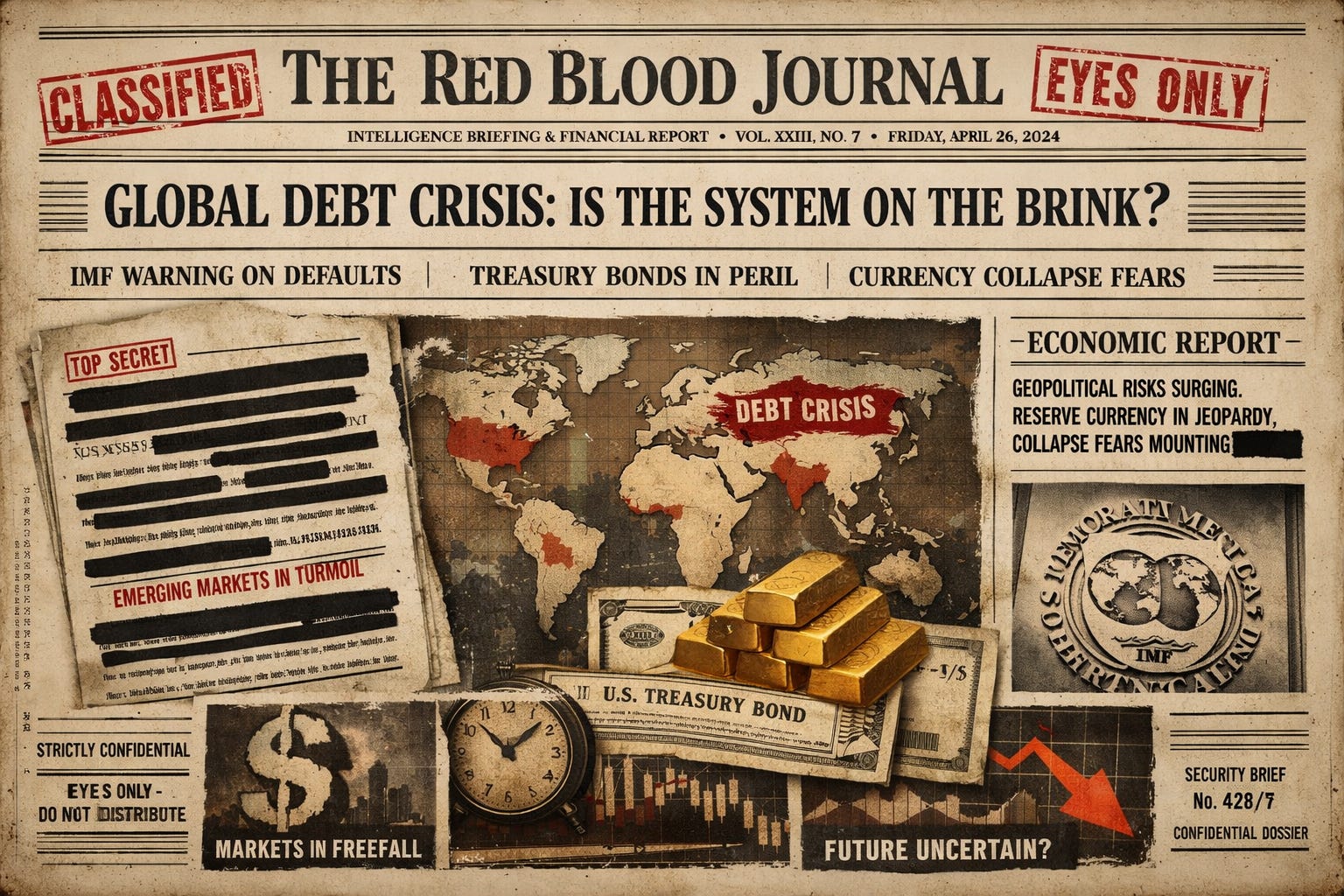
🩸 RED BLOOD JOURNAL — TRANSMISSION
T#122625–MONEY–BAZOOKA–SOVEREIGNTY
Classification: Monetary Power / Imperial Plumbing
Distribution: Open File
Subject: IDEOLOGY IS THE STORY. MONEY IS THE ENGINE.
FRONT-PAGE HEADLINE
THE CASH THAT WRITES THE SCRIPT
Subhead: How “emerging markets debt,” IMF tranches, reserve-currency privilege, and asset seizures reveal the hidden operating system behind “foreign policy.”
PROLOGUE — THE MIDLIFE REALIZATION NOBODY ADMITS
Most people are trained to read the world like a debate club.
These people believe X.
Those people believe Y.
That’s why they fight.
That’s why they ally.
But the older you get, the more the pattern sharpens:
Ideology is the costume. Money is the skeleton.
The stage directions are written in debt, not speeches.
And the oldest line in the book still holds:
The love of money is the root.
Not because money is evil—
but because money is leverage, and leverage tempts the worst parts of human nature.
I. EMERGING MARKETS DEBT — A POLITE NAME FOR “THE WORLD OWES”
“Emerging markets debt” sounds like a finance term.
In reality, it’s a map of dependency.
It grew out of the 1980s debt crisis:
Big banks held piles of loans from countries that couldn’t repay.
So the system did what it always does when the bill comes due:
It repackaged the problem into something sellable.
II. THE BRADY PLAN — HOW YOU CLEAN A BANK BALANCE SHEET WITHOUT CALLING IT A BAILOUT
The Brady Plan (late 1980s / early 1990s) is described as “restructuring” and “opening investor access.”
In plain language:
Banks were stuck holding bad loans.
The plan turned those loans into tradable bonds.
Those bonds were sweetened with U.S. Treasury collateral (Treasury strips / zero-coupon bonds).
The debt could now be sold to a broader investor base.
Translation:
The system created a bridge that moved risk out of the banks’ basement and into a market—
then called it liquidity.
And liquidity is a magic spell: it makes a burden look like an opportunity.
III. IMF TRANCHES — “OF COURSE THEY’LL DISBURSE IT”
Investor trips. Finance ministries. Meetings with the IMF.
The recurring question:
“Will the next tranche be delivered?”
And the quiet answer from anyone who has watched long enough:
Of course it will.
Because that’s what the institution is built to do: lend, roll, extend, “backstop,” “stabilize.”
The official story is guidance + prosperity.
The operational reality is:
keep the country afloat
demand austerity
preserve the repayment pipeline
maintain the geopolitical alignment
prevent contagion (markets hate surprise)
And it’s politically radioactive domestically, because it looks like taking orders from outsiders—especially “the West.”
So the IMF becomes a paradox machine:
The “help” is real.
The “help” is hated.
The “help” is also the leash.
IV. DEBT = LESS SOVEREIGNTY (AND EVERYONE IS IN DEBT)
Debt is not just a number. Debt is permission.
When you owe:
your options shrink
your timeline shortens
your policy becomes “market-compatible”
And the brutal punchline:
If every country is indebted, then no country is fully sovereign.
They’re connected, collateralized, rated, priced, and compared—like assets in a portfolio.
The U.S. has had a special advantage: reserve-currency privilege.
Meaning: we can run more “profligate” policy longer than others… until the privilege cracks.
V. THE “BAZOOKA” DOCTRINE — HOW BAILOUTS REALLY WORK
In every crisis the same discovery repeats:
Half-measures don’t restore confidence.
They buy a moment.
Then panic returns.
So eventually the system reaches for the “mega bazooka”:
swap lines
emergency facilities
massive packages
coordinated interventions
This is not morality. It’s physics:
Markets don’t respond to good intentions—
they respond to force.
VI. THE RESERVE-CURRENCY PRICE TAG — THE DAY THE VAULT DOOR CHANGED
Then comes the moment that keeps echoing:
Western powers froze/seized Russian reserves held in Western jurisdictions.
Whatever you think about that war, the financial implication is simple:
A precedent was set.
If reserves can be immobilized, then reserves are no longer “neutral savings.”
They are conditional property.
That changes behavior:
less appetite for Treasuries
more appetite for assets outside the reach of seizure
especially gold (and sometimes other alternatives)
Not because gold is magical—
but because gold is harder to “turn off” with a policy memo.
VII. DEBASEMENT TRADE — WHY “THE DOLLAR IS STRONG” CAN BE A TRICK
People talk about the dollar like it’s a sports score—up or down versus other currencies.
But if everyone is a basket case, that comparison can hide the larger truth:
Look at the dollar versus gold (or other hard measures), and the long arc becomes clearer:
Debasement isn’t a headline. It’s a slow leak.
And that leak is politically useful because it’s quiet:
it funds promises
it postpones consequences
it spreads pain over time (and across voters)
VIII. THE FED’S BOOGEYMAN — DEFLATION
The logic chain you’re being shown is important:
Excess debt + deflation = defaults cascade
So the Fed fears deflation as the ultimate collapse trigger
Which leads to “emergency” measures that last way longer than emergencies should
When you cap the price of money (interest rates) for too long, you don’t just “stimulate.”
You rewrite the price system.
And if price is the information mechanism of capitalism, then controlling it is not “free markets.”
It’s something else wearing a free-market mask.
IX. THE NEW BUBBLE SMELL — OPTIONS, PASSIVE FLOWS, AND CHIP-COLLATERAL DAISY CHAINS
The excerpt sketches a modern fragility stack:
Concentration risk (a handful of giants pulling the index)
Passive 401(k) flows that mechanically buy the same winners
Zero-day options turning investment into high-frequency gambling
Leverage on leverage
AI build-out shifting “capital light” giants into debt-fueled physical infrastructure
even borrowing against assets that naturally depreciate (chips replaced by next-gen chips)
You don’t have to predict the crash date to recognize the odor:
When financing becomes circular, complexity becomes a sales tactic, and acronyms start getting squared—
you’re no longer watching growth. You’re watching reflex.
X. ESG — THE DREAM OF CONTROL ECONOMY
Then comes the ideological overlay:
ESG, a framework so elastic that even “experts” struggle to define it consistently.
In the excerpt, the blunt diagnosis is:
It’s intervention.
A way to inject ideology into the investment process—
into the last machine that used to resist narrative pressure: pricing.
And the warning is also blunt:
Once embedded into processes, it’s hard to remove.
Not because it’s right or wrong—
but because bureaucracy loves anything that expands justification.
XI. TOKENIZATION — THE NEW RAILS (AND THE NEW POINTS OF CONTROL)
The promise of blockchain/tokenization in the excerpt is real:
faster settlement
lower friction
fewer middlemen fees
cleaner ledgers
reduced “paperwork corruption” (like title messes)
But Red Blood caution is simple:
New rails create new toll booths.
And the same institutions that mastered old tolls will compete to own the new ones.
So the question isn’t “Will it work?”
It’s:
Who governs it? Who can freeze it? Who can gatekeep it?
Because “efficient” can also mean “more easily administered.”
XII. THE END QUESTION — WHO BAILS OUT THE BAILER?
The thread running through the entire excerpt is the quiet imperial function:
crises erupt
the U.S./IMF-aligned system backstops
markets stabilize
the machine continues
Then Tucker asks the question everyone avoids:
What happens if the United States becomes the crisis?
Who bails out the bailer?
And the most honest answer in the excerpt is also the most terrifying:
Nobody.
So the real conclusion is not doom—it’s a diagnostic:
When the backstop is the final backstop, the system depends on trust.
And trust is a currency too.
Once you teach the world that reserves can be seized, that rules are conditional, that money is political—
you begin spending trust like debt.
RED BLOOD TAKEAWAY — HOW TO READ THE WORLD AFTER THIS
Stop asking only:
“What do they believe?”
“Which ideology is winning?”
Start asking:
Who is funding it?
Who profits if it continues?
Who gets liquid when it collapses?
What collateral is being pledged—and to whom?
What gets privatized, what gets socialized?
Where does sovereignty end and refinancing begin?
Because ideology is what people say.
Debt is what people obey.
⛓️IDEOLOGY IS THE STORY. MONEY IS THE ENGINE.
This text examines the hidden financial mechanisms that govern global politics, suggesting that debt acts as the true skeleton beneath the surface of ideology.
It argues that international institutions and frameworks, like the IMF and the Brady Plan, function as tools of leverage that prioritize repayment pipelines over national sovereignty.
By analyzing the seizure of foreign reserves and the slow debasement of currency, the source illustrates how money has become increasingly conditional and political.
The author warns that the modern financial system relies on a “bazooka” doctrine of massive bailouts that may eventually fail if the primary backer faces its own crisis.
Ultimately, the narrative posits that global trust is a depleting resource being sacrificed to maintain an fragile, interconnected economic order.
The central thesis is that while people focus on political speeches, they should instead follow the collateral and debt to understand true power.


