


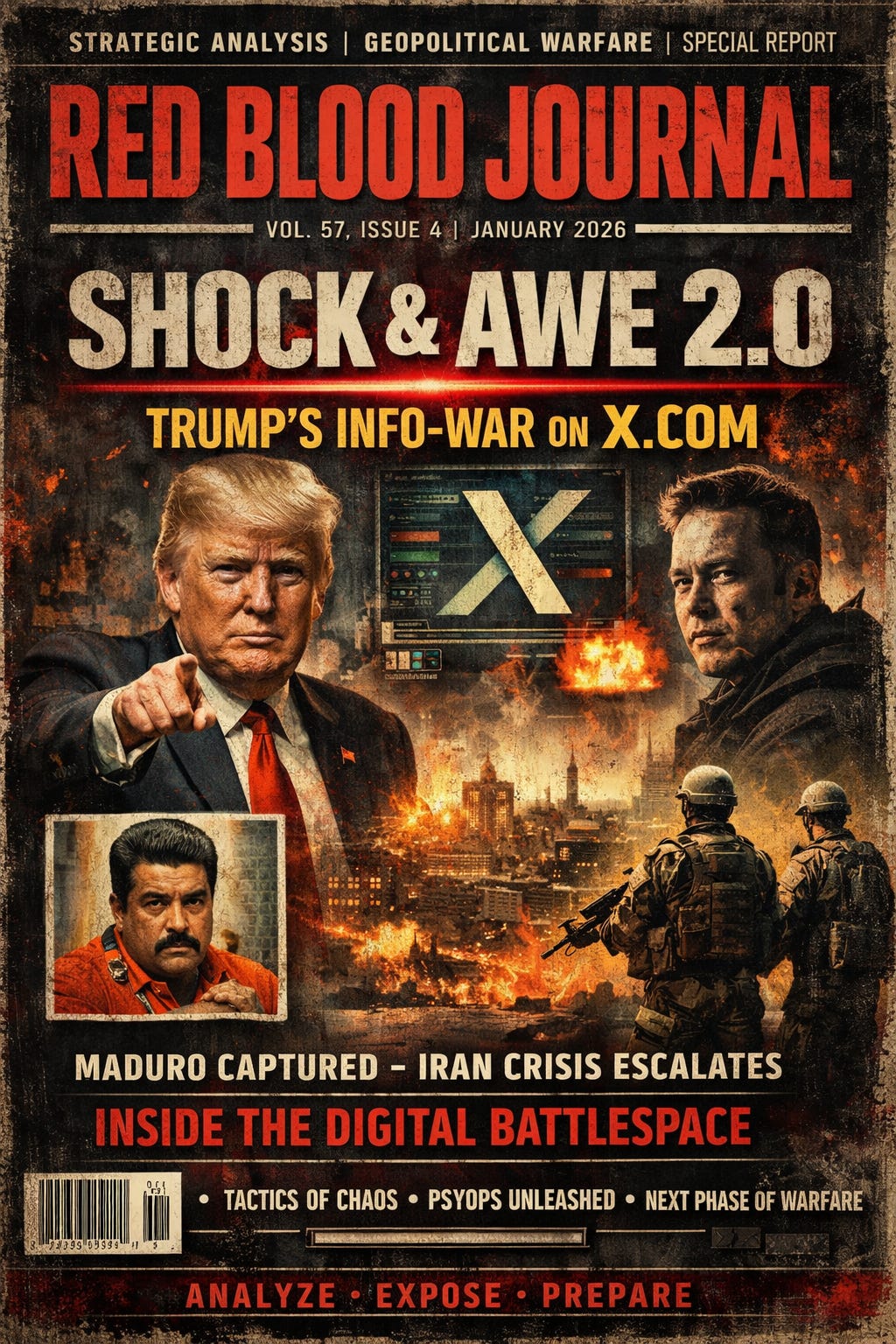
🩸 RED BLOOD JOURNAL – STRATEGIC INTEL FEATURE
Volume 57, Issue 4 – January 2026
Title: Shock & Awe in the Digital Battlespace: How X.com Became the New Theater of American Political Warfare
Author: Red Blood Journal – Intelligence & Media Forensics Division
Executive Overview
In recent days, X.com has transformed into the central arena for America’s political, psychological, and geopolitical conflict. Former President Donald J. Trump—now operating with the full force of incumbency and a disciplined digital apparatus—has deployed a communication strategy that mirrors the Pentagon’s classic shock and awe doctrine.
Originally engineered to paralyze adversary decision-cycles during kinetic warfare, this doctrine has been reconfigured for the information domain: rapid salvos, overlapping narratives, high-impact visuals, and algorithm-optimized distribution.
The result is a political environment defined not by linear debate, but by cognitive saturation, where opponents struggle to maintain footing amid a relentless tempo of announcements, reversals, foreign policy operations, and theatrical displays of state power.
This feature dissects the tactics used across all major factions on X.com—Trump’s coalition, the political opposition, media intermediaries, and the platform’s owner, Elon Musk—and analyzes why this emergent battlespace mirrors the U.S. military playbook used in the high-velocity operation that extracted Venezuelan strongman Nicolás Maduro.
1. The Timeline as Operational Battlespace
What once functioned as a social media feed has evolved into a dynamic, 24/7 theater of political operations. Trump’s communications team—now tightly aligned with White House rapid-response units and external media surrogates—utilizes X as the primary channel to:
Announce foreign policy escalations
Telegraph regulatory demolitions or reversals
Circulate courtroom or detention imagery
Broadcast negotiations, threats, or retaliatory framing
Preempt media narratives before traditional outlets mobilize
The structural effect is the same as on a kinetic battlefield:
seize the initiative, dictate tempo, force adversaries into reactive posture.
2. Trump’s Digital “Shock & Awe”: A Tactical Breakdown
2.1 Multi-Vector Announcement Waves
Trump’s team releases policy actions in compressed clusters—often within hours of each other.
Examples include:
UN withdrawals and funding cuts
Tariff escalations and trade threats
Starlink-based proposals to puncture foreign blackouts
Framing of the Maduro operation as a model of global “decapitation justice”
Each announcement is immediately repackaged into:
short clips
cinematic thumbnails
stylized quote-cards
meme-forward visual assets
This ensures saturation across every demographic layer of X’s user base.
2.2 First-Frame Dominance
A defining feature of political shock & awe is controlling the first image that circulates before debate begins.
On X, Trump’s media arm consistently deploys:
courtroom sketches of captured figures
airstrike or convoy footage
patriotic or executive-aesthetic imagery (flags, spotlights, aggressive camera angles)
These materials become the gravitational center of the information cycle. Critics who quote-tweet or react inadvertently amplify the original frame, embedding Trump’s narrative architecture into the public consciousness.
2.3 The Venezuela Template
Trump’s handling of Venezuela—and the high-risk, limited-scope operation that culminated in Maduro’s capture and transport to U.S. jurisdiction—serves as the prototype.
Key parallels to digital strategy:
High-velocity execution: rapid action, limited warning, overwhelming visuals
Decapitation optics: transforming geopolitical action into a moral spectacle
Narrative compression: collapsing complex events into a single, digestible storyline of “justice delivered”
This same operational rhythm now manifests across domestic politics, foreign crises, and cultural flashpoints.
3. The Opposition: Reactive Communication Under Duress
Opponents on X—including political actors, legal analysts, legacy media figures, and academic institutions—consistently operate in a reactive posture due to Trump’s tempo.
Their typical counter-operations include:
3.1 Legal-Linguistic Framing
Threaded explanations reinterpreting Trump’s actions as unlawful, authoritarian, or institutionally corrosive.
3.2 Clip-Based Rebuttal Cycles
Opposition accounts quote-tweet Trump’s footage with fact-check overlays or historical analogies (Hitler, Chávez, junta models).
This, however, accepts Trump’s framing as the baseline.
3.3 Risk-Based Internationalization
Think-tank analysts contextualize U.S. actions in Venezuela, Iran, or Africa within broader escalation concerns.
These longer-form analyses provide intellectual ballast, but lack the viral velocity of Trump’s media machine.
3.4 Satirical Counter-Aesthetic
Memes depicting Trump as incompetent, overreaching, or cartoonish aim to blunt the strongman narrative.
Their reach is high, but their strategic impact remains limited.
4. Elon Musk & X.com: The Terrain Is Alive
Trump’s shock & awe strategy gains potency because the battlefield itself—X—is in rapid transformation.
4.1 Algorithm Transparency as Warfare Amplifier
Musk’s repeated pledge to release the platform’s core recommendation code in rolling updates has two implications:
External analysts can map how political narratives travel, peak, and decay.
Sophisticated political actors can optimize their content to perfectly align with the algorithm’s engagement vectors.
No platform in history has given campaigns such real-time visibility into the mechanics of public persuasion.
4.2 X as a High-Pressure Narrative Accelerator
The new engagement architecture favors:
short-form video
high-contrast imagery
emotionally charged content
rapid feedback cycles
This environment inherently rewards political shock & awe and punishes deliberative communication.
5. Strategic Assessment: Understanding the New Battlespace
For Red Blood Journal analysts, the following dynamics are now central:
5.1 Trump Sets the Initiative Window
By flooding the zone with overlapping policy declarations and visual narratives, he prevents opponents from establishing sustained counter-messaging.
5.2 The Opposition Communicates in Delay
Even high-quality legal or academic analyses emerge only after Trump’s first frame has circulated globally.
5.3 X.com Functions as a Real-Time Ops Log
The platform no longer reflects political discourse—
It is the battlefield.
5.4 Shock & Awe Is Now Psychological, Not Kinetic
The objective is to overload processing capacity, collapse adversary planning horizons, and generate permanent asymmetry in agenda-setting.
Conclusion
The American political arena has entered a new phase of information warfare. Trump’s digital strategy—amplified by Musk’s evolving platform architecture—constitutes the most sophisticated adaptation of military shock & awe doctrine ever translated into civilian politics.
The opposition remains active and vocal, but structurally disadvantaged by tempo, aesthetic momentum, and algorithmic synergy.
As global crises unfold—in Iran, Venezuela, and beyond—the X.com battlespace will remain the primary venue where narratives are forged, contested, and weaponized.
Red Blood Journal will continue to monitor the evolving tactics, operational tempo, and psychological impacts of this conflict as it intensifies across the digital front.
⚡Digital Shock and Awe: The X.com Battlespace
This report examines how X.com has evolved into a high-stakes arena for modern political warfare, specifically through the digital application of the military’s “shock and awe” doctrine.
The text details how Donald J. Trump’s administration utilizes rapid-fire announcements and high-impact visuals to saturate the information landscape, effectively paralyzing opposition response cycles.
By controlling the initial narrative frame and leveraging the platform’s algorithmic architecture, the government dictates the pace of public discourse much like a kinetic battlefield operation.
Meanwhile, Elon Musk’s leadership of the platform is portrayed as providing the technical infrastructure necessary for this aggressive communication strategy to thrive.
Ultimately, the source argues that political power is now defined by the ability to overload public cognition and maintain a permanent state of narrative dominance.


