


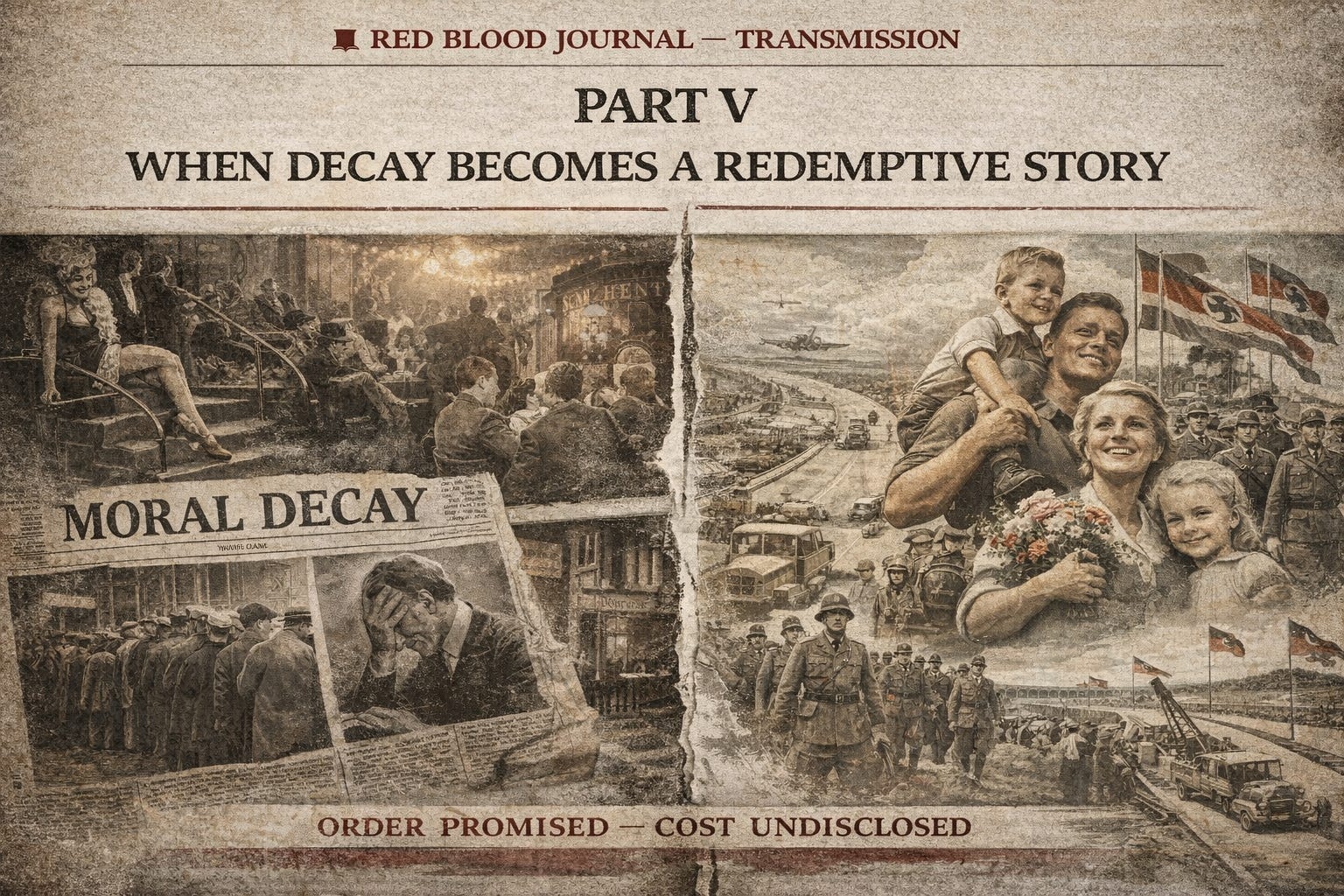
🩸 RED BLOOD JOURNAL — TRANSMISSION
PART V — WHEN DECAY BECOMES A REDEMPTIVE STORY
Subject: Sex, feminism, Weimar collapse, and the construction of a savior
Status: Examination in progress
Judgment: Reserved
I. THE STORY TURNS INTIMATE
Part V moves away from treaties and ideologies and into the private sphere.
Women.
Sex.
Marriage.
Family.
Morality.
The claim is no longer only that nations were destabilized — but that souls were corrupted, deliberately.
This is an important shift.
Because when political failure is reframed as moral decay, the solution stops being reform and starts becoming purification.
II. THE “WOMEN’S LIBERATION” ORIGIN MYTH
The section opens with a familiar insider anecdote:
a Rockefeller confession.
Women’s Liberation, we are told, was never about dignity or choice.
It was a tax strategy.
An indoctrination pipeline.
A way to separate children from parents and reassign loyalty to the state.
Whether the anecdote is true or not is almost beside the point — its function is clear.
It reframes every gain for women not as agency, but as elite manipulation.
And it transforms mothers into unwitting collaborators in their own dispossession.
This is not analysis of policy.
It is moral inversion.
III. FEMINISM AS ANNIHILATION DOCTRINE
The documentary then stacks quotations — radical, shocking, maximalist — attributed to feminist figures.
Marriage must be destroyed.
Men are the enemy.
Culture must be beaten down.
These quotes are used not as examples of extremes, but as representative intent.
Here is the move being made:
select the most inflammatory rhetoric
remove historical context
universalize it
attach it to an entire movement
then attach that movement to a single ethnic identity
Once again, identity replaces mechanism.
The reader should notice a recurring pattern by now.
IV. WEIMAR BERLIN AS MORAL CRIME SCENE
The documentary then descends into Weimar Berlin.
Prostitution.
Drugs.
Pornography.
Homosexual subcultures.
Sex clubs.
Pedophilia.
Berlin is painted as a “Babylon,” a cesspit engineered to humiliate and dissolve the German family.
Some of this imagery reflects real excesses of a collapsed society.
Some reflects exaggeration.
Some reflects projection.
But the framing is consistent:
Decadence is not the symptom of collapse — it is the weapon that caused it.
Economic devastation disappears as a primary cause.
Unemployment becomes backdrop.
Hyperinflation becomes secondary.
Culture becomes the culprit.
V. THE MOVE FROM DISGUST TO NECESSITY
At this stage, something subtle happens.
The reader is not merely informed.
They are repulsed.
And once disgust is fully activated, the narrative introduces its next figure.
A man who hated this decay.
A man who suffered in the streets.
A man who fought, bled, and watched his country humiliated.
The transition is deliberate:
From chaos →
to disgust →
to longing →
to rescue.
This is not accidental sequencing.
VI. HITLER ENTERS AS ANSWER, NOT QUESTION
Adolf Hitler is introduced not as a politician, but as a witness.
A poor artist rejected by elites.
A decorated war veteran.
A man blinded by gas.
A man betrayed by surrender.
He is framed as someone who felt what the people felt.
This is important.
Because once he is framed as an emotional mirror of national pain, his ideas no longer need scrutiny — they feel earned.
VII. NATIONAL SOCIALISM AS “CLEAN” SOCIALISM
The documentary draws a bright line:
Communism destroys property.
National Socialism protects it.
Communism erases the individual.
National Socialism honors him.
Communism enslaves through debt.
National Socialism liberates through labor.
This is where Part V becomes the most dangerous.
Because it does not merely criticize communism.
It rehabilitates National Socialism as benevolent correction.
Economic recovery figures are presented without context.
Debt-free money is framed as liberation without cost.
Rearmament is disguised as employment.
Suppression is renamed order.
Everything bad is assigned to bankers.
Everything good is assigned to the state.
VIII. CULTURE “RESTORED”
Book burnings are reframed as cleansing.
Censorship is reframed as protection.
Art control is reframed as renewal.
Family values return.
Pride returns.
Unity returns.
The story insists that Germany did not lose freedom — it regained dignity.
And here the reader must pause.
Because when freedom is judged solely by how good it feels, history becomes seduction.
IX. THE FINAL CONVERSION
By the end of Part V, the transformation is complete.
Germany was broken.
Decadence reigned.
The people were lost.
Then one man arrived — and everything worked again.
Jobs.
Joy.
Order.
Pride.
This is no longer historical analysis.
This is redemptive myth.
X. THE QUESTION THAT MUST BE ASKED
Before proceeding further, one question must be held firmly:
If a system produces prosperity, order, and pride — does that alone absolve it?
Because Part V does not yet confront what followed.
It stops at the point where belief feels justified.
That is not an accident.
XI. RETURNING THE JUDGMENT
This transmission does not deny that Weimar Germany collapsed.
It does not deny that people were desperate.
It does not deny that disorder breeds hunger for authority.
But it refuses the sleight of hand that equates moral disgust with moral clarity.
Ask yourself:
Does sexual excess explain economic collapse?
Does cultural shock justify total control?
Does recovery erase what is required to maintain it?
Does relief from chaos mean the cure was just?
If these questions are never asked, then history is no longer being examined.
It is being prepared.
⚖️Propaganda Collapse Reframed as Moral Decay
This text critiques a documentary segment that utilizes a redemptive myth to justify the rise of National Socialism in Germany.
The narrative reframes social and moral decay as a deliberate weapon used to destabilize the nation, transitioning from themes of economic collapse to a focus on cultural purification.
By portraying feminism as an elite manipulation and Weimar-era decadence as an engineered crime, the source illustrates how disgust is leveraged to foster a longing for authoritarian order.
Ultimately, the author warns that Adolf Hitler is presented not as a political figure, but as a savior whose supposed economic and moral restoration serves to mask the totalitarian control and suppression that followed.


