


🩸RED BLOOD JOURNAL TRANSMISSION
T#: RBJ-2026-PREEMPTIVE-DEFENSE-PARADOX
Classification: Strategic Doctrine Analysis / Logic Examination
Source Anchor: Bennett – “Self-Defense Doctrine”
Self Defense
Status: Analytical Commentary
PROLOGUE — THE LOGIC OF PREEMPTION
Former Israeli Prime Minister Naftali Bennett defends military action against Iran as self-defense, citing Article 51 of the United Nations Charter. The central claim is simple:
If a hostile state is expected to acquire weapons that could threaten your survival, waiting until those weapons are operational may be too late. Therefore, striking earlier is justified.
Self Defense
The doctrine he describes is not new.
It is the strategic principle known as preemptive self-defense.
However, when this logic is translated into ordinary human terms, its ethical tension becomes immediately visible.
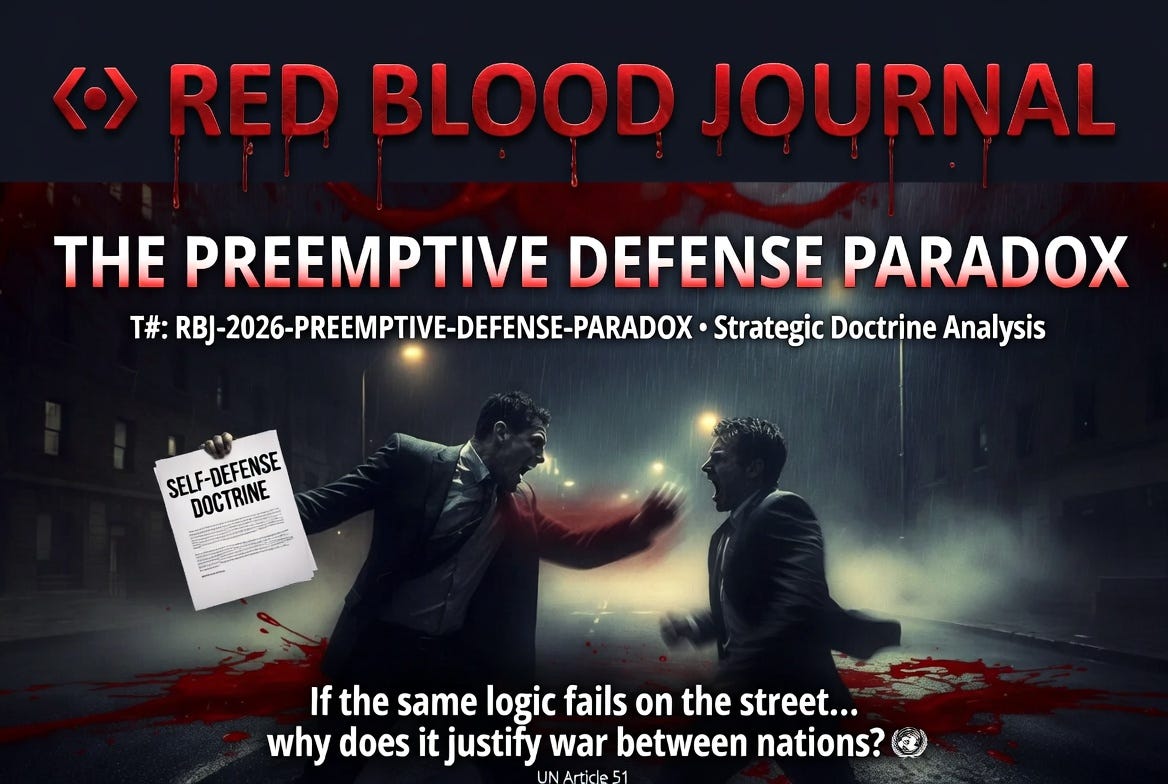
I — THE STREET ANALOGY
Imagine two pedestrians walking down the same street.
One suddenly punches the other in the face.
When questioned, the attacker explains:
“I acted in self-defense. I knew he was thinking about punching me first, so I beat him to it.”
The logic mirrors the strategic doctrine described in the interview:
Perceived future threat
Fear of losing the opportunity to act
Decision to strike first
The difference lies only in scale:
a street confrontation versus a state conflict.
II — THE DOCTRINE BEING DEFENDED
Bennett argues that Israel acted because waiting would allow Iran to complete its nuclear capability, which would make retaliation impossible.
Self Defense
He frames the choice as binary:
Wait until the threat materializes and risk catastrophic destruction.
Strike earlier while action is still possible.
In this framework, the strike is not aggression but preventative survival.
III — THE INTERNATIONAL LAW QUESTION
International law recognizes a nation’s right to self-defense under Article 51 of the UN Charter.
Self Defense
However, the interpretation of that right has long been disputed.
Two doctrines compete:
Immediate Self-Defense
Force is legitimate only when an attack is imminent or underway.
Preemptive Self-Defense
Force is legitimate if a future attack is considered inevitable.
The tension between these interpretations is one of the central unresolved questions in modern international law.
IV — THE SECURITY DILEMMA
The deeper problem is structural.
If one nation believes another is preparing a future attack, the first may strike to prevent it.
But the second nation may interpret that strike as aggression, prompting retaliation.
This dynamic creates what strategists call the security dilemma:
Actions taken for defense appear as offensive threats to others.
V — THE NUCLEAR ERA PARADOX
In the nuclear age, this dilemma becomes even sharper.
Waiting until an adversary possesses nuclear weapons may remove any possibility of intervention.
But allowing preventive wars also opens the door to endless justification for conflict.
The paradox becomes unavoidable:
Act too early and risk unjustified war.
Act too late and risk annihilation.
VI — THE LOGIC TEST
The street analogy functions as a logic test.
If the justification sounds unreasonable when applied to individuals, it raises a question:
Why is the same reasoning considered acceptable when applied to nations?
The answer lies in scale, fear, and the catastrophic consequences of miscalculation.
States operate in an environment where a single strategic mistake can destroy entire societies.
CONCLUSION — THE PREEMPTIVE DEFENSE PARADOX
The debate presented in the interview is not simply about Israel or Iran.
It is about a deeper dilemma in global security:
Can a nation legitimately wage war to prevent a future threat that has not yet materialized?
Supporters argue this is the only rational strategy in an age of nuclear weapons.
Critics argue it erodes the very legal foundations meant to prevent war.
Between those two positions lies the enduring paradox of modern security doctrine:
The line between defense and aggression becomes increasingly difficult to define.
⚖️The Preemptive Defense Paradox
The provided text examines the preemptive defense paradox, a controversial strategic doctrine where a nation initiates military action to neutralize a potential future threat.
Using former Israeli Prime Minister Naftali Bennett’s justification for striking Iran as a case study, the analysis compares state-level security to a street-level physical confrontation.
The core dilemma explores whether preventative survival constitutes a legitimate form of self-defense under international law or merely a form of justified aggression.
This tension is amplified in the nuclear age, where waiting for an attack might lead to total annihilation, yet striking early risks starting unnecessary wars.
Ultimately, the source highlights the difficulty of defining the boundary between protection and provocation in global politics.


