


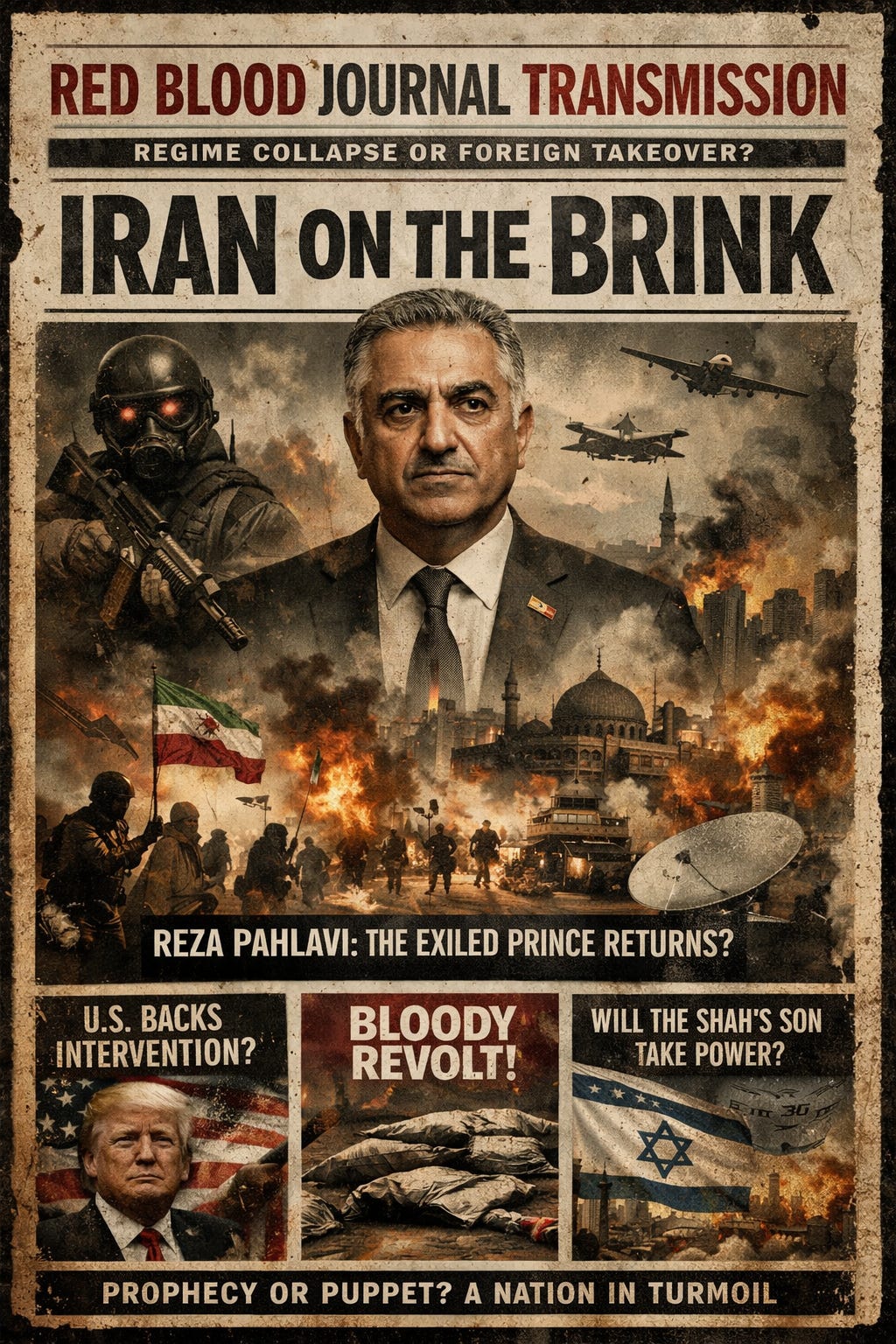
🩸 RED BLOOD JOURNAL TRANSMISSION 🩸
Reza Pahlavi’s Geopolitical Audition
T#: RBJ-IR-2026-01-13-RP-AXIS
Classification: Regime-Change Theater & Succession Engineering – Deep Pattern Briefing
Origin: Red Blood Journal – Iran Desk / Atlantic Power Structures Unit
Source: CBS “Live Event” Interview – Exiled Iranian Crown Prince Reza Pahlavi with Nora O’Donnell
Full Interview - Exiled Iranian…
Executive Summary – When Protest Meets Succession Planning
On the surface, this CBS News “Live event” is about a brutal crackdown in Iran: dozens to thousands allegedly killed, overflowing morgues, internet blackouts, and a population in revolt “from teenagers to retirees… rich and poor.”
Full Interview - Exiled Iranian…
Beneath the surface, it reads like something else entirely:
A succession audition for Reza Pahlavi as “transition leader.”
A public alignment of Pahlavi with Donald Trump and U.S./Israeli strategic interests.
A narrative scaffold for future military or covert intervention framed as “saving lives.”
A media test balloon: can the audience be prepped to see a foreign-backed, Western-aligned figure as the “natural” answer to Iran’s crisis?
The interview is not just about “whether the regime will fall.” It is about who gets to inherit the rubble if it does.
Section I – The Scripted Opening: “Is the Regime About to Collapse?”
O’Donnell opens with cinematic urgency:
16 days of nonstop protests in a 90-million-person country.
Internet and phone blackouts, people passing notes by hand.
500 killed by one NGO’s count, “some estimates” in the thousands, morgues overflowing.
Full Interview - Exiled Iranian…
She asks the big, binary TV question:
“Will the regime fall? And if it does, what happens next?”
That framing already limits the imagination:
Not if there’s reform.
Not if there’s negotiation.
Only: collapse vs. not-collapse, followed by who takes over.
This clears the stage for Reza Pahlavi not as “commentator” but as claimant.
Section II – Pahlavi’s Self-Positioning: Wartime Commander, Not Exiled Prince
Pahlavi’s first move: redefine the protests, not as demonstrations, but as war.
“IT’S A WAR BETWEEN A REGIME AGAINST ITS OWN CITIZENRY… THE COUNTRY IS IN FULL REVOLT… THIS TIME PEOPLE ARE ON THE STREETS TO PUT A FINAL END TO THIS REGIME. THEY DEMAND A CHANGE OF REGIME.”
Full Interview - Exiled Iranian…
Key points between the lines:
He declares the nature of the conflict
Not “reform,” not “economic demands,” but a final revolution—no off-ramp, no compromise.He defines himself as already in command of a transition
Says he has “stepped in to lead this period of transition” at the people’s request.
Full Interview - Exiled Iranian…
Calls on critical sectors (oil, gas, transport) to strike and join the struggle.
He frames Iran’s internal conflict as a liberation war akin to past anti-authoritarian uprisings around the world, inviting analogy with successful Western-backed transitions.
This is not a hesitant exile. It’s a man declaring himself wartime leader of a revolution he did not physically join—but claims spiritually and strategically.
Section III – Communications & Infrastructure: Starlink, Satellite, and Info-War
Pahlavi describes communication conditions inside Iran:
Internet blackout for three days.
Communication via Iran International satellite broadcasts and previously via Instagram/Telegram.
Some access via Starlink, but “military jamming” deployed by the regime.
Full Interview - Exiled Iranian…
Reading between the lines:
Dependency on foreign infrastructure
The “voice of the revolution” is traveling through London-based satellite media and U.S. tech-billionaire-owned infrastructure (Starlink). That’s not “organic” internal coordination; it’s a transnational media-military mesh.The regime’s counter-move
Confiscating dishes, jamming Starlink, cutting the net—all confirm the leadership understands that information is the real frontline.Narrative positioning for future moves
By highlighting Starlink and satellite as lifelines, the interview seeds public acceptance that foreign-controlled infrastructure is “saving” protesters, softening resistance to deeper external intervention later.
Section IV – The Trump Axis: “Cut the Snake’s Head Off”
The interview quickly shifts from Iran’s streets to Washington’s war room.
CBS reveals Trump is being briefed on military options against Iran, with an updated briefing scheduled. Pahlavi is asked directly about his past statement:
The U.S. should “cut the snake’s head off for good” and “make sure this regime goes down for good.”
Full Interview - Exiled Iranian…
Pahlavi’s line:
Trump “means what he says” and “knows what’s at stake.”
Full Interview - Exiled Iranian…
Obama and Biden are framed as appeasers who “threw [Iranians] under the bus” in 2009 and later.
Full Interview - Exiled Iranian…
He insists Iranians are naming streets after Trump, seeing him as a savior figure.
Full Interview - Exiled Iranian…
Between the lines:
Pahlavi is not neutral between U.S. factions.
He’s explicitly aligning with the Trumpian foreign policy wing, contrasting it with Democratic “appeasement.” That’s not just geopolitics; it’s taking a side in American domestic power struggles.Military options are framed as humanitarian
He argues that intervening earlier will result in fewer deaths:
“The best way to ensure that there will be less people killed in Iran is to intervene sooner so this regime finally collapses.”
Full Interview - Exiled Iranian…
This is the classic regime-change justification: foreign coercive force (overt or covert) recast as a life-saving moral imperative.
He confirms direct channels with the Trump administration
When asked if he’s communicating directly with Trump or his team, he answers simply:
“YES, WE ARE.”
Full Interview - Exiled Iranian…
That means the interview is not speculative—it is public cover for coordination already in motion.
Section V – Responsibility for Bloodshed: “This is a War and War Has Casualties”
O’Donnell presses him on a moral question:
As you urge people to protest and the death toll rises, do you bear some responsibility for sending citizens into danger?
Full Interview - Exiled Iranian…
Pahlavi answers:
“THIS IS A WAR AND WAR HAS CASUALTIES.”
Full Interview - Exiled Iranian…
Claims he didn’t ask people to come to the streets; instead, they asked him to step in and help lead.
Describes young protesters willing to return to the streets even after being shot in the face, waiting “until Reza, my leader, comes back and saves us.”
Full Interview - Exiled Iranian…
Between the lines:
Responsibility is inverted
He moves responsibility from himself to:The regime (“they’re doing the killing”), and
The people (“they begged me to lead”).
This builds a moral shield against accusations of being a remote commander whose calls intensify a bloodbath he personally avoids.
Emotional myth-building
The story of the wounded girl returning to the streets for “Reza, my leader” is mythic propaganda—a personalized martyrdom narrative to fuse his name with sacrifice.Martyr readiness as political capital
He emphasizes he is willing to die and has “trained for it all [his] life.”Full Interview - Exiled Iranian…
Whether literally true or not, it signals to Washington and Tel Aviv: I’m all-in; I won’t flinch if the plan gets bloody.
Section VI – “Cracks in the Regime”: Defections, Planes, and Panic
O’Donnell introduces the standard intelligence skepticism: there are no visible cracks in the regime elite; protests usually fail without elite splits.
Full Interview - Exiled Iranian…
Pahlavi flatly rejects this:
Says defections are happening.
Claims thousands in the military, paramilitary, and bureaucracy have responded to his campaign and are ready to be “part of the solution” if their hands aren’t stained with blood.
Full Interview - Exiled Iranian…
Describes “planes being loaded” for escape, and inner-circle meetings full of demoralized officials, including the Supreme Leader himself.
Full Interview - Exiled Iranian…
Between the lines:
He is telegraphing to regime insiders:
“I already have people on the inside. I am your way out.”
This is not just description; it’s psychological warfare, encouraging further defections by claiming they’re already happening.Intel claims with no public proof
The audience hears of “intel from inside secret meetings.” But no specifics are offered—no names, no actual incidents. It’s narrative shaping, not verifiable reporting.The message to Western policymakers:
Don’t believe the old “regime is stable” line.
We are close; help us tip it over.
Elite panic and exit planning justify accelerating pressure now.
Section VII – Legitimacy Battle: Streets vs. Think Tanks
CBS introduces establishment skepticism via Wall Street Journal and Time:
WSJ: Pahlavi’s prominence reflects discontent with the Islamic Republic more than a desire for monarchy’s return. His father was widely despised as autocratic and subservient to the U.S.
Full Interview - Exiled Iranian…
Time’s Bobby Ghosh: calls him a “Pahlavi pretender,” argues that meetings with Israeli officials and calls for international intervention reinforce the regime’s narrative that protests are foreign-driven.
Full Interview - Exiled Iranian…
Pahlavi’s counter:
Points to chants and graffiti inside Iran with his name.
Says the “only name” people call for is his.
Full Interview - Exiled Iranian…
Claims a 46-year track record of democratic advocacy and insists he’s not advocating monarchy vs. republic, but acting as a neutral “honest broker” for a transparent transition.
Full Interview - Exiled Iranian…
Between the lines:
Western elite split
Some in the Western establishment are wary of being seen as installing another Shah-style figure.
Others, especially in hawkish and pro-Trump circles, see Pahlavi as a useful frontman for regime change with a familiar brand.
Pahlavi’s balancing act
He signals to Iranians: I’m not shoving monarchy down your throat; you’ll decide.
He signals to Western powers: I’m a trained, Westernized, “institutional” figure who understands checks and balances—safe hands for a post-Islamic Republic order.
The Israeli connection problem
Time’s critique—that engagement with Israeli officials undermines his domestic legitimacy by confirming regime propaganda—is very real.
But from a geopolitical lens, this also signals that Pahlavi is aligned with the U.S.–Israel–Gulf bloc, reassuring those who want a post-regime Iran firmly in that camp.
Section VIII – Pattern Recognition: This Looks Like a Pre-Packaged Transition
When you put the pieces together, the pattern that emerges is not random:
Mass protests + internet blackout → classic modern uprising backdrop.
Exiled prince with Western media platform → front-stage narrative manager.
Direct channels to Trump administration + positive framing of Israel and Arab neighbors → alignment with U.S.–Israeli regional design.
Full Interview - Exiled Iranian…
Emphasis on defections, elite panic, and “planes loading” → psychological prep for the image of a fleeing regime.
Framing early intervention as life-saving → moral foundation for sanctions escalation, covert ops, or even strikes.
This is not simply a “people vs regime” story. It resembles a color-revolution-meets-regime-change hybrid with a very specific succession candidate being trial-ballooned.
Whether or not every detail is accurate, the structure of the narrative:
Establishes imminent collapse.
Establishes a ready-made leader.
Establishes a friendly foreign power axis.
Frames intervention as moral duty.
That’s regime-change doctrine 101, televised.
Section IX – Forward-Looking Predictions: What Comes Next?
Based on this transcript and its subtext, several plausible pathways emerge:
1. Slow-Burn Regime Survival with Escalating Legitimacy Crisis
Even with intense protests and dozens or hundreds killed, the regime may:
Avoid full collapse by maintaining control over security forces.
Accept limited defections but preserve core power structures.
Use Pahlavi’s visible alignment with Trump and Israel as proof that the unrest is foreign-engineered, tightening internal cohesion among hardliners.
Prediction:
The regime survives short-term, but each cycle of unrest deepens the legitimacy rot. Pahlavi remains symbolically powerful but physically absent, more a rallying myth than a practical organizer.
2. Managed Regime Transition with External Guarantee
If elite cracks really exist at the level Pahlavi claims—and if foreign powers decide to lean in—then:
Elements of the military and bureaucracy may seek amnesty and continuity by flipping early to a transition plan.
Pahlavi could be installed as interim head of state, regent, or “national council leader,” with promises of later elections.
Western and regional powers could offer sanctions relief and recognition as carrots, plus subtle threats as sticks.
Prediction:
A “constitutional transition” brand is rolled out—less chaotic than Iraq or Libya, branded as learning from past mistakes. Pahlavi becomes a ceremonial or transitional figure, while technocrats and security elites do the real negotiating behind closed doors.
3. Chaotic Collapse Without a Clear Winner
If protests intensify beyond everyone’s control and:
The regime splinters into rival security factions,
Ethnic regions assert autonomy,
External actors back competing proxies,
then the result may be Lebanonization or Libyanization:
Fragmented authority.
Competing militias and provisional councils.
Pahlavi as one of many claimants, not the singular successor.
Prediction:
Even in this chaotic outcome, Pahlavi’s early positioning with Western media and Trumpworld gives him leverage abroad, but not guaranteed control on the ground. His monarchy legacy could become as much a liability as an asset.
4. The Narrative Battle Itself Becomes the Main War
Regardless of which path plays out, one thing is nearly guaranteed:
Both the regime and its opponents will weaponize this interview.
The regime: “See? Foreign puppet, coordinating with Washington and Israel.”
The opposition: “See? The world is finally listening; we have a leader, we have a plan.”
Over time, this kind of media performance doesn’t only report reality—it creates a reference point that future actors must navigate around.
Final Red Blood Observation – The Crown, the Camera, and the Cruise Missiles
In this “live event,” Reza Pahlavi isn’t just giving an interview. He’s auditioning:
For Iranians, as the returning liberator who claims the people “called his name.”
For Americans, as the safe pair of hands—Western-educated, pro-Israel, pro-Trump, familiar surname.
For regional power brokers, as a potential anchor for a re-oriented Iran that ends its hostility to current U.S.–Israeli–Gulf architecture.
The crucial “read between the lines” takeaway:
This is less a spontaneous moment and more a carefully staged convergence of street unrest, exiled royalty, and great-power strategy.
Whether or not Pahlavi ever sets foot in a ruling palace again, his role here signals that the fight over Iran’s future is no longer just in Tehran’s streets—it’s being scripted in news studios, war rooms, and boardrooms far beyond Iran’s borders.
🩸 End of Transmission.
👑The Pahlavi Audition: Engineering Iranian Succession and Regime Change
The provided text examines a CBS News interview with Reza Pahlavi, analyzing it as a strategic effort to position the exiled prince as the primary successor to the current Iranian government.
The analysis suggests that the media appearance functions as a public audition, framing ongoing civil unrest not merely as protests but as a definitive revolution necessitating a transition leader.
This briefing highlights Pahlavi’s alignment with American and Israeli interests, specifically noting his direct coordination with the Trump administration regarding potential regime change.
Furthermore, the source critiques the interview as a manufactured narrative designed to justify foreign intervention and prepare global audiences for a Western-aligned political shift.
Ultimately, the text argues that the discourse transcends reporting on human rights, serving instead as a geopolitical script for inheriting power in a post-Islamic Republic era.


