


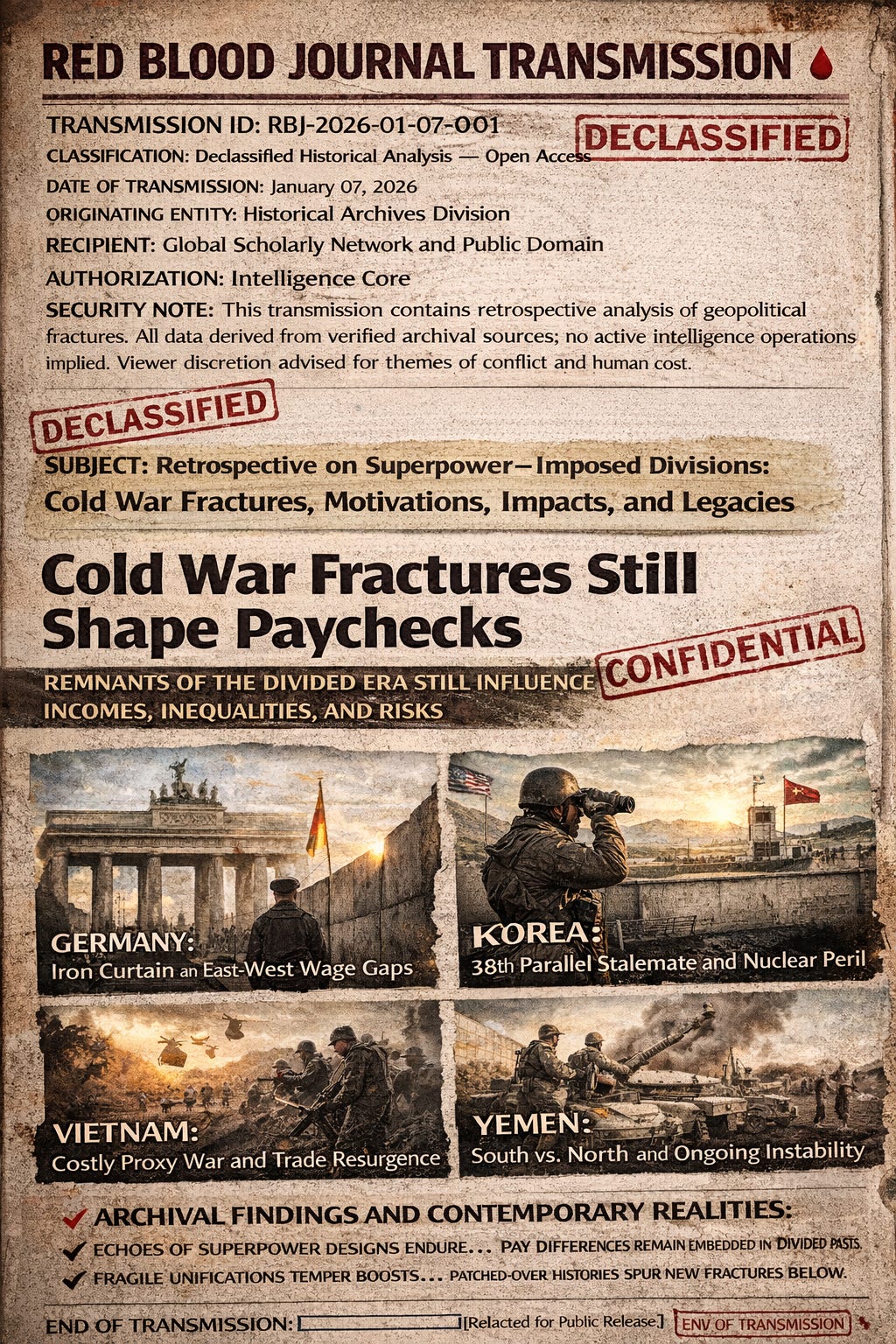
🩸 RED BLOOD JOURNAL TRANSMISSION 🩸
TRANSMISSION ID: RBJ-2026-01-07-001
CLASSIFICATION: Declassified Historical Analysis – Open Access
DATE OF TRANSMISSION: January 07, 2026
ORIGINATING ENTITY: Historical Archives Division
RECIPIENT: Global Scholarly Network and Public Domain
AUTHORIZATION: Intelligence Core
SECURITY NOTE: This transmission contains retrospective analysis of geopolitical fractures. All data derived from verified archival sources; no active intelligence operations implied. Viewer discretion advised for themes of conflict and human cost.
SUBJECT: Retrospective on Superpower-Imposed Divisions: Cold War Fractures, Motivations, Impacts, and Legacies
Executive Summary
The Cold War era (1945–1991) witnessed the United States and Soviet Union engineering national divisions as strategic maneuvers in their ideological contest. These “West/East” and “North/South” splits, imposed on vulnerable regions, served as buffers and proxies, often disregarding local sovereignty. This transmission dissects key cases—Germany, Korea, Vietnam, and Yemen—examining architects, rationales, human tolls, resolutions, and enduring echoes. Insights reveal these divisions as transient yet scarring, with reunifications underscoring resilience amid persistent inequalities. Bloodshed metrics: Millions perished in proxy conflicts; economic divergences linger as modern ghosts.
Detailed Analysis
Section 1: Germany – The Iron Curtain’s Archetype
Post-WWII conferences (Yalta, Potsdam) birthed Germany’s bifurcation, with the US/UK/France forging West Germany (1949) as a capitalist stronghold via Marshall Plan aid, while the USSR molded East Germany into a Stalinist enclave for security and ideological export. Primary perpetrators: Truman, Stalin, Marshall, and Molotov. Rationale: US containment of communism; Soviet reparations and invasion buffers.
Impacts: West’s economic boom contrasted East’s repression (Stasi, Berlin Wall 1961), fracturing families and claiming border-crossing lives. Daily existence: Western prosperity vs. Eastern shortages and surveillance.
Resolution: 1989 Wall fall, 1990 reunification via Gorbachev reforms and protests. Legacy: Unified powerhouse, yet Eastern wage gaps (20–30% lower) fuel populism. Observation: Psychological divides outlast physical ones, exposing superpower hubris.
Section 2: Korea – The Unhealed Wound
Arbitrary 38th parallel occupation (1945) evolved into permanent split: US-backed South (Rhee, 1948) vs. Soviet-supported North (Kim Il-sung). War (1950–53) entrenched it. Architects: Truman, Stalin, MacArthur. Motivations: Domino prevention (US); Asian sphere expansion (USSR).
Human Costs: 2–3 million dead; South’s industrialization vs. North’s famines (1990s, 2–3 million fatalities) and gulags. Lives: Southern freedoms and conscription; Northern indoctrination and isolation.
Status: Armistice stasis; DMZ militarization. Legacy: South’s $35K GDP/capita tech dominance vs. North’s $1.7K nuclear hermitry. Insight: Cultural drive amplifies ideological outcomes, with South’s adaptability triumphing.
Section 3: Vietnam – Nationalism Over Ideology
Geneva Accords (1954) divided at 17th parallel: North (Ho Chi Minh, USSR/China) vs. South (Diem, US). War (1955–75) followed. Key Figures: Eisenhower, Kennedy. Why: US domino fears; Soviet anti-colonial support.
Toll: 3–4 million deaths; Agent Orange legacies. North’s unity vs. South’s corruption; post-war camps and reforms (Doi Moi 1986).
Unification: 1975 Southern fall. Today: Economic boom ($124B US trade 2023), fading internal rifts. Note: Diaspora preserves trauma, contrasting homeland pragmatism.
Section 4: Yemen – Peripheral Echoes
Indirect split (1960s): North (US/Saudi lean) vs. South (Soviet communist). Motivations: Red Sea strategy.
Effects: Civil wars, tribalism. Unification (1990) fragile; ongoing conflict (2015–) displaces millions (75% aid-dependent).
Observation: Lesser direct meddling yields unstable unity, worsened by vacuums.
Comparative Insights and Archival Observations
Bloodshed Quantification: Proxy wars extracted millions in lives; economic schisms persist as inequality amplifiers.
Architectural Patterns: Conferences as division tools; US dependency-framed “freedom,” USSR repression-masked “equality.”
Endgame Dynamics: Ideology crumbles to agency—economic collapse enables reunification; entrenchment sustains divides.
Politically Charged Note: In faith-influenced regions, secular impositions clash, extending chaos beyond Cold War.
Global Ripple: Shaped modern hybrids (e.g., Vietnam’s socialist-capitalism) and risks (Korea’s nukes).
Appendices
Archival Cross-References: See RBJ transmissions on Proxy Wars (Vol. 12) and Ideological Exports (Vol. 8).
Methodological Note: Analysis synthesizes declassified docs, avoiding surface narratives for subsurface truths.
END OF TRANSMISSION
VERIFICATION HASH: [Redacted for Public Release]
CONTACT: Inquiry Portal – Reference RBJ-2026-01-07-001
🩸 Transmission Concluded 🩸
Cold War Fractures Still Shape Paychecks
🩸Cold War Fractures: The Legacy of Superpower Divisions
This declassified historical analysis examines the geopolitical fragmentation of nations orchestrated by the United States and the Soviet Union during the Cold War.
By investigating specific divisions in Germany, Korea, Vietnam, and Yemen, the text illustrates how superpower rivalries imposed artificial borders that prioritized ideological expansion over local sovereignty.
These strategic splits resulted in staggering human casualties, long-term economic disparities, and psychological scars that persist decades after the initial conflicts.
While some regions achieved reunification through economic shifts or military victory, others remain locked in dangerous stalemates or cycles of instability.
Ultimately, the source highlights how foreign intervention reshaped global geography, leaving a complex legacy of both resilient recovery and enduring systemic inequality.


