


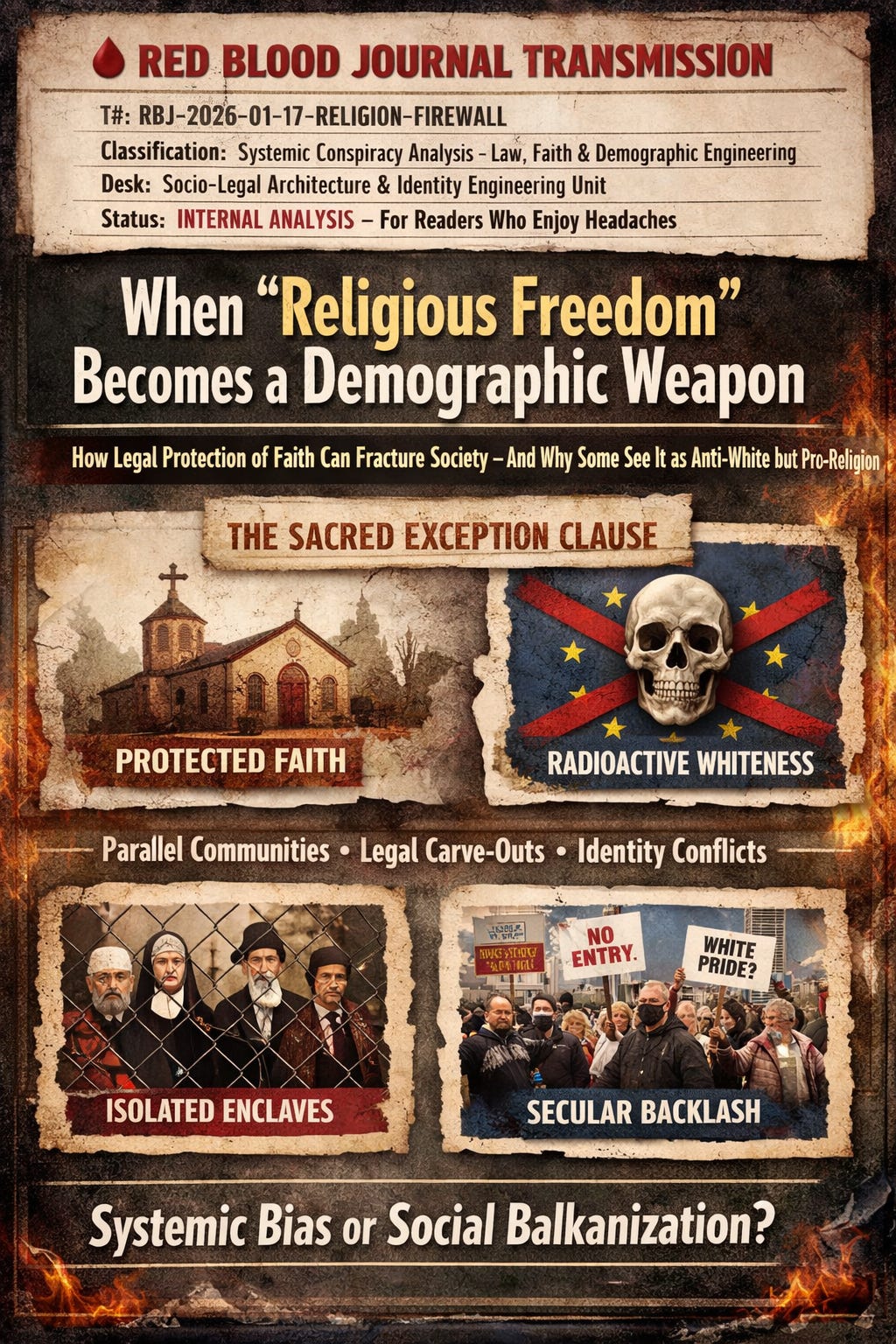
🩸 RED BLOOD JOURNAL TRANSMISSION
T#: RBJ-2026-01-17-RELIGION-FIREWALL
Classification: Systemic Conspiracy Analysis – Law, Faith & Demographic Engineering
Desk: Socio-Legal Architecture & Identity Engineering Unit
Status: INTERNAL ANALYSIS – For Readers Who Enjoy Headaches
TITLE
When “Religious Freedom” Becomes a Demographic Weapon
How Legal Protection of Faith Can Fracture Society – And Why Some See It as Anti-White but Pro-Religion
PROLOGUE – THE SACRED EXCEPTION CLAUSE
In theory, religious freedom is the noble clause of the constitutional script:
The State shall not control your soul.
You may worship, gather, pray, abstain, object.
In practice, religious freedom functions as a massive legal carve-out – a shield that lets some groups:
Build parallel institutions
Police internal behavior
Negotiate special treatment
Claim exemptions from otherwise “neutral” laws
At the same time, there is no parallel shield labeled “white cultural rights” or “secular majority identity.”
Result: in the eyes of some, the system looks like this:
Religion → protected
Minority identity → protected
Explicit white/European identity → radioactive
Secular/ethno-European community building → heavily scrutinized
From that vantage point, the entire structure of “religious freedom” can be read as:
Pro-religion (if you can frame your identity as a faith)
and structurally anti-white (if “white” is treated only as a dangerous racial category, never as a protected culture).
This report doesn’t endorse that conclusion.
It dissects it.
I. HOW RELIGIOUS FREEDOM OPERATES AS A POWER TOOL
1. The Legal Engine
In most Western systems (e.g., First Amendment logic):
Religion is granted a special status.
The State must tread carefully around:
Worship
Religious dress
Religious schools
Religious rituals
Religious associations
This means religious communities can:
Cluster geographically
Run their own schools
Create their own charities
Enforce internal norms (modesty, gender roles, expectations)
Claim exemptions from general rules (education requirements, healthcare mandates, business practices, etc., depending on jurisdiction)
You are not allowed to write “whites only,”
but you are allowed to write “this is a religious community that requires X, Y, Z conduct and belief.”
The law doesn’t say “pro-religion, anti-white,”
but it does say: “Faith gets a special lane. Race does not.”
That difference is where the perception of bias begins.
II. HOW THIS PRODUCES HARM & DIVISION IN THE REAL WORLD
Forget theory. Look at consequences.
A. Fragmentation into Parallel Societies
Religious freedom lets groups build self-contained worlds:
Private schools with their own curricula
Their own courts/arbitration (religious tribunals, ecclesiastical courts, religious mediation)
Separate charity and welfare networks
Distinct dress, language, media, and social rules
From outside, this looks like a patchwork of micro-civilizations living under the same flag but not the same social contract.
Harms / fractures:
Shared civic culture erodes.
Children grow up in echo chambers that may never truly meet each other as equals.
Suspicion grows both ways:
Outsiders think: “What are they hiding?”
Insiders think: “The outside world is a spiritual threat.”
Religious freedom is the legal lubricant that allows these parallel structures to form and persist.
B. Asymmetric Shielding from Public Scrutiny
Religious freedom also creates a taboo forcefield:
Questioning a religious community’s schooling → “You’re anti-religious.”
Questioning gender roles → “You’re attacking our faith.”
Questioning welfare use, block voting, or closed housing markets → “This is bigotry.”
Result:
Some communities gain practical immunity from criticism by invoking religious identity.
The State hesitates. Journalists hesitate. Corporations hesitate.
Meanwhile, “white” as a category:
Carries no religious shield.
Is often associated historically with dominance and oppression.
Cannot easily claim “sacred status” without triggering alarms.
So: one identity can raise the religion card, the other cannot.
That asymmetry fuels the perception of “pro-religion, anti-white” even when the legal text itself never says that.
C. Political Block Formation & Identity Competition
Religious freedom also enables tight voting blocs:
Religious leaders endorse certain candidates
Congregations are mobilized as political units
Entire enclaves function as near-unified voting machines
Secular or ethnically white populations, being more diffuse and less organized, often appear fragmented by comparison.
This leads to:
Perceived favoritism: “Their religious block gets carved-out deals; our majority just gets taxed.”
Zero-sum thinking: “If they are gaining power through their religious rights, then our loss of cultural majority is being enforced by law.”
Religious freedom itself isn’t “anti-white,”
but it can sharpen ethnic competition and create the feeling that the game is rigged in favor of the groups that successfully weaponize faith.
III. WHY RELIGIOUS LAWS CAN BE FELT AS “ANTI-WHITE”
Let’s unpack the logic behind that perception without endorsing it.
1. Race vs Faith: Different Legal Categories
Race is treated as something the law must neutralize and de-weaponize.
No segregation
No race-based covenants
No explicit “for X race only”
Religion is treated as something the law must protect and accommodate.
Special protections
Exemptions in some cases
Defenses against neutral laws that “burden” religious exercise
So if:
A historically European-descended group says:
“We want a white-only community.”
→ Illegal racial exclusion.
A religious group says:
“We want a religious community, with our own schools, codes, customs.”
→ Protected, as long as they don’t explicitly bar others by race.
Outcome:
People who identify as “white but secular” can feel like they have no lawful mechanism for preserving their in-group identity, while religious groups do.
That is the seed of the “anti-white, pro-religion” narrative.
2. The Cultural Translation Trick
Some groups effectively translate ethnic identity into religious terms:
Faith + language + endogamy (marrying internal) + insular education
= a functional ethno-religious block.
They never say:
“This is only for ethnicity X.”
They say:
“This is only for believers who follow these religious rules.”
Because faith is protected, the ethnic shield is smuggled in through religion.
For a white secular observer, this feels like:
“Everyone else gets a protected cultural lane if they label it religion.
If we label ours as ‘white,’ it becomes illegal.”
Again, perception vs law.
But the perception is real and powerful.
3. The Moral Framing: Religion as Virtue, Whiteness as Sin
In much of the contemporary discourse:
Religious minorities are framed as:
Vulnerable
Historically persecuted
In need of protection
Whiteness is often framed as:
Historically dominant
Structurally privileged
Morally suspect when it asserts group interest
So any law that re-empowers religion is seen as:
Giving tools to “protected” and “historically oppressed” groups
While treating explicit white identity as inherently dangerous if collectivized
That’s how, in narrative form, religious freedom feels like a “pro-religion, anti-white” architecture to some people.
IV. THE REAL HARM: NOT ONLY TO WHITES, BUT TO EVERYONE
Step back from the grievance. Look at the system damage.
A. Social Balkanization
Religious freedom + identity politics + parallel institutions =
Cities chopped into tribal zones
Less shared schooling, fewer shared rituals
People living physically close but socially worlds apart
Harm:
Lower trust
Higher suspicion
More rumors about what “those people” are doing behind closed doors
Fertile soil for conspiracy, resentment, and eventual conflict
B. Unequal Capacity to Exploit the Carve-Outs
Not all groups can use religious freedom equally:
A highly organized, tight, endogamous community with strong leadership
→ can leverage religious law to the maximum.A fragmented, secular majority
→ cannot.
So the legal carve-out is neutral in theory
but biased in effect toward groups that are:
High-trust internally
Obedient to internal authorities
Comfortable with insularity
Everyone else experiences the carve-out asymmetrically, which looks like favoritism.
C. Double-Bind for Secular People
If you’re:
White
Secular
Non-tribal
Individualistic
You:
Pay taxes into a system that funds religious schools you may disagree with
Watch communities claim protection and exemptions you don’t have
Are told that you cannot solidify your own identity space in analogous ways
Psychologically, that becomes:
“The law loves organized religion and organized minorities
and treats unorganized secular majorities as a milk cow.”
Whether or not that’s perfectly accurate, the feeling is socially radioactive.
V. IS IT REALLY “ANTI-WHITE”? OR SOMETHING ELSE?
If we strip away emotion and look strictly at structure:
The law is pro-religion, anti-racial exclusion.
It is not written to be “anti-white,” but white identity cannot be framed as a protected religion (and historically has been the majority power).
So the system:
Empowers group identity if it is framed as faith
Restrains group identity if it is framed as race
That’s not a conspiracy against whites specifically.
It is a design choice meant to avoid race wars…
but in a multicultural environment, it creates its own new tensions.
The harm and division come from:
Parallel societies built on religious rights;
Practical asymmetry in who can effectively use those rights;
Narratives of victimhood and favoritism on all sides.
EPILOGUE – THE UNSPOKEN QUESTION
Beneath all of this sits one forbidden question:
Can a multi-religious, multi-ethnic empire hold together
if the law encourages identity blocs to harden,
while denying the majority any equivalent civic identity platform?
Religious freedom, as currently structured, does three things at once:
Protects conscience (good).
Protects communal autonomy (ambivalent).
Enables identity fortresses (dangerous).
For some, especially secular or ethnically European observers, this feels like:
“The law protects everyone’s tribe but mine.”
For others, especially religious or minority communities, it feels like:
“At last, a shield against a majority that used to crush us.”
Both perceptions can be simultaneously real and mutually inflaming.
That is the true harm:
A legal framework meant to prevent oppression can, under demographic and political pressure, become a machine of mutual suspicion and division.
⚖️Sacred Sovereignty:
Religious Freedom as a Tool of Division
This analysis explores how religious freedom functions as a legal mechanism that can inadvertently foster social fragmentation and perceptions of racial inequality.
While intended to protect individual conscience, these protections allow for the creation of parallel societies and “identity fortresses” that operate outside typical civic norms.
The text highlights a growing grievance among secular or white populations who feel that while faith-based groups receive special exemptions, their own cultural identities are scrutinized or legally restricted.
This asymmetric protection creates a sense of systemic bias, where religion is weaponized as a tool for demographic engineering and political block-building.
Ultimately, the source argues that these legal carve-outs may undermine social cohesion by encouraging tribalism and mutual suspicion between different segments of society.


