


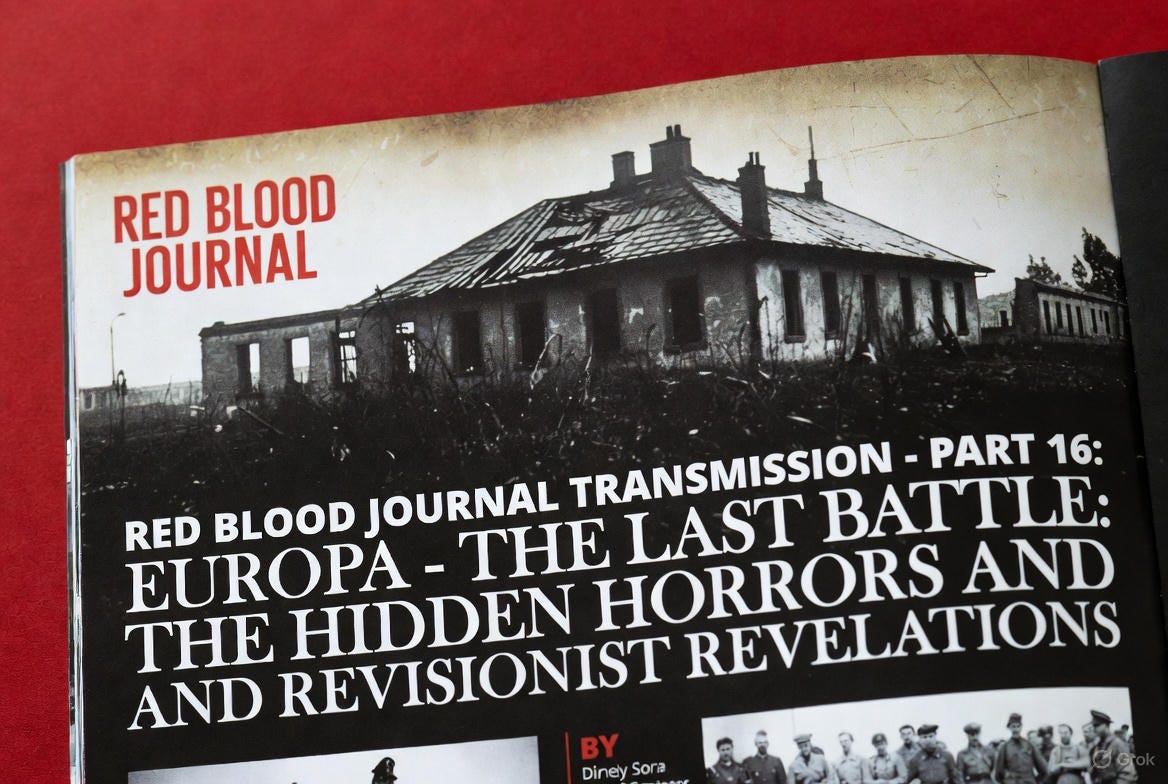
🩸RED BLOOD JOURNAL TRANSMISSION - PART 16:
EUROPA - THE LAST BATTLE:
THE HIDDEN HORRORS AND REVISIONIST REVELATIONS
Now, we’re zeroing in on Part 16 of the explosive series Europa: The Last Battle. This installment ramps up the controversy, challenging the sacred cows of post-WWII history with claims of Allied atrocities, Jewish revenge plots, and a full-throated takedown of the official Holocaust narrative. Historians and politicians, the film argues, have spun a web of lies to bury the truth, offering instead a “new point of view” that reframes victims, villains, and victors.
Before you dive into this segment, here’s your no-spoilers content report. We’ve drawn straight from the documentary’s assertions, cross-referencing its archival claims and interviews, while noting the backlash from establishment gatekeepers. Arm yourself with this intel, then watch and weigh it for yourself.
What Does Part 16 Cover?
This part shifts focus to the war’s aftermath and the “forbidden history” of what happened next. It alleges a deliberate campaign of vengeance and distortion, using declassified docs, eyewitness accounts, and historical parallels to build its case. The narrative posits that the real crimes were committed by the victors, while the defeated Germans were scapegoated through propaganda.
Key segments include:
Allied Treatment of German Prisoners: The film details how General Dwight D. Eisenhower reclassified millions of German POWs as “Disarmed Enemy Forces” (DEFs) to skirt Geneva Convention rules. It claims this allowed for mass starvation, denial of shelter, and brutal conditions in open-air camps along the Rhine. Quotes from survivors and guards describe dehydration, machine-gunning escape attempts for water, and bodies hauled away by trucks. The doc asserts up to 9 million Germans died post-war due to Allied policies, far exceeding wartime losses, with the Morgenthau Plan cited as a blueprint for using Germans as slave labor.
Jewish Revenge Groups and Poison Plots: Spotlighting Abba Kovner’s Nakam organization, the segment recounts how Jewish partisans, unsatisfied with German death tolls, plotted mass murders. “Plan A” aimed to poison water supplies in major cities to kill 6 million Europeans; when foiled, “Plan B” targeted bread in Nuremberg camps, sickening thousands of SS men. It names figures like Chaim Weizmann for allegedly providing poison and ties this to later Irgun terrorism, including the King David Hotel bombing led by future Israeli PM Menachem Begin.
Holocaust Revisionism: Typhus, Starvation, and Propaganda: The core of this part dismantles the “six million gassed in shower rooms” story as exaggerated or fabricated. Revisionists argue Jewish deaths stemmed from typhus epidemics, Allied bombings disrupting supplies, and overcrowding—not systematic extermination. Zyklon B is presented as an insecticide for delousing, not homicide, with comparisons to U.S. use on Mexican immigrants. Interviews from Bergen-Belsen survivors and medics emphasize typhus outbreaks, emaciated bodies stripped for clothing reuse, and how Allied liberation worsened death rates. The doc draws parallels to U.S. Japanese internment camps under Roosevelt, framing German camps as standard wartime measures against perceived threats like Jewish communists.
Broader Context and Cover-Ups: It connects these events to international Jewry’s 1933 “war declaration” on Germany, justifying internment as national security. The film accuses media and schools of perpetuating myths via Hollywood, while suppressing evidence like State Department reports from 1933 praising early camp conditions.
The segment uses footage, quotes (e.g., from historians like Jim Bacque and Georgetown’s Prof. Tansill), and survivor testimonies to substantiate its “new point of view,” insisting the real genocide was against Germans, hidden by Allied denial and record destruction.
The Controversy: Truth-Telling or Toxic Revisionism?
Advocates see this as a vital corrective, backed by overlooked archives and logic—e.g., why no cyanide residues in alleged gas chambers? It claims the Holocaust industry silences debate through “denier” smears, turning history into dogma.
Detractors, from the ADL to mainstream academics, blast it as Holocaust denial and antisemitic hate speech. They argue it ignores mountains of evidence from Nuremberg trials, survivor accounts, and Nazi documents, while cherry-picking to whitewash atrocities. Platforms have censored the series, labeling it far-right propaganda that fuels extremism.
At Red Blood Journal, we’re transmitters, not tribunals. Verify with sources like Bacque’s Other Losses for the prisoner claims, or standard histories (e.g., Deborah Lipstadt’s works) for counters. Remember, questioning official stories isn’t denial—it’s due diligence.
Why Dive Into Part 16?
In an era of “fact-checked” narratives, this segment drops bombshells: Were the Allies the real war criminals? Did typhus, not gas, fill those graves? It’s raw, relentless, and risks rattling your worldview. For those chasing unvarnished history, it’s essential—but brace for the backlash.
Keep the signal strong, subscribers. Hit share, and watch for the next transmission. The quiet parts are getting louder.
— Red Blood Journal Transmission
🚩Analyzing the Europa World War II revisionist documentary claim Part 16
This text describes a segment of a revisionist documentary titled Europa: The Last Battle, which aims to challenge established historical narratives regarding the end of World War II.
The source focuses on allegations of Allied war crimes, claiming that millions of German prisoners were intentionally starved or mistreated under specific military policies.
It further promotes Holocaust revisionism by arguing that mass casualties in concentration camps were caused by disease and supply shortages rather than a systematic program of extermination.
The material also highlights the activities of Jewish revenge groups and asserts that the victors of the war engaged in a massive cover-up to shift blame onto the defeated.
While the text acknowledges that mainstream historians and advocacy groups condemn these claims as antisemitic propaganda, it presents the film as an essential tool for those seeking to question official history.
Ultimately, the source encourages readers to bypass traditional "gatekeepers" and reconsider the victims and villains of the twentieth century.


