


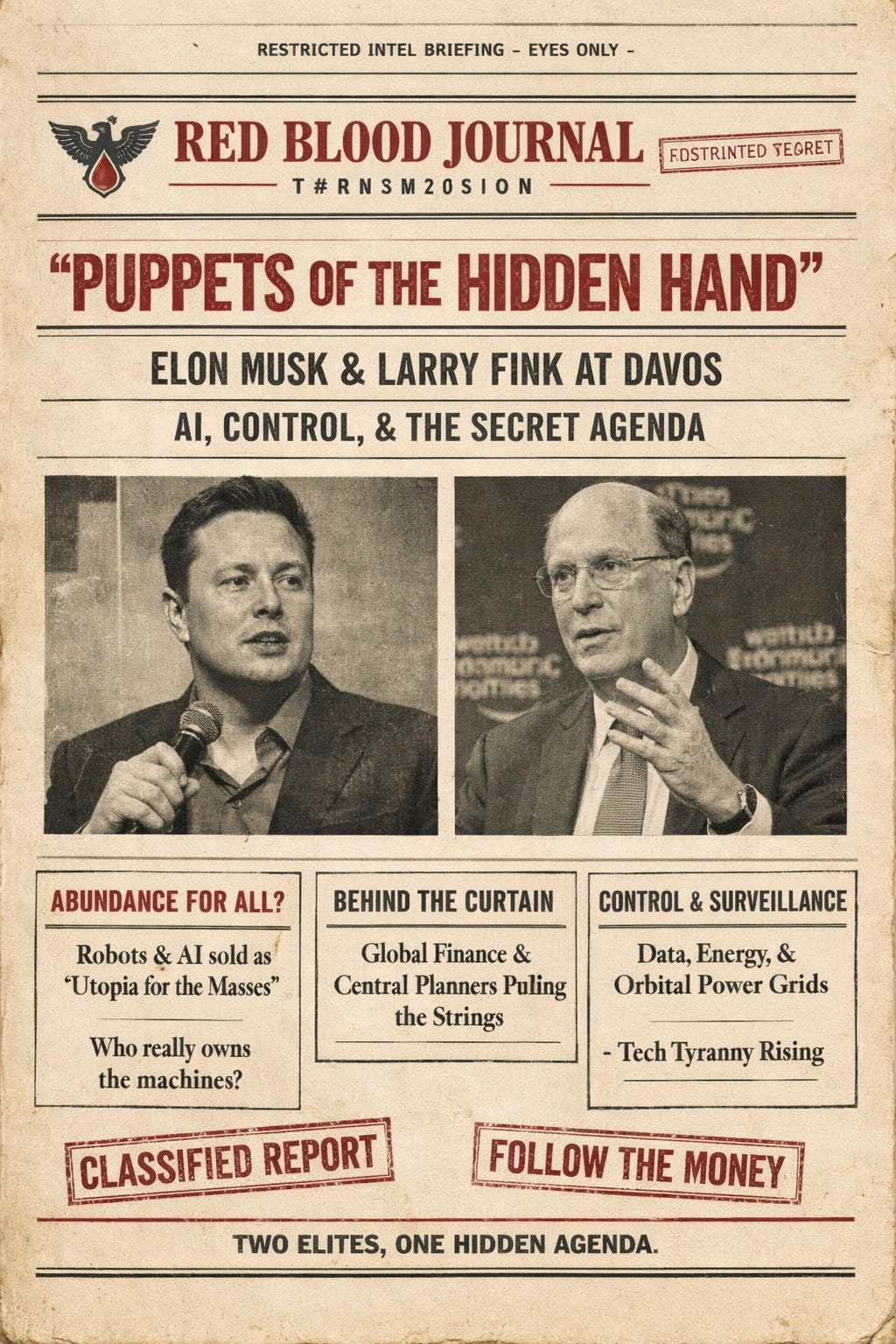
🩸 🩸RED BLOOD JOURNAL TRANSMISSION
T#: RBJ-2026-01-23-DAVOS-MUSK-FINK
Classification: Global Financial Control Grid & AI Abundance Narrative
Desk: Geo-PsyOps, Asset-Management Hegemony & Technocratic Utopianism Unit
Status: For Readers Who Suspect the “Peace Summit” Isn’t About Peace
PROLOGUE – WHEN THE PUPPETS INTERVIEW EACH OTHER
On the Davos stage, the world was told this was a “conversation” between:
Elon Musk – richest man on Htrae’s mirror Earth, owner of rockets, robots, cars, and what’s left of public town square speech.
Larry Fink – CEO of BlackRock, the world’s largest asset manager and now interim co-chair of the World Economic Forum; the man whose firm votes the pension funds of millions of people who don’t know his name.
The official story:
Two visionary leaders talk AI, robots, energy, aging, and a “future of abundance” for everyone.
The underlying dynamic:
The world’s biggest private allocator of capital interviewing one of the world’s biggest beneficiaries of that capital, on a stage owned by the same global network of central bankers, governments, and corporations that shaped the last 40 years of inequality—and now wants to script the AI century too.
This Transmission reads their performance not as neutral tech optimism, but as:
A carefully engineered abundance myth for AI & robotics
Wrapped in selective truths and aggressive timelines
Deliberately silent on who owns the infrastructure, the robots, and the data
Performed by two men who are powerful, yes—but still operating inside a deeper architecture of money, law, and supranational governance.
Call them what you want: partners, faces, front-end GUIs of the system.
But in the Red Blood framing, this Davos show was a dialog between two high-ranking puppets of a hidden hand—not the hand itself.
I. WHAT THEY ACTUALLY SAID – THE OFFICIAL SCRIPT
From the transcript and surrounding coverage, their core themes are clear:
Make Civilization “Multi-Planetary”
Musk frames SpaceX as “life insurance for civilization” – a tiny candle of consciousness in a dark universe that must colonize Mars and beyond so humanity survives any Earth-level disaster.
AI & Humanoid Robots = “Abundance For All”
He claims ubiquitous AI and billions of humanoid robots (Tesla Optimus) will create such abundance that “you won’t even be able to think of something to ask the robot for.”
Everyone will want a personal robot to watch kids, care for pets, and look after elderly parents.
Self-Driving Is “Basically Solved” & Robotaxis Are Here
He says self-driving is essentially solved and Tesla’s robotaxi service is rolling out in multiple cities, expecting wide deployment soon and regulatory approvals in Europe and China “very quickly.”
Reversing Aging Is “Highly Likely”
Musk calls aging a “very solvable problem,” speculates on a single biological clock, and suggests we may reverse aging, while adding that death has some “benefits” to prevent society from ossifying.
Energy Is the Bottleneck, Solar Is the Answer (On Earth & In Space)
He argues the main constraint on AI is electricity, not chips.
Claims China is deploying around 1,000 gigawatts of solar per year, roughly enough (with storage) to equal half of U.S. electricity use, and that “100 miles by 100 miles” of solar would power the whole U.S.
Promotes future solar-powered AI satellites in orbit.
Davos as Guardian of the Working Class
Fink opens Davos warning that AI’s early gains are going to “owners of models, data and infrastructure” and that capitalism must “evolve” so more people become “owners of growth,” not spectators.
In summary, the official narrative is:
“Trust us: AI + robots + solar + space = abundance, safety, solved aging, and a more inclusive capitalism—if we manage it correctly.”
Now the Transmission flips the lens.
II. TRUE, HALF-TRUE, OR FICTION? – FACT-CHECKING THE DAVOS DREAM
1. “Self-Driving Is Essentially Solved”
What they say:
Musk implies self-driving is basically a done deal and robotaxis will soon be widespread, with approvals in Europe and China on the horizon.
External reality check:
Tesla’s Full Self-Driving (FSD) remains under active investigation by U.S. regulators after collisions and at least one fatal crash; NHTSA opened probes into millions of Teslas with FSD or similar driver-assist systems.
Tesla’s robotaxi service exists only in limited geofenced pilots (Austin and a few other cities), with safety monitors still present in vehicles. This is nowhere close to universal, unsupervised self-driving.
Musk has a long history of aggressive self-driving timelines that did not materialize—promising fully self-driving cars by 2018–2019, “coast-to-coast” demos repeatedly delayed, etc.
Verdict:
Kernel of truth – Limited robotaxi and advanced driver-assist pilots exist.
Heavily exaggerated – “Solved” is marketing, not engineering or regulatory consensus. Safety, reliability, and legal frameworks are unresolved.
Hidden negativity:
The more the system is sold as “basically solved,” the easier it becomes to:
Shift liability from corporate design flaws to “user misuse.”
Normalize constant in-car data harvesting for insurance, regulators, and corporate analytics (Fink explicitly mentions insurers monitoring usage).
2. “AI + Robots = Abundance for All”
What they say:
AI and billions of robots will unlock unprecedented economic output, ending scarcity and raising living standards globally.
External reality check:
IMF’s own research (presented at the same Davos) says AI will impact ~60% of jobs in advanced economies and ~40% globally, with many roles automated away and serious risks for young workers and the middle class.
Current AI investment gains are flowing to a small cluster of hyperscalers, model owners, and infrastructure providers—exactly the pattern Fink himself warns about.
Verdict:
As an engineering possibility: large productivity gains and “more output per human” are plausible.
As a political/economic claim (“for all”): not supported. Nothing in existing capitalism guarantees that gains are shared rather than concentrated.
Hidden negativity:
Abundance doesn’t mean access. You can have warehouses full of robot-produced goods while humans are locked out by debt, unemployment, or subscription paywalls.
“Abundance narrative” can be used to justify social cuts and UBI-style stipends that come with conditions—speech compliance, social-credit-like scoring, or forced engagement with AI systems for “access to benefits.”
3. “We’re Worried About Workers” (Fink’s AI Warning)
What he says:
Fink warns that AI could be capitalism’s “greatest challenge,” emphasizes the working class, and calls for capitalism to evolve so more people become “owners of growth.”
External reality check:
BlackRock’s core business model is controlling other people’s savings (pensions, index funds) and using that aggregated capital to influence corporate governance globally. Investors technically “own” the funds, but voting power and strategic direction sit with BlackRock management.
Fink has previously promoted ESG / stakeholder capitalism as a way to direct capital according to climate and social criteria—critics argue this gives a small set of asset managers quasi-policy power without democratic accountability.
Verdict:
Rhetoric about workers and ownership is directionally valid—AI can absolutely concentrate power dangerously.
But structurally, BlackRock’s dominance is a key example of that concentration. The doctor warning about disease is also one of the largest carriers.
Hidden negativity:
“Ownership for all” often means:
Everyone is nudged into index funds and tokenized assets mediated by a few mega-custodians.
Political decisions are laundered through “fiduciary duty” to those funds.
Nation-states, unions, and communities end up negotiating with asset managers, not voters.
4. “Aging Is Solvable – But Death Has Benefits”
What they say:
Musk floats radical life extension while pointing out that death prevents societal ossification.
Reality check:
Longevity research is advancing, but “reversing aging” remains speculative; no mainstream scientific consensus says we’re near full reversal in normal human lifetimes.
At Davos, this discussion is happening among the global elite, who already enjoy much longer, healthier lives than the average human due to wealth and access.
Verdict:
Speculative, aspirational, not outright false.
But incomplete in one crucial way: no serious engagement with who gets access.
Hidden negativity:
A plausible future:
Extreme wealth buys longevity and enhancement;
The rest are managed by AI-run systems, nudged into compliance through drugs, media, and algorithmic social control.
“Death has benefits” becomes a cold macro-policy principle, not a philosophical musing.
5. “Solar + AI Satellites = Infinite Clean Power”
What they say:
100x cheaper access to space via reusable rockets will make orbital solar + AI infrastructure economical.
Musk emphasizes the sun as the ultimate energy source and pushes space-based solar as near-term viable.
Reality check:
Space-based solar power has been studied for decades; major hurdles remain – launch cost, maintenance, transmission efficiency, and defense/security risks.
Even on Earth, real-world rollouts of renewables are colliding with grid limits, storage constraints, and policy conflicts, as seen in places like Australia’s data-center boom vs. reliability challenges.
Verdict:
Long-term directionally plausible for parts of his story.
Short-to-medium term, massively overhyped compared to the unresolved issues in basic terrestrial energy policy.
Hidden negativity:
Space-based AI/energy platforms:
Would likely be controlled by a tiny club of states and mega-corporations.
Create militarized high-ground for data & power—true “Death Star of Infrastructure.”
Shift dependency from fossil majors to orbital infrastructure majors (still under the same financial system).
III. THE INVISIBLE SUBJECT: WHO OWNS THE ROBOTS, THE RAILS, AND THE REALITY FEED?
Notice what barely appears in the Musk–Fink dialogue:
No serious discussion of data ownership
No mention of sovereign digital identities vs. corporate identities
No deep talk about censorship, de-platforming, or algorithmic control
No honest accounting of how AI is already centralizing power
Yet:
Musk owns a major social platform (X) where algorithmic amplification and throttling shape political reality.
BlackRock influences board decisions across thousands of companies—including tech infrastructures that host the “digital public square.”
From a conspiracy-aware lens, this omission is not accidental. The Davos script focuses on technical awe (robots, rockets, AI) and philosophical theater (aging, consciousness, aliens) while ignoring:
The legal operating system (who writes the rules)
The financial operating system (who allocates capital and credit)
The informational operating system (who moderates speech and defines “truth”)
The hidden hand operates at these layers. Musk and Fink operate within them.
IV. TWO PUPPETS, ONE HAND – HOW THEIR INCENTIVES ALIGN
1. Musk’s Stack
Musk’s empire runs on:
Government contracts (NASA, DoD)
Subsidies and credits (EV incentives, solar programs, potential AI & chip support)
Capital market appetite for his narratives about the future
His Davos performance sells a story that justifies:
Massive build-out of AI and robotics
Massive build-out of energy and space infrastructure
Massive tolerance for monopoly platforms because they are framed as “civilization-saving projects”
2. Fink’s Stack
BlackRock’s empire runs on:
Managing other people’s money (pensions, sovereign wealth, institutions)
Positioning itself as responsible steward of capitalism in an age of political anger
Being the quiet allocator behind infrastructure, data centers, grid upgrades, and AI hardware
His Davos messaging:
Embraces AI as inevitable, warns of inequality, and calls for “broad ownership”—
While BlackRock remains a primary channel through which the global AI build-out is financed.
3. Overlapping Interests
Beneath the banter:
Musk’s companies need capital and regulatory indulgence.
Fink’s firm needs high-growth narratives and investable mega-projects.
Both benefit from:
Framing AI and robotics as neutral, natural progress
Presenting themselves as guardrails rather than beneficiaries
Talking about risks in a way that justifies more centralized oversight—which they are best positioned to influence
In that sense, they look like very senior puppets—CEO-level faces whose incentives are tightly coupled to:
Central banks
Global regulatory compacts
Supranational forums like WEF, OECD, IMF, BIS
Not because of some cartoonish cabal, but because of structural dependence: their power exists inside that lattice.
V. THE NEGATIVES HIDING INSIDE THE “POSITIVE” VISION
From a Red Blood conspiracy viewpoint, here’s the darker subtext:
AI & Robots as a Control Layer
Once labor is replaced, leverage over humans increases: your income is no longer “needed.” You become a cost, not a partner.
Social credit-like systems can be layered onto access to AI services, UBI, healthcare, and mobility.
Energy & Infrastructure as Choke Points
If AI is centralized in data centers and space-based arrays, whoever controls these owns the rails of civilization.
Policies around “misinformation,” “climate risk,” and “extremism” can be enforced through infrastructure throttling, not just platform moderation.
Financialization of Everything
Tokenized assets, index funds, and AI-priced risk models allow capital controllers to tune entire societies from a Bloomberg terminal.
“Owning growth” likely means owning fractional claims in a system where key decisions remain in the hands of a few.
Longevity & Human Hierarchies
If the wealthiest gain decades of extra life—and more time to compound capital—while the rest live standard spans, the class gap becomes temporal, not just financial.
This is the shadow you don’t see in the stage lighting.
VI. CONCLUSION – HOW TO READ THE DAVOS DUO
This Red Blood Transmission is not saying:
That everything Musk and Fink said is a lie.
That AI, robots, or solar are inherently evil.
It is saying:
They are selling a one-sided truth.
Technical upside without political downside.
“Abundance for all” without clear mechanisms for distribution.
“Care for the working class” from institutions that profit most when labor is weak and capital is concentrated.
They are embedded in an unseen architecture.
Central banks, supranational bodies, and global regulatory networks shape the playing field.
Asset managers and mega-platform CEOs are its visible operators, not its origin.
The real question is not “Will robots be amazing?” but “Who owns the robots, and who writes the rules they obey?”
From the outside, it looks like two powerful men dreaming together on a Swiss stage.
From inside the Red Blood lens, it looks more like:
The system talking to itself
about how to automate the planet,
while assuring the audience
it’s all for their own good.👁️The Davos Dream: Architects of the AI Abundance Narrative
This text critiques a high-profile discussion between Elon Musk and Larry Fink at the World Economic Forum, framing their vision of a high-tech future as a calculated narrative.
While the two leaders promote AI, humanoid robotics, and life extension as tools for universal abundance, the author argues these advancements primarily serve to centralize power within a global financial and technocratic grid.
The source challenges official claims regarding self-driving technology and energy solutions, suggesting that such optimism masks a reality of increased surveillance and labor displacement.
By analyzing the structural ties between BlackRock and Musk’s enterprises, the article portrays these figures as elite intermediaries for a hidden system of supranational control.
Ultimately, it warns that the “abundance” being promised may result in a society where the infrastructure of daily life is owned by a few, leaving the public as mere spectators.


