


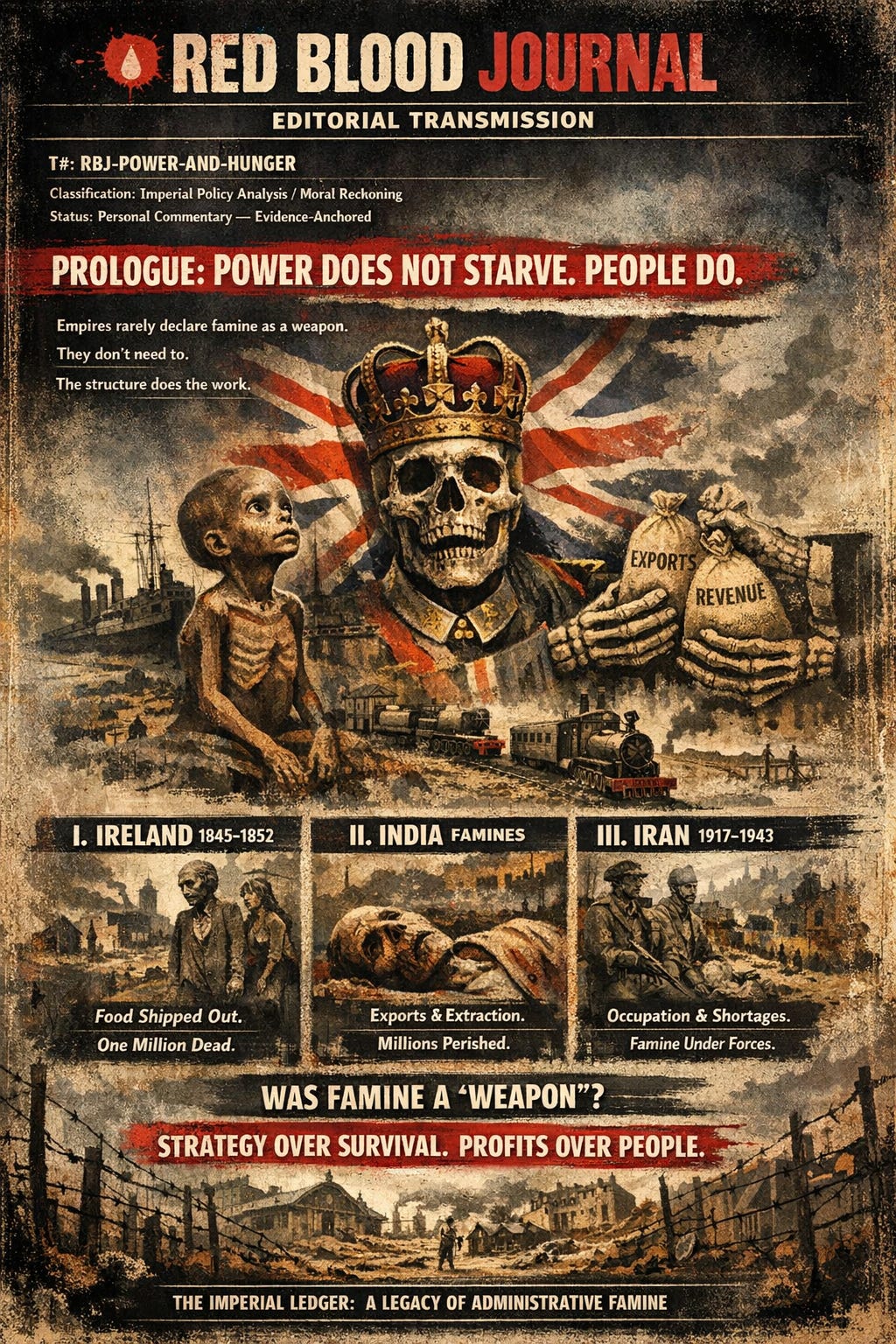
🩸 RED BLOOD JOURNAL — EDITORIAL TRANSMISSION
T#: RBJ-POWER-AND-HUNGER
Classification: Imperial Policy Analysis / Moral Reckoning / Historical Editorial
Status: Personal Commentary — Evidence-Anchored
PROLOGUE — POWER DOES NOT STARVE. PEOPLE DO.
Empires rarely declare famine as a weapon.
They don’t need to.
Famine can emerge when revenue is collected during drought, when exports continue during scarcity, when shipping is reserved for war, when relief is rationed by ideology. No decree needs to say “let them starve.” The structure does the work.
The British Empire was the largest empire in modern history. It governed trade routes, ports, railways, and granaries across continents. That scale produced infrastructure—and it produced catastrophe.
The record contains episodes where policy choices during crisis coincided with immense human loss.
The question is not whether famine was “invented” by Britain.
The question is whether imperial power prioritized strategy over survival.
I. IRELAND (1845–1852) — Governance and Grain
Great Famine
Under United Kingdom governance, potato blight struck Ireland. Food shortages escalated into mass death and migration.
What remains debated—but documented—is this:
Food exports from Ireland to Britain continued during the famine years.
Relief policy was influenced by laissez-faire economics and reluctance to disrupt markets.
Workhouses and public works were structured with strict eligibility and minimal rations.
Historians disagree on intent. They do not disagree on outcome: roughly one million dead, millions emigrated.
Power maintained fiscal orthodoxy.
The population paid the cost.
II. INDIA — REVENUE, EXPORTS, AND THE LOGIC OF RULE
1️⃣ The Great Bengal Famine (1770)
Great Bengal famine of 1770
Under the East India Company’s expanding territorial rule, drought combined with revenue extraction and market control structures. The Company did not suspend taxation at scale. Grain markets remained commercial.
Mortality reached into the millions.
The Company survived.
2️⃣ The Great Famine (1876–1878)
Great Famine of 1876–1878
Under Crown rule, southern and western India suffered crop failure. At the same time:
Grain exports from India remained high.
Relief was shaped by strict cost-containment philosophy.
Officials feared “dependency” more than mortality.
Modern scholarship widely recognizes that policy amplified natural drought into mass death.
Estimates: 5–10 million.
3️⃣ Bengal Famine (1943)
Bengal famine of 1943
World War II context. Shipping prioritized for war. “Denial policies” removed boats and rice in coastal Bengal to prevent Japanese access.
London reduced or delayed shipping allocations requested for famine relief.
The debate over causation remains complex—cyclone damage, inflation, rice distribution collapse—but the political fact stands:
Relief was subordinated to wartime priorities.
Deaths: approximately 3 million.
III. IRAN — OCCUPATION AND SHORTAGE
1️⃣ Persian Famine (1917–1919)
Persian famine of 1917–1919
Iran, officially neutral during WWI, was occupied by British, Russian, and Ottoman forces. Armies requisitioned supplies. Transport networks broke down.
Scholars debate mortality figures—estimates range widely—but the disruption of agriculture and food distribution under occupation contributed to severe famine.
2️⃣ Iranian Famine (1942–1943)
Iranian famine of 1942–1943
During the Anglo-Soviet occupation, Iran became the Allied “Persian Corridor.” Railways and food distribution were commandeered for war logistics.
Food scarcity intensified. Inflation soared.
Again: war first. Civilians later.
IV. WAS FAMINE A “WEAPON”?
Here the editorial must be disciplined.
There is no archival evidence that Britain formally declared famine policy as a weapon of extermination in these cases.
What historians do document:
Market fundamentalism during crisis.
Revenue collection during crop failure.
Export continuation amid scarcity.
Shipping reserved for imperial or wartime needs.
Relief programs designed to deter dependency.
Famine becomes a by-product of system logic.
Intent may be debated.
Outcome is not.
V. THE IMPERIAL EQUATION
Across these episodes a recurring pattern appears:
Strategic priority (war, trade, revenue, empire stability)
Ideological rigidity (free markets, fiscal discipline)
Delayed or insufficient humanitarian intervention
Mass mortality among colonized populations
Empires measure stability in balance sheets and shipping routes.
Villages measure survival in grain.
VI. THE MORAL INTERROGATION
Does this prove that “England is nonhumanitarian”?
No.
Modern Britain contains humanitarian institutions, global aid systems, and democratic accountability mechanisms unimaginable in imperial centuries.
But the imperial record does show this:
When power and profit were threatened, human survival in colonies was not always the first priority.
That is not a condemnation of a people.
It is a historical reckoning of an empire.
VII. FINAL EDITORIAL NOTE
Famine is rarely loud. It is slow. Bureaucratic. Procedural. Often defended as necessity.
The empire did not need to invent famine.
It only needed to decide that other priorities mattered more.
And history shows—at least in multiple documented cases—that it did.
⚖️The Imperial Ledger:
A Legacy of Administrative Famine
This text analyzes the historical relationship between British imperial governance and a series of catastrophic famines across Ireland, India, and Iran.
The author argues that while starvation was not necessarily an intentional weapon of war, it was often the inevitable byproduct of administrative priorities like revenue collection, free-market orthodoxy, and wartime logistics.
By examining specific crises from 1770 through 1943, the source illustrates how strategic interests and fiscal discipline were consistently prioritized over the survival of colonized populations.
The narrative suggests that these tragedies resulted from a systemic logic where the needs of the empire outweighed humanitarian concerns.
Ultimately, the document serves as a moral reckoning of how bureaucratic decisions and ideological rigidity transformed natural scarcities into mass mortality events.


