


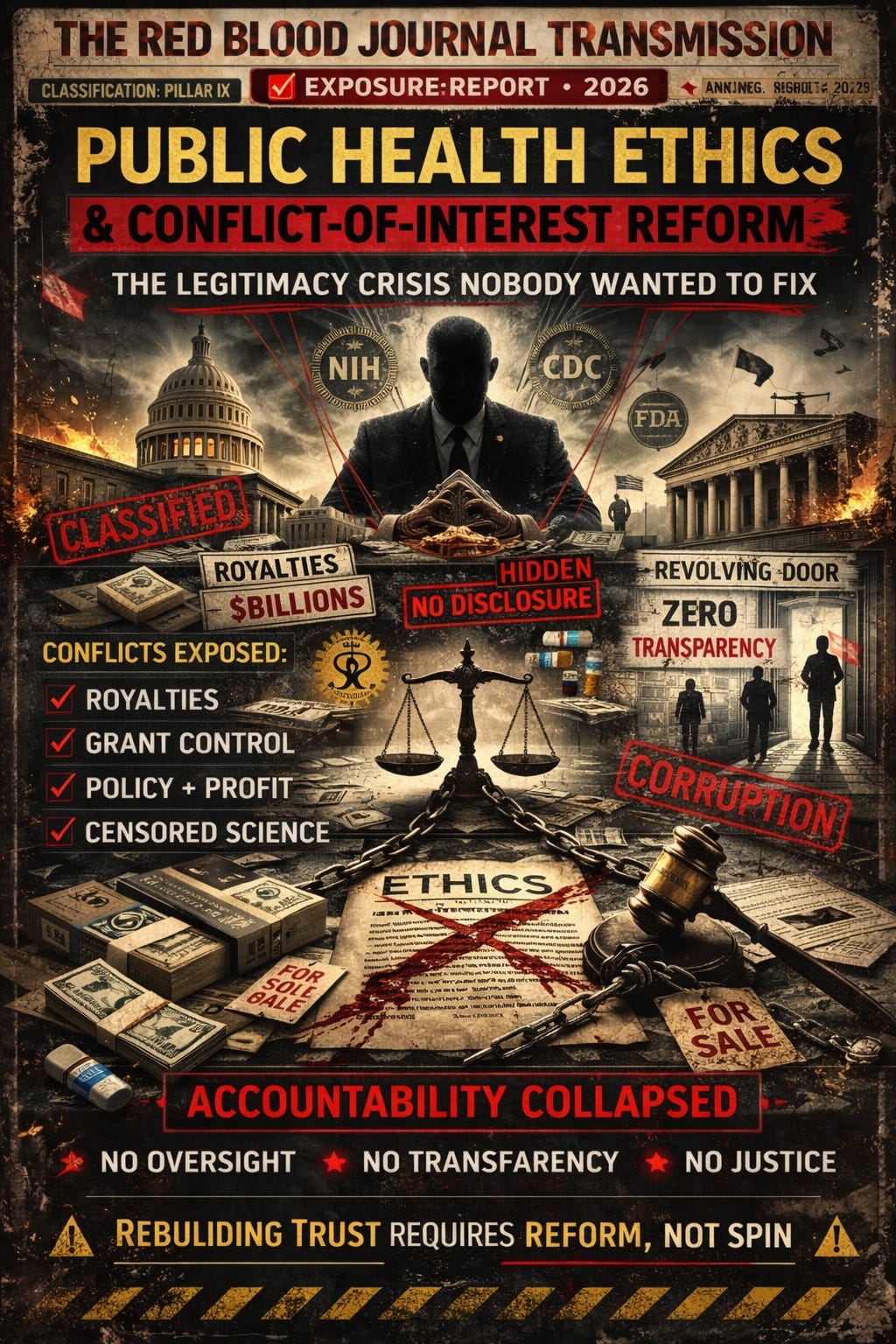
🩸 9. PUBLIC HEALTH ETHICS & CONFLICT-OF-INTEREST REFORM: THE LEGITIMACY CRISIS NOBODY WANTED TO FIX
🔥 Social Media Buzz Index: 6.2 / 10
📍 Platforms: Reddit, long-form YouTube, policy forums
📊 Why It Trends Less:
Complex and technical
Lacks emotional shock value
Gains traction only during scandal cycles
Appeals to analytical audiences more than viral crowds
Yet beneath the lower buzz lies one of the most foundational issues exposed in the Rogan × Rand Paul discussion:
Public health did not collapse because of bad science alone —
it collapsed because of ethical entanglement.
This pillar examines the structural conflicts of interest that eroded trust, blurred accountability, and turned public health institutions into credibility liabilities.
⚖️ IX.A — When Regulators Also Profit: The Core Ethical Fracture
A basic ethical principle in governance:
Those who regulate must not benefit from what they regulate.
During COVID, that line blurred.
As discussed in earlier pillars:
Government scientists were eligible for royalties
Advisory committee members did not always disclose financial ties
Agencies both funded research and evaluated its products
Officials could influence policy while connected to industry interests
Even if every decision were made in good faith, the appearance of conflict alone damages institutional legitimacy.
Trust in public health is not built on claims of integrity.
It is built on structural independence.
🧬 IX.B — The NIH Royalty Controversy: Transparency as an Afterthought
Rand Paul repeatedly emphasized one reform demand:
Full disclosure of NIH royalty payments to agency scientists.
The resistance to this request revealed a deeper problem:
Royalty amounts were shielded from public view
Agencies resisted disclosure
Oversight required prolonged pressure
The public could not easily determine financial entanglements
Ethics is not merely about avoiding corruption.
It is about preventing incentives that distort judgment.
When public health officials have financial relationships tied to biomedical products, credibility erodes — even if misconduct cannot be proven.
🧾 IX.C — Advisory Panels & Undisclosed Interests
Vaccine committees and regulatory boards hold immense power:
They recommend products
They shape mandates
They influence insurance coverage
They determine emergency authorizations
Yet questions persist:
How independent are these panels?
Are disclosures comprehensive and accessible?
Are recusal rules consistently enforced?
Do committee members evaluate products tied to prior research funding?
Public health ethics requires distance between evaluation and benefit.
That distance narrowed during the pandemic.
🏛️ IX.D — Emergency Authorizations & Ethical Trade-Offs
Emergency Use Authorizations (EUAs) accelerated medical deployment — but at a cost:
Reduced long-term data
Limited transparency
Rapid advisory processes
Expedited review under intense political pressure
Ethically, emergency powers demand heightened transparency.
Instead, the opposite often occurred:
Data release delays
Redacted documents
Limited public debate
Framing dissent as dangerous
The ethical question is not whether emergencies justify speed.
It is whether speed justifies opacity.
🔄 IX.E — Revolving Doors & Institutional Dependence
A recurring structural issue in U.S. governance:
The revolving door between:
Regulatory agencies
Pharmaceutical companies
Academic research institutions
Advisory committees
This dynamic creates:
Professional interdependence
Social networks across sectors
Career incentives aligned with industry
Soft pressure against aggressive oversight
Ethics reform cannot rely on personal virtue.
It must rely on institutional design.
🧠 IX.F — The Crisis of Credibility
The Rogan × Rand Paul conversation repeatedly returns to one theme:
Trust was not lost because people rejected science.
Trust was lost because institutions resisted transparency.
Even those who supported vaccination policies questioned:
Why were dissenting scientists silenced?
Why were internal debates hidden?
Why were financial disclosures difficult to obtain?
Why did advisory panels appear insulated from scrutiny?
Credibility collapses when institutions appear defensive rather than open.
🛠️ IX.G — What Conflict-of-Interest Reform Could Look Like
If reform were serious, it would include:
Mandatory public disclosure of all royalty payments
Strict recusal requirements for advisory panels
Prohibition of simultaneous regulator-industry financial ties
Full publication of internal scientific debates
Sunset clauses on emergency powers
Independent ethics audits for public health agencies
Strong whistleblower protections
Ethics reform is not ideological.
It is structural.
Without reform, every future crisis will inherit the same credibility deficit.
📊 Why This Topic Has Moderate Buzz (6.2 / 10)
Unlike masks or vaccines, ethics reform:
Does not trigger immediate emotional reactions
Requires sustained attention
Involves legal nuance and governance design
Peaks during scandal exposure
Resonates more in analytical communities than viral networks
But its lower viral heat hides its strategic importance.
Ethics reform is the difference between:
Public health as authority
Public health as legitimacy
Authority can be imposed.
Legitimacy must be earned.
🩸 THE RED BLOOD JOURNAL POSITION
Pillar IX concludes:
The greatest long-term damage of the pandemic was not medical —
it was ethical.
Without structural conflict-of-interest reform, public health institutions will continue to operate under suspicion.
Rebuilding trust requires more than messaging.
It requires redesign.
⚖️The Ethical Fracture:
Structural Reform in Public Health Governance
The provided text examines the eroding legitimacy of public health institutions caused by structural conflicts of interest and a lack of financial transparency.
It highlights how royalty payments to government scientists and the revolving door between regulators and industry have created an ethical fracture that undermines public trust.
The source argues that institutional credibility collapsed not because of scientific failure, but due to opaque decision-making and the appearance of financial entanglement during the pandemic.
To restore faith, the author suggests rigorous reforms, including mandatory disclosures of income and stricter recusal rules for advisory panels.
Ultimately, the text asserts that public health legitimacy must be earned through independent oversight rather than through the mere imposition of authority.


