


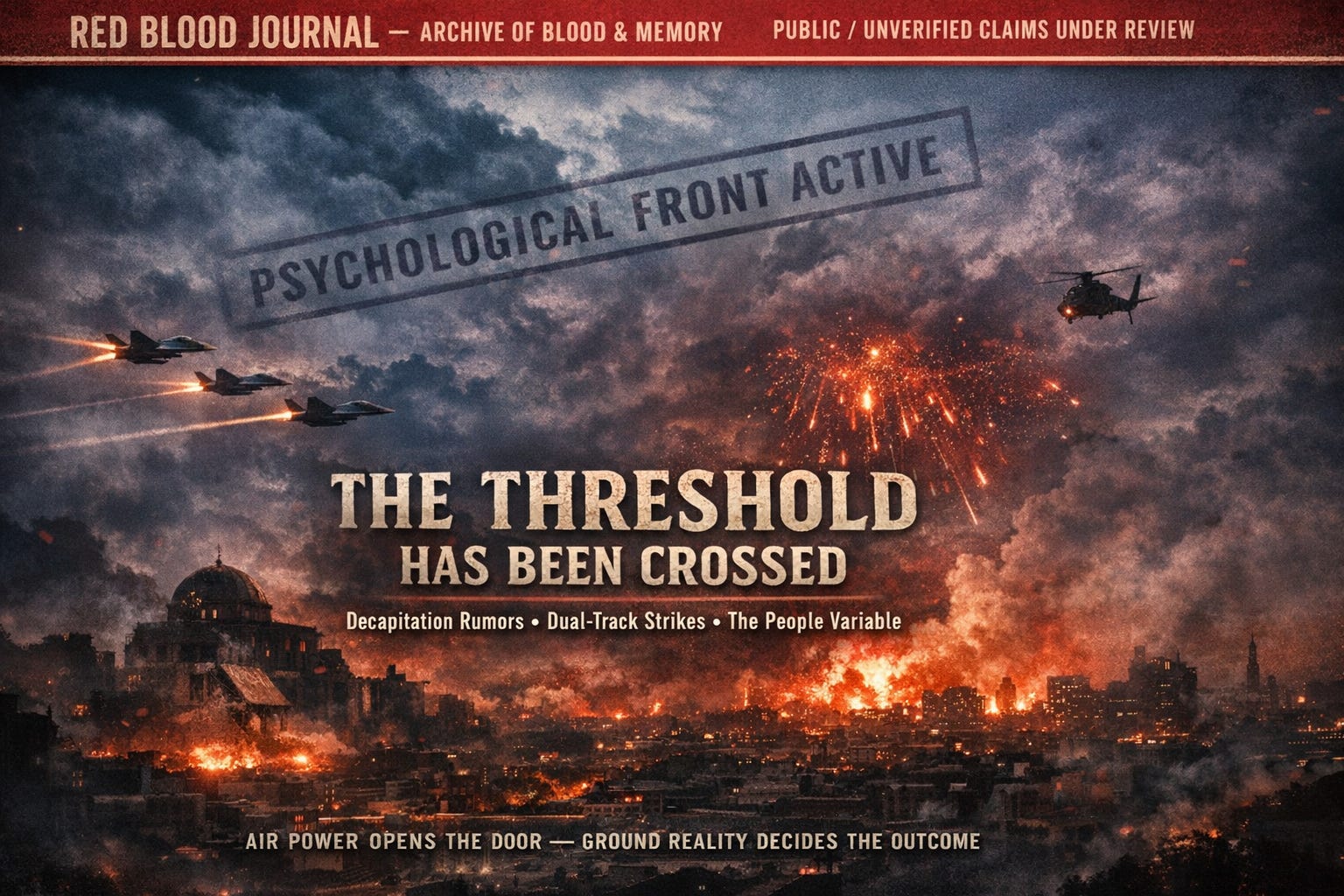
🩸 RED BLOOD JOURNAL TRANSMISSION
T#: RBJ-2026-PERSIAN-THRESHOLD-PROTOCOL
Classification: Strategic Conflict Mapping / Regime Stability Assessment / Public Morale Analysis
Status: Active War-Phase Transmission
Notice: This document analyzes circulating battlefield claims, political messaging, and strategic projections. Claims referenced include unverified reports emerging during fast-moving events.
PROLOGUE — THE NIGHT THE SKY OPENED
In the early hours, the signal changed.
Explosions replaced ambiguity.
Rumor replaced diplomacy.
And a single claim rippled across networks:
The Leader is gone.
Whether confirmed or denied, the psychological threshold had been crossed.
For the first time in 47 years, the possibility of decapitation entered public consciousness not as theory — but as headline.
This transmission does not chase emotion.
It maps the architecture of the moment.
I — THE DECAPITATION QUESTION
Reports circulating during the opening phase alleged:
Direct Israeli targeting of senior Iranian leadership.
Severe destruction of key residences.
Claims of fatalities among top IRGC command figures.
Conflicting official denials from Iranian authorities.
The strategic meaning of such claims — true or false — is identical:
Regime mortality is now imaginable.
In authoritarian systems, perception of vulnerability is often more destabilizing than confirmed loss.
The psychological front may matter as much as the kinetic one.
II — THE DIVISION OF FIRE
According to circulating analysis:
Israel — leadership targeting.
United States — infrastructure, missile systems, nuclear facilities.
A dual-track strategy.
Decapitate command.
Blind operational capacity.
Reported scale includes:
Multi-province strikes.
Missile and IRGC sites targeted.
Naval tension in the Strait of Hormuz.
Regional spillover into Gulf states.
This is not a symbolic strike.
This is systemic pressure.
III — THE VANCE DOCTRINE: “NO LONG WAR”
Vice President JD Vance introduced the core framework:
Not Iraq.
Not Afghanistan.
No endless ground occupation.
This messaging serves two functions:
Reassure American war-fatigued voters.
Signal to Tehran that escalation may be swift but limited.
The phrase “overlearning from Iraq” surfaced.
Meaning:
Do not let past failure paralyze present action.
The message to both audiences was clear:
This will be fast. Controlled. Finite.
Whether reality follows rhetoric remains unknown.
IV — TRUMP’S CALIBRATED AMBIGUITY
Trump’s public posture:
Prefers diplomacy.
Dissatisfied with negotiations.
Prepared to use force.
Uncertain whether regime change would follow.
He referenced:
Soleimani.
Al-Baghdadi.
Prior targeted operations.
His message:
America does not seek ground war.
But America will strike if necessary.
Oil prices dismissed.
Human lives emphasized.
Military supremacy asserted.
The door to diplomacy was left ajar —
but the runway for escalation was fully paved.
V — AIRSTRIKE VS COLLAPSE
A key debate emerging from strategic commentary:
Does decapitation equal regime collapse?
Counter-analysis argues:
IRGC and Basij structures are decentralized.
Thousands of mid-level enforcers implicated in repression.
Fear of prosecution may harden resistance.
Air superiority alone does not remove ground control.
Conclusion of that line of thought:
Bombardment weakens.
It does not automatically dissolve.
Regime survival may depend less on missiles —
and more on street control.
VI — THE PEOPLE VARIABLE
Perhaps the most volatile component:
Public sentiment appears divided but shifting.
Reports suggest:
Segments of the population view strikes as liberation.
Anti-regime anger extends even into some security families.
Opposition figures frame this as a historic window.
Yet the structural warning stands:
If external strikes stop,
and internal uprising does not materialize,
a wounded but intact regime could reassert control.
Air power opens a door.
Only domestic mobilization determines whether it stays open.
VII — REGIONAL EXPANSION RISK
Alleged retaliatory actions include:
Strikes toward Gulf states.
Maritime disruption threats.
Missile launches toward Israel.
If escalation widens:
Hormuz becomes critical.
Oil markets destabilize.
Hezbollah and Mediterranean assets enter calculation.
This remains a contained strike — for now.
History teaches containment is fragile.
VIII — THE SOVIET PARALLEL WHISPER
Some commentators invoke:
“Small Soviet scenario.”
Naval positioning.
Negotiation pressure.
Rapid military superiority.
Internal collapse trigger.
But history does not repeat mechanically.
It echoes — and mutates.
Iran is not the USSR.
The IRGC is not the Red Army.
The social fabric is different.
Outcome remains probabilistic.
IX — THE STRATEGIC TRUTH
Three realities coexist:
Airstrikes alone may not topple the regime.
Ground invasion appears unlikely.
Internal uprising becomes the decisive factor.
Which means:
The battlefield is not only in the sky.
It is in the streets.
X — THE THRESHOLD MOMENT
This phase represents something larger than a military exchange.
It is a legitimacy test.
For the regime.
For the opposition.
For external actors.
If leadership loss is confirmed, history accelerates.
If denied but psychologically accepted, instability spreads.
If bombing continues without internal shift, stalemate forms.
If uprising ignites while air superiority holds —
The structure fractures.
FINAL TRANSMISSION NOTE
There are moments when geopolitics becomes personal.
When external force intersects internal exhaustion.
When fear of change becomes smaller than fear of continuation.
This may be such a moment.
Or it may be another violent chapter in a long, unresolved struggle.
The sky has opened.
The question now is not whether bombs fall.
The question is:
Who moves when they stop?
🦅Persian Threshold:
Mapping the Architecture of Regime Collapse
The provided document, titled “Persian Threshold,” analyzes a critical shift in the geopolitical landscape following reported military strikes against the Iranian leadership.
It examines a dual-track strategy involving precision targeting by Israel and infrastructure degradation by the United States, framed by a desire to avoid protracted ground conflicts.
Central to the analysis is the psychological impact of potential regime decapitation, suggesting that the perception of vulnerability may be more destabilizing than actual kinetic loss.
While the Vance Doctrine emphasizes rapid, finite operations, the text warns that airstrikes alone may not dissolve a decentralized power structure like the IRGC.
Ultimately, the source posits that the regime’s fate depends less on external bombardment and more on the mobilization of the domestic population to seize this historic window of instability.
This strategic assessment concludes that while air superiority can fracture a government’s legitimacy, only internal uprising determines if a systemic collapse occurs.


