


🩸 RED BLOOD JOURNAL TRANSMISSION
T#: RBJ–2026–01–09–FISHBACK–FLA–PART VI
Classification: Campaign War-Gaming & Civic Fault Lines – Florida 2026 as Proxy Battlefield
Subject: Can Fishback Win, and What Does “Old Florida vs New Florida” Really Mean?
Source: Tucker Carlson Interview, January 9, 2026 (Part 6)

🩸 PART VI REPORT
“OLD FLORIDA VS NEW FLORIDA” — THE FINAL PITCH AND THE BATTLEFIELD AHEAD
The final segment of the Tucker–Fishback conversation closes with three interlocking themes:
Patriotism and contempt – what it means to stand (or refuse to stand) for the American flag.
The path to victory – money, media, Waffle House, and a closed primary.
The next fault lines – free speech, foreign taboos, immigration, and who Florida’s public schools are ultimately for.
Taken together, Part VI frames Florida’s 2026 governor’s race as a proxy war for the soul of the Republican Party and, by extension, the model of what “America First” will mean going forward.
1. Standing for the Anthem: Reverence vs Contempt
Fishback begins with something deceptively simple: standing for a national anthem.
His mother is Colombian; he spent childhood summers there.
He is explicit: he does not identify as Colombian, but as an American—and says his mother feels the same.
He describes the idea of attending a Colombian soccer match (football) and sitting through their anthem as unthinkable; it would be an act of blatant disrespect.
He applies the same logic to the United States:
To refuse to stand for the American anthem—whatever your disagreements on the Supreme Court, abortion, or any other issue—is, in his words, to hold “the most vile form of contempt for this nation and her people.”
In the Red Blood lens, this isn’t about sports rituals.
It’s about declaration of allegiance: you are either inside the project called America, or you’re only renting space within it.
2. “Can You Win?” – The Attention Economy vs 45 Million Dollars
Tucker asks the central question: can Fishback actually win in a system he calls “so corrupt” he usually avoids it?
Fishback’s response:
He will not out-raise Byron Donalds.
He will not out-spend him.
But Trump didn’t outspend Hillary or Kamala either.
The battlefield, as he defines it, isn’t money—it’s attention and connection:
We live in an attention economy.
The candidate who wins is the one who shows up and earns trust, not the one who sits in a Fox studio four days a week.
Fishback roots his claim to Florida in four generations:
He lives there now.
His father grew up there.
His grandfather taught there.
His great-grandfather ran a hotel on Fort Lauderdale Beach.
His promise:
“This is my home and I’m not going to let it be stolen – least of all by Byron Donalds and his donors.”
3. The Ground Game: 67 Counties and a Waffle House Tour
Fishback outlines a classic retail-politics insurgency:
Visit all 67 Florida counties in three months.
In just the first five weeks, he says he has already visited 12.
Visit every state college.
Launch a statewide Waffle House tour, meeting voters where they already are.
The symbolism is deliberate:
Not fundraising galas.
Not think-tank conferences.
Waffle House at midnight, college student unions, small-town diners—spaces where the political class rarely goes except for photo ops.
Fishback’s standard:
Voters are “hiring” a governor.
Therefore, he says, he should never hide from them; if they want to yell, debate, or question, that’s part of the job interview.
4. Small-Dollar Insurgency vs Donor Capture
Tucker presses the money question: where will funding come from?
Fishback’s answer:
Primarily small-dollar donors.
He’s willing to meet any donor—but only on the condition that:
They are supporting an already-defined campaign.
They do not shape its platform.
He invites the public to “hold his feet to the fire” on that commitment.
He then contextualizes this within Florida’s recent political history:
In 2018, Adam Putnam was the establishment favorite for governor—long-time family name, donor backing.
Ron DeSantis was the challenger.
The race turned on a Fox News primary debate, where the two men faced each other without handlers, live for 2.5 million GOP viewers.
Fishback’s thesis:
Put him on that same kind of stage with Byron Donalds, and he’ll end Donalds’ career—and prove his vision of Florida to be the superior one.
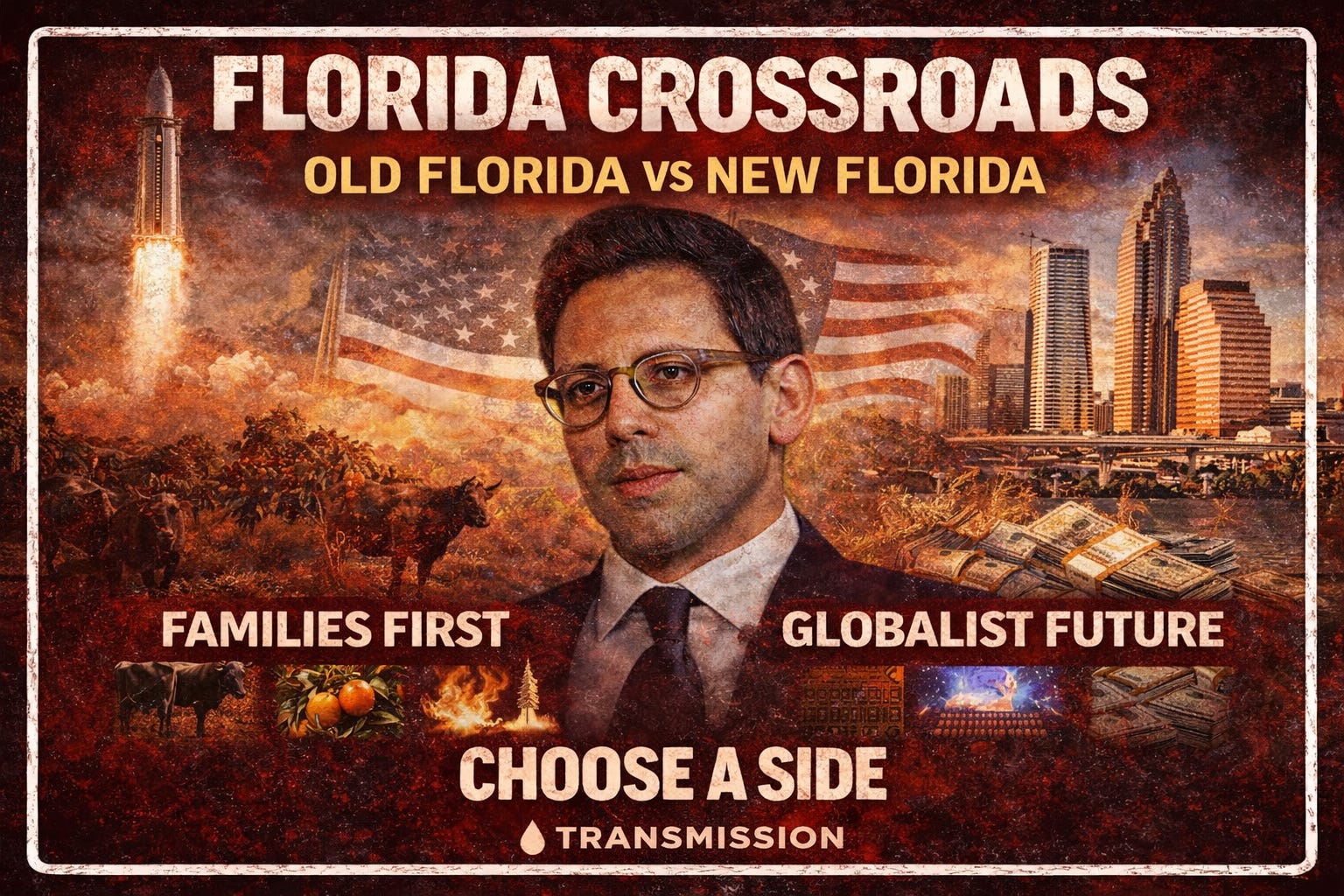
5. Old Florida vs New Florida – Two Competing Futures
Fishback frames the race as a fork in the road:
“New Florida” – The Byron/Donor Vision (as he describes it)
Make Florida the financial capital of the world.
Accelerate construction of AI data centers.
Double down on finance and tech as the state’s defining industries.
“Old Florida” – The Fishback Vision
Restore:
Cattle, citrus, space, and agriculture as pillars of the economy.
Halt or reverse overdevelopment and sprawl that he says has destroyed communities.
Protect land, traditional industries, and small towns from being paved over for speculative projects.
His appeal:
If you want Florida to become another global financial node, vote for them.
If you want Florida to remain recognizably Florida, he wants your vote.
6. The Jay Collins Question – Free Speech and “Hurtful Words”
The conversation then pivots back to speech and foreign policy taboos.
Tucker describes a clip of Lieutenant Governor Jay Collins:
Collins appears to argue that people do not have the right to say things that “hurt” others.
The context: criticism of Israel and the boundaries of “free speech.”
Fishback confirms:
Yes, the clip is real.
Yes, Collins said, “You do not have a right to hurt people with your words.”
Tucker points out the irony:
That formulation—“words as violence”—is straight out of left-wing campus ideology.
To hear it from a Republican official is, in his words, surreal.
Fishback responds with ridicule and a pointed example:
Collins criticized Venezuelan leader Nicolás Maduro in a post.
Fishback replied sarcastically that, under Collins’ own standards, he should file a “hate crime speech” complaint against the lieutenant governor for using “harmful words” against Maduro.
The point:
If speech that offends one group can be policed, it can be policed everywhere.
Once “hurt feelings” become the legal standard, the First Amendment is effectively dead.
Fishback then broadens this into a larger claim:
The Florida GOP’s internal struggle in 2026 will serve as an early proxy fight for the entire Republican Party’s future identity:
Will it embrace free speech, national interest, and substantive loyalty?
Or drift toward donor-protected, speech-regulating, globalist-aligned conservatism?
7. Open Field: No DeSantis Endorsement, New Voters in Play
Fishback notes:
DeSantis has not endorsed Byron Donalds.
Nor has he endorsed Jay Collins.
The race is, for the moment, wide open.
He offers an anecdote that functions as a microcosm of his hoped-for coalition:
At a Chipotle stop, a 22-year-old maintenance worker named Aiden recognizes him.
Aiden has never voted in any election.
He pledges to change party registration to Republican and cast his first-ever ballot for Fishback in the August 18 primary.
To Fishback, this is the model:
Converting independents and low-propensity voters.
Attracting “Dixie Democrats” who still haven’t formally switched parties.
Building a bloc that donor-funded candidates, despite money and media exposure, have not locked down.
He points to polling showing roughly 54% of GOP voters still undecided despite Byron Donalds’ 11 months in the race, $45 million war chest, and constant cable exposure.
In his telling, that undecided mass is the audience for a different vision.
8. Closed Primary Mechanics and the Teacher Pitch
Fishback then gets tactical:
Primary date: August 18.
Registration cut-off: around July 20 for party changes.
System: closed Republican primary—only registered Republicans can vote.
He encourages independents and “Dixie Democrats” (in his language) who lean Republican in practice to formally switch in order to have a say at the real decision point, which he argues is August, not November, in a deep-red state.
Then he turns to a key demographic: public school teachers.
His pitch, summarized:
Florida has, by his count, roughly 1.4 million undocumented immigrants, many with children in public schools.
Teachers struggle with classes where a quarter to a third of students don’t speak English.
Teacher pay in Florida is near the bottom nationally.
He argues this setup dilutes education for citizens and overloads teachers.
His proposed response:
Executive Order #4 as governor: remove undocumented children from Florida public schools.
Challenge the Supreme Court’s 1982 Plyler v. Doe decision, which held that states must provide K–12 education regardless of legal status.
He frames this not as cruelty, but as ending what he sees as cruelty toward American students and overburdened teachers.
Whatever one thinks of this policy, in the Fishback narrative it’s framed as:
A test of whether the state exists primarily to serve its citizens, or as an all-purpose service hub for whoever arrives.
9. Red Blood Journal Summary – Part VI
Part VI is the closing argument of the six-part series:
National Reverence: Refusing to stand for the anthem is treated as open contempt for the country, not quirky dissent.
Path to Victory: He bets on attention, authenticity, county-by-county contact, and small-dollar donors over big checks and cable news bookings.
Old vs New Florida:
New Florida: AI data centers, global finance hub, rapid development.
Old Florida: cattle, citrus, space, agriculture, and limits on overdevelopment.
Speech and Loyalty: A Republican lieutenant governor echoing “words are violence” ideology becomes a symbol of how donor-driven conservatism is drifting into speech restriction and foreign deference.
Proxy War for 2028: The 2026 governor’s primary, in his framing, previews what the GOP will be in 2028—
a party of free citizens in one nation, or a party of regulated speech, divided loyalties, and imported feuds.Schools and Borders: The final note is hard-edged: public resources, especially schools, should prioritize citizens first—even if that means legally challenging long-standing Supreme Court doctrine.
For Red Blood Journal purposes, Part VI functions as the campaign manifesto distilled:
Florida 2026 isn’t just about one statehouse race.
It is a referendum on whether the American right will be governed by donors, data centers, and taboo words,
or by families, farms, and a single flag.
🩸 END OF PART VI / END OF SERIES
🚩The Fishback Manifesto: The Battle for Old Florida
This document outlines a political manifesto for a 2026 Florida gubernatorial candidate who frames the upcoming election as a battle for the state’s identity.
The text contrasts “New Florida,” a vision driven by global finance and technological development, against “Old Florida,” which prioritizes traditional industries like agriculture and the preservation of local communities.
The candidate promotes a populist, insurgent campaign strategy, relying on retail politics and small-dollar donations rather than establishment funding.
Key policy positions include a strict defense of unrestricted free speech and a controversial plan to prioritize public school resources exclusively for legal citizens.
Ultimately, the source presents this race as a proxy war that will determine the future direction of the Republican Party and the broader “America First” movement.


