



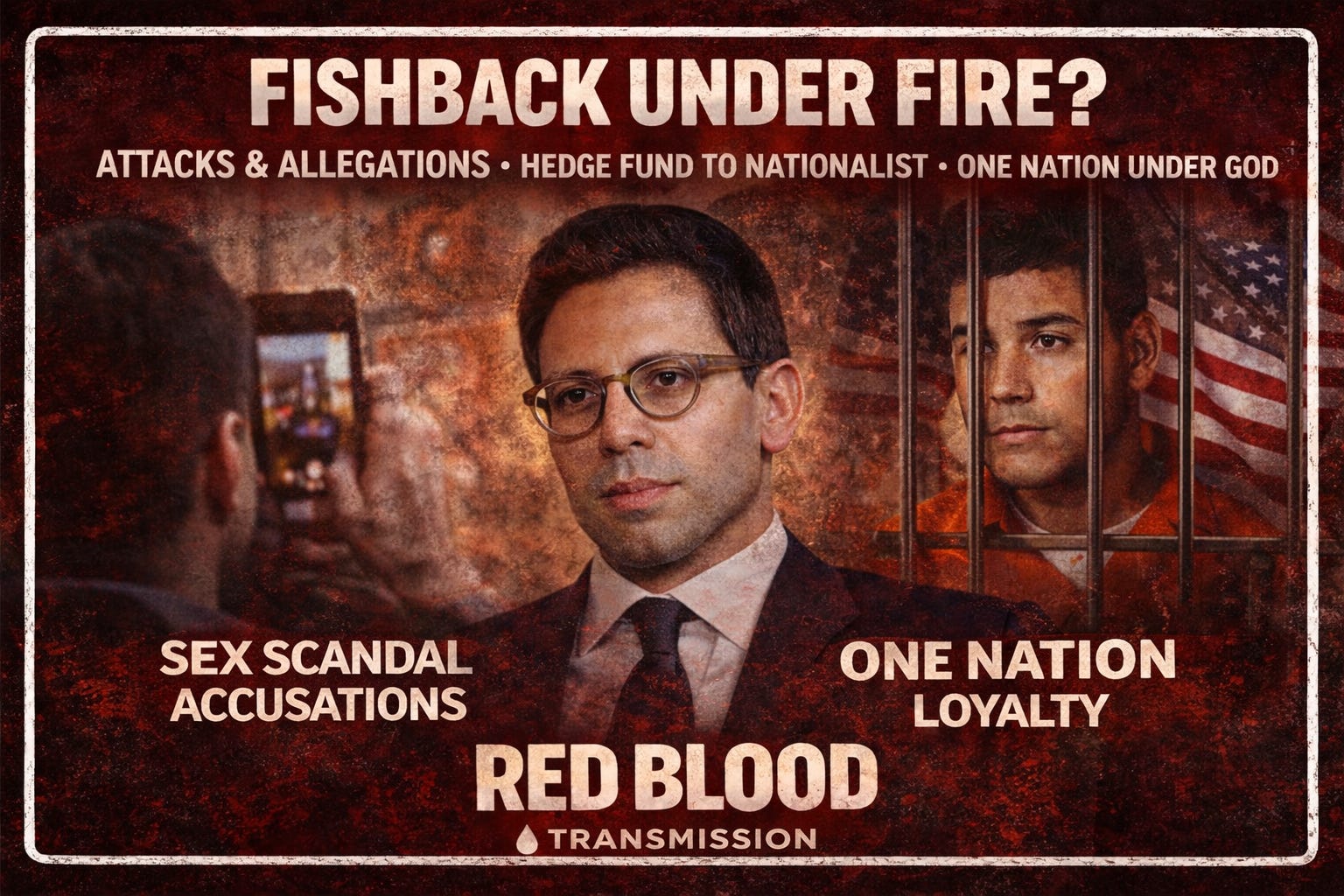
🩸 RED BLOOD JOURNAL TRANSMISSION
T#: RBJ–2026–01–09–FISHBACK–FLA–PART V
Classification: Reputation Warfare, Economic Awakening & National Allegiance
Subject: Character Assassination, Hedge-Fund Conversion, and the One-Nation Principle
Source: Tucker Carlson Interview, January 9, 2026 (Part 5)
🩸 PART V REPORT
“OPEN BOOK UNDER FIRE” — How Fishback Frames Smears, Conversion, and Loyalty
In Part 5 of the interview, the temperature shifts from policy to personal warfare and spiritual realignment.
The themes are threefold:
Character attacks and the politics of allegation.
Fishback’s ideological shift from Bloomberg-terminal economics to family-centered nationalism.
The “one nation” doctrine—no imported feuds, no divided loyalties.
This is where Fishback tries to prove he’s not just another talker, but a man who has been changed by what he’s seen.
1. Sex Smears and Due Process
Tucker opens by addressing the elephant in the room:
once Fishback became a political threat, opponents began pushing a narrative that he was involved in a sex scandal.
Key points Fishback stresses:
He was never charged with any crime.
Allegations were litigated in Florida’s Second Judicial Circuit.
After two lengthy hearings (about seven hours total), a judge found the accusations not credible, with “no evidence to support it,” and effectively exonerated him.
Fishback’s framing:
False accusations against men are “all too common” in modern politics.
The fact that this was already adjudicated, yet revived once he ran for governor, proves (in his view) that the establishment is scared of his candidacy.
He accepts that running a large state means his life becomes an “open book” — cameras outside his house, people filming him at bars — and says he welcomes that scrutiny.
Tucker’s role here is to call out what he sees as hypocrisy:
if critics themselves have chaotic private lives, their moral authority to smear others is questionable.
2. From Hedge Fund Terminal to Hollowed-Out Towns
The second half of this segment pivots to Fishback’s conversion story—how his worldview changed.
Background:
Dropped out of college in 2015 to start a hedge fund.
Spent years as a macro trader, glued to the Bloomberg terminal.
Obsessed over GDP, inflation prints, Fed moves, COVID-era money printing, stimulus, and fiscal transfers.
In that world:
Success is measured by trades and ticks, not families and towns.
The unit of meaning is the chart, not the neighborhood.
The turn:
Fishback says his outlook shifted when he:
Founded Incubate Debate, a nonprofit offering free debate leagues across Florida.
Traveled to previously thriving towns now hollowed out.
Saw real people behind the abstractions of GDP and “consumer spending.”
He contrasts two metrics:
Old metric: GDP growth, stock surges, another trillion in AI market cap.
New metric (inspired by Nathan Heller/Hoblestott, as he cites):
What percentage of 30-year-old men are married and own a home?
Fishback argues that:
Economic policy should be judged by whether it increases that percentage.
AI data centers employing 50 foreign workers don’t move that needle.
Revitalizing citrus, rebuilding local industry, ending H-1B abuse, and blocking Blackstone-style bulk home purchases do.
His confession:
he once imbibed the worldview of Brookings, AEI, Heritage and the D.C. think-tank circuit—
and now sees that orientation as incomplete and detached from the lived reality of Florida families.
3. X, AF Post, and the “Slow Red-Pill”
Fishback insists real ideological change rarely comes from a single viral moment; it comes from a steady drip of context:
He credits Tucker’s 2020 monologues as formative for both him and his grandmother.
More recently, he cites the X account AF Post, which:
Posts constant updates about layoffs and H-1B hiring.
Puts corporate announcements in context (e.g., “30,000 Americans fired, 10,000 H-1Bs added”).
Exposes how big media often reports half the story.
For Fishback, this continuous stream of information reshaped his understanding of:
Labor arbitrage
Corporate disloyalty
How heavily rigged the job market is against Americans
4. “I Was Wrong on Israel” — Propaganda Trips and a Florida Teen in a Military Prison
The most sensitive part of Part 5 is Fishback’s explanation of how his stance on Israel changed.
Stage 1: Establishment Alignment
He wrote for Bari Weiss’s Free Press in 2023 about high school debate going woke.
He publicly supported her work on antisemitism at the time.
He saw campus radicals screaming at Jewish students and lumped that in under “antisemitism” generally.
Stage 2: Propaganda Trip Realization
He was invited on a sponsored trip to Israel for young professionals.
He says he discovered it functioned like a guided narrative exercise:
Restricted movement, supervision of where he could go.
Expectations for what he would say publicly afterward.
Pressure to “clear” his stories before posting.
That experience made him wary of scripted loyalty.
Stage 3: The Case of Mohamed Ibrahim
Fishback describes a specific case:
A 16-year-old American citizen from Florida, Mohamed Ibrahim, visiting family in the West Bank.
Accused of throwing a rock at a vehicle.
No trial, no due process, held in a military prison for eight months, lost weight, contracted illness.
Fishback’s conclusion:
If Israel is held up as “the only democracy in the Middle East,” rule of law must apply especially to American citizens.
He filmed a video about the case and even texted it directly to Trump, asking for intervention.
When he spoke up, he was accused of antisemitism by political opponents.
This becomes a test case in his mind:
Criticism of a foreign ally’s treatment of a U.S. citizen is not hatred — it’s loyalty to Americans.
5. No Imported Feuds: The “One Nation Under God” Doctrine
The segment closes on a principle that ties immigration, religion, and foreign policy together:
Tucker and Fishback argue that America must not be used as a battlefield for old-world ethnic and sectarian conflicts—whether from the Middle East, the Caribbean, or anywhere else.
They object to using U.S. politics as a vehicle for age-old grudges.
Fishback cites a black pastor’s reminder about the Pledge of Allegiance:
“One nation, under God.”
From this, he draws several policy implications:
Public schools should restore and require daily recitation of the pledge.
Immigrants who come here should commit to one national loyalty.
No divided allegiances:
No serving in a foreign military while holding U.S. citizenship.
No dual citizenship if it conflicts with American interests.
No advocacy of foreign state priorities over those of the United States.
His standard is simple but strict:
“When you stand for our pledge, you must adhere to the principle of one nation.
I don’t care where you came from. Once you are here, that loyalty comes first.”
He insists these are normal rules for any serious country—and the fact that America hesitates to enforce them is, in his view, a sign of how far its political class has drifted.
6. Red Blood Journal Summary — Part V
Part 5 is the autopsy of a conversion:
Reputation Warfare:
Allegations surface when he becomes a threat; he points to a court record to claim exoneration and frames attacks as proof of establishment fear.Economic Awakening:
A former hedge-fund macro trader abandons GDP worship and adopts a family-centric metric:
How many 30-year-old men are married homeowners?National Priorities:
He now judges AI data centers, bond-buying, H-1B pipelines, and foreign aid by one question:
Does this make it easier for Americans to form families and own homes?Foreign Policy Shift:
From writing in establishment outlets to questioning propaganda trips and defending an American teen detained abroad, he redefines criticism of Israel as loyalty to Americans, not hostility to Jews.One-Nation Principle:
He insists America must not host imported conflicts or competing national allegiances; pledging allegiance means one flag, one people, one primary loyalty.
In the logic of this transmission, Part 5 is the bridge between:
James Fishback the trader
and
James Fishback the nationalist candidate
— and between abstract metrics and embodied lives.
🇺🇸
The Fishback Conversion: National Allegiance and Economic Realignment
This document analyzes an interview with James Fishback, detailing his transition from a hedge-fund trader to a nationalist political candidate.
The text outlines how Fishback addresses personal scandals by claiming legal vindication and framing the attacks as political character assassination.
He rejects traditional economic metrics like GDP growth, proposing instead that national success be measured by housing affordability and family formation for young Americans.
Fishback also describes a significant ideological shift regarding foreign policy, specifically questioning the unconditional support for allies when it conflicts with the rights of U.S. citizens.
Ultimately, the source promotes a “one nation” doctrine that demands absolute national allegiance and the rejection of imported foreign conflicts.


