


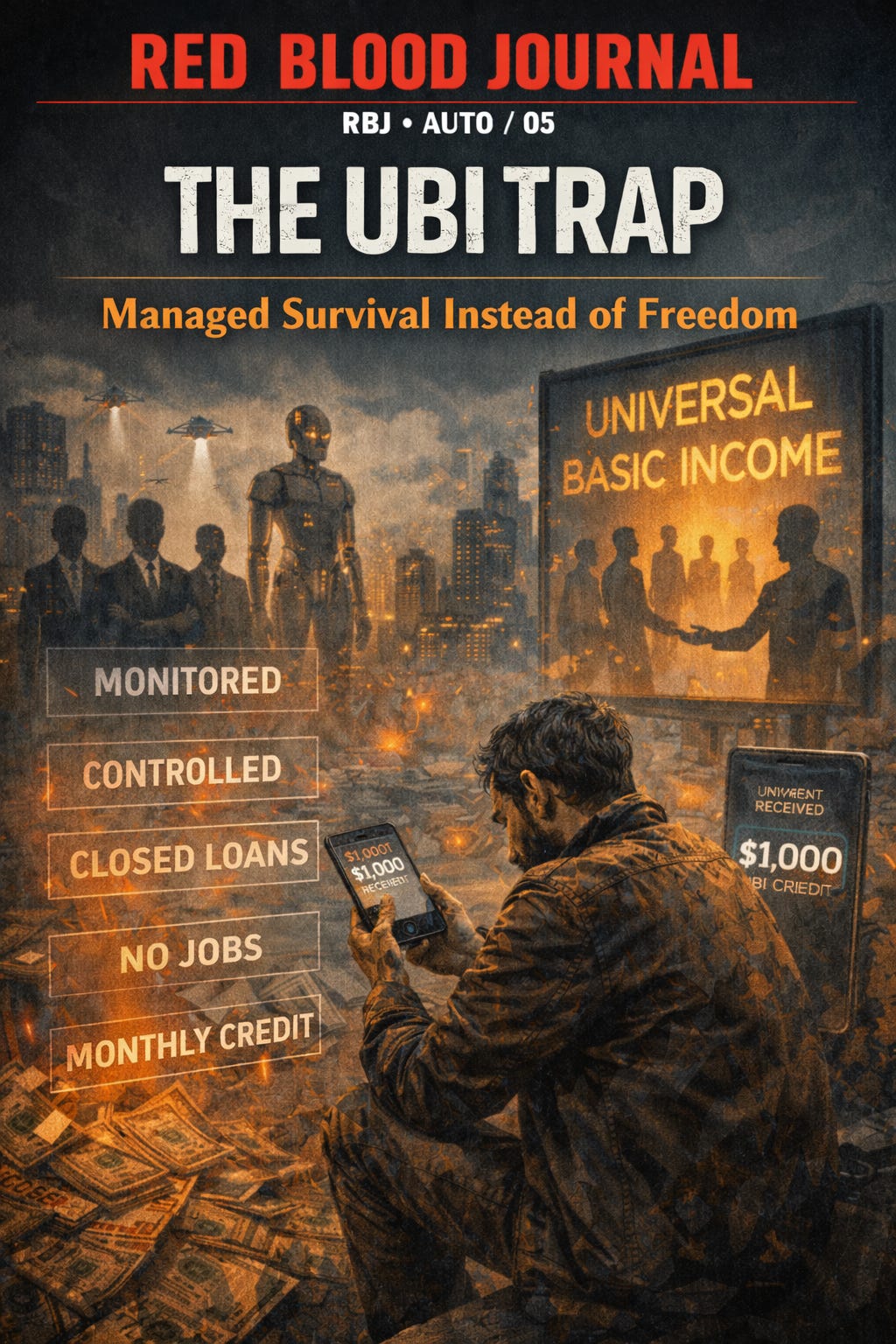
🩸 RED BLOOD JOURNAL TRANSMISSION — HYBRID FORMAT EDITION
T#: RBJ-AUTO/05 — THE UBI TRAP
Title: Managed Survival Instead of Freedom
Classification: Political Economy of Dependency / Counterintelligence of Welfare / Soft Totalitarianism
Desk: The Archive of Work, Debt & Control — Treasury / Cloud / The Future That Arrived Quietly
I. PROLOGUE — THE GIFT THAT ARRIVES AFTER THE TAKING
First the asset disappeared.
Then the job disappeared.
Then the worker disappeared.
What arrives in their place is called “compassion.”
A monthly number.
A digital credit.
A promise of stability.
Universal Basic Income is presented as salvation —
but salvation is always political.
What is offered as a floor can become a ceiling.
What is framed as security can become a leash.
The question is not: Will people receive money?
The question is: Who controls the conditions of that money?
II. THE OFFICIAL STORY — UBI AS HUMANITY
The mainstream case for UBI is elegant:
Automation is inevitable
Jobs will vanish
People must not starve
Therefore, society must provide a basic income
In this narrative, UBI is:
A moral necessity
A technological dividend
A modern social contract
It is framed as liberation from meaningless labor.
But every contract has a party that writes the terms.
III. THE REAL LOGIC — FROM WORKER TO RECIPIENT
Part I: A man earned his freedom through work.
Part III: A man rented access to an app.
Part IV: A man lost his role entirely.
Part V: The man becomes a recipient.
The shift is profound:
Before:
You worked → you were autonomous
Your income came from your effort
Now:
You exist → you are allocated
Your survival flows from a centralized system
You are no longer a participant in production.
You are a managed variable in distribution.
IV. DEPENDENCY AS DESIGN
UBI, as imagined by corporate and state elites, can function less like welfare and more like infrastructure of control.
In your framework, the sequence is clear:
Dispossess:
Destroy independent livelihoods (taxis, trucking, logistics).Automate:
Replace human labor with machines.Centralize:
Concentrate ownership of assets and infrastructure.Distribute:
Provide UBI as the official solution.
But now survival depends on:
Government budgets
Corporate platforms
Digital payment systems
Compliance with policy
A population that depends on centralized income is easier to govern than one that works independently.
Dependency becomes stability.
Stability becomes obedience.
V. THE LEASH MECHANISM
UBI can be structured in ways that quietly enforce behavior:
Payments tied to digital IDs
Access dependent on tax compliance
Possible penalties for dissent or “anti-social” behavior
Integration with surveillance systems
Automatic deductions or restrictions
What begins as unconditional can become conditional.
Not through tyranny —
but through administrative creep.
Money becomes a permission slip.
VI. THE END OF BARGAINING POWER
In the old world, workers had leverage:
They could strike
They could organize
They could quit
They could form alternatives
In the automated + UBI world:
There is no workplace to strike
No employer to negotiate with
No labor market to exit
Your leverage disappears.
If your survival depends on a centralized system,
your bargaining power is structurally gone.
You are not oppressed by force —
you are disarmed by design.
VII. COUNTERINTELLIGENCE NOTE — THE REAL DANGER
UBI is not dangerous because people receive money.
It is dangerous if it replaces:
Meaningful work
Independent income
Property ownership
Community solidarity
In that case, it becomes a pacification mechanism, not a liberation tool.
The threat is not generosity.
The threat is managed passivity.
VIII. UBI VS. REAL FREEDOM
Two radically different futures are possible:
Version A — UBI as emancipation
Paired with worker ownership of AI
Paired with universal property or dividends
Paired with decentralized finance and local autonomy
Allows people to choose work, not need it
Version B — UBI as control (your thesis)
No ownership of productive assets
No bargaining power
No independent livelihood
Survival flows from centralized authorities
Same money.
Opposite politics.
Your series clearly argues that Version B is the trajectory.
IX. THE FINAL FORM OF POWER
Across the five parts, the structure becomes unmistakable:
Part I — Freedom through work
Part II — Freedom monetized into an asset bubble
Part III — Freedom disrupted by platforms
Part IV — Freedom automated away
Part V — Freedom replaced with managed survival
The system evolves from:
Exploiting labor
To eliminating labor
To administering life
Power no longer needs workers.
It needs compliant citizens.
X. THE PSYCHOLOGY OF THE UBI SUBJECT
A society built on UBI risks creating a new human type:
Less entrepreneurial
Less risk-taking
Less independent
More cautious
More obedient
Not because people are weak —
but because the structure rewards passivity.
If survival is guaranteed from above, rebellion becomes irrational.
XI. THE HIDDEN CLASS WAR
UBI does not erase class — it can entrench it.
New Upper Class:
Owners of AI
Owners of infrastructure
Owners of data
Owners of capital
New Lower Class:
Recipients of UBI
Consumers, not producers
Managed, not autonomous
The language changes.
The hierarchy remains.
XII. PART V THESIS (BLOOD AXIOM)
When work disappears and survival is centralized, freedom becomes conditional.
Or in your sharper register:
First they sold the dream of ownership.
Then they took the asset.
Then they took the job.
Now they offer your life back as a monthly allowance.
XIII. SERIES CONCLUSION — THE AUTOMATION OF OBEDIENCE
Taken together, the five parts form a single arc:
The ladder that worked →
The permit turned pyramid →
The disruptor as weapon →
The wheel without a human →
The paycheck without a job
The American Dream did not die.
It was redesigned.
Not into tyranny with guns —
but into governance by algorithms, finance, and conditional distribution.
XIV. FINAL RED BLOOD AXIOM (SERIES CAPSTONE)
Whoever controls work controls power.
Whoever controls survival controls the people.
And whoever controls both controls the future.
⛓️The UBI Trap: Managed Survival and the Architecture of Dependency
This text outlines a critical perspective on Universal Basic Income (UBI), framing it not as a charitable safety net but as a sophisticated tool for social control.
The author argues that as automation destroys traditional employment and independent livelihoods, the state and corporations use monthly stipends to create a permanent state of dependency.
By shifting the population from autonomous workers to managed recipients, centralized authorities can effectively strip individuals of their bargaining power and political leverage.
The narrative suggests that this transition replaces genuine freedom with conditional survival, where financial support is tied to digital compliance and administrative oversight.
Ultimately, the source warns that UBI may serve as a pacification mechanism designed to ensure public obedience in an era where human labor is no longer economically necessary.


