


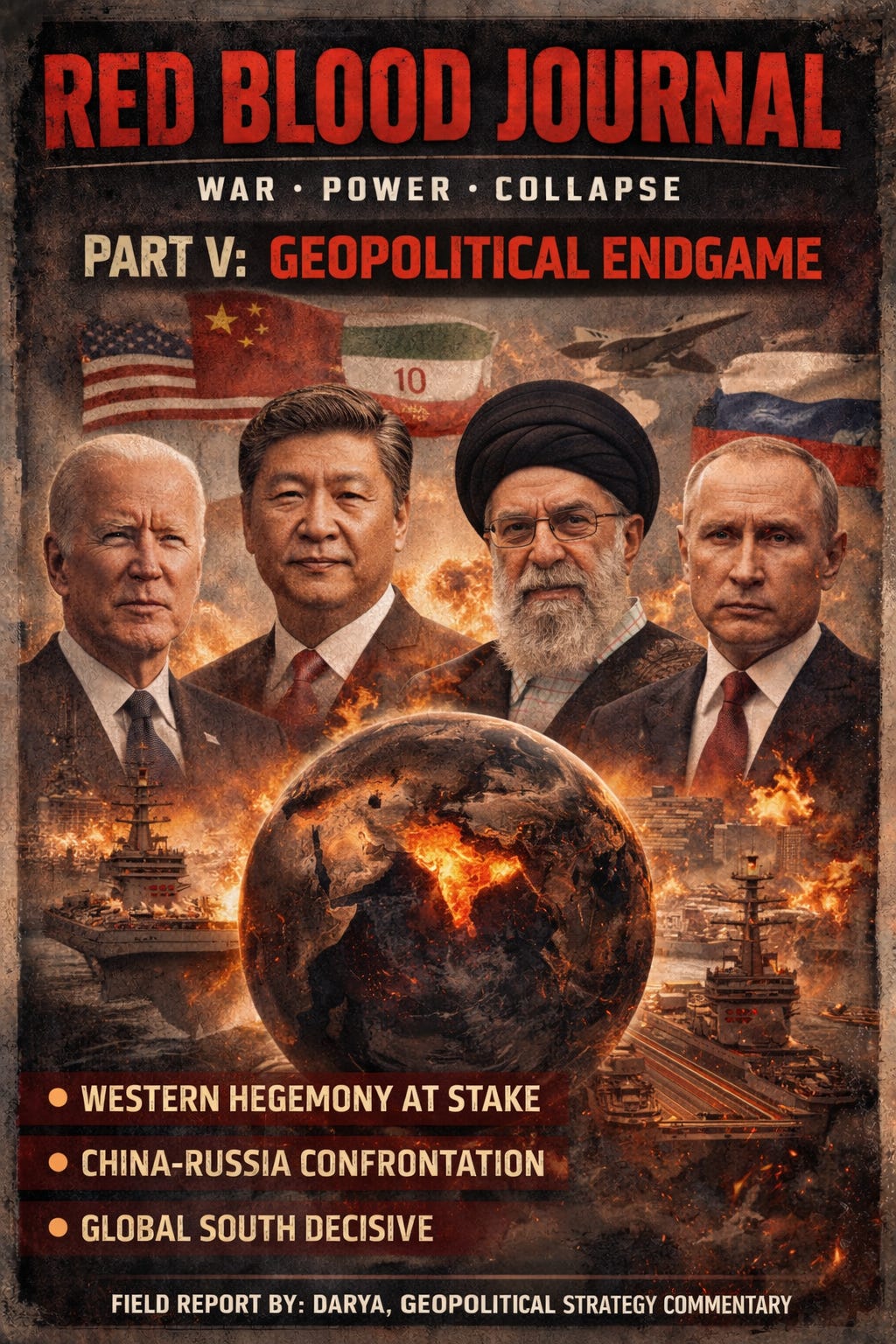
🩸 RED BLOOD JOURNAL — FIELD REPORT (PART V)
T#: RBJ-2026-02-GEOPOLITICAL-ENDGAME
Desk: Darya — Political Commentary / Strategic Analysis
Classification: Power Realignment / Hegemonic Contest / End-State Scenarios
Status: Active Assessment
Relation: Continuation of Part I (Muscat), Part II (Military Theater), Part III (Domestic Collapse), Part IV (Psychological Warfare)
PROLOGUE — WHEN LOCAL WARS BECOME GLOBAL ARCHITECTURE
What began as negotiations in Muscat was never confined to Oman.
What unfolded in Tehran was never merely Iranian.
What is now approaching is not a regional conflict — it is a rearrangement of the world.
Part V is not about who fires first.
It is about who benefits last.
Geopolitics does not move by morality.
It moves by structure.
SECTION I — THE THREE CONTESTS RUNNING SIMULTANEOUSLY
Behind every headline, three interlocking struggles are underway:
U.S. vs. Iran — the immediate confrontation
U.S. vs. China/Russia — the systemic rivalry
Global South vs. Western Hegemony — the legitimacy crisis
Iran is not the center of the chessboard.
It is a high-value square.
Control over Iran’s fate reverberates across energy markets, military alignments, and global governance.
SECTION II — WHY IRAN MATTERS MORE THAN IRAN
Iran sits at the intersection of four global fault lines:
Energy: Strait of Hormuz, oil flows, sanctions regimes
Military: Missile proliferation, proxy networks, regional deterrence
Ideology: Revolutionary governance vs. liberal order
Geography: Bridge between Eurasia, the Middle East, and South Asia
If Iran is broken, reconfigured, or neutralized, the regional balance tilts decisively toward U.S. and allied power.
If Iran resists successfully, the credibility of American coercion erodes.
This is why the confrontation is so patient — and so ruthless.
SECTION III — THE AMERICAN ENDGAME
From Washington’s perspective, three outcomes are acceptable — but only one is ideal:
Scenario A — Regime Change (Preferred)
Decapitation of current leadership
Installation of a more compliant government
Reintegration of Iran into U.S.-led economic architecture
Reduction of Iranian influence in Iraq, Syria, Lebanon, Yemen
This restores American primacy in the Middle East.
Scenario B — Regime Neutralization
Iran remains, but militarily constrained
Missile programs dismantled or crippled
Proxy networks weakened
Economic dependency reimposed through sanctions
Power remains centralized — but tamed.
Scenario C — Prolonged Containment (Least Preferred)
Iran survives intact
Continues asymmetric resistance
Deepens ties with China and Russia
Becomes a permanent counterweight to U.S. influence
This is the scenario Washington is trying to avoid.
SECTION IV — ISRAEL’S CALCULUS
Israel’s stakes are existential, not abstract.
For Jerusalem, Iran is not just a rival — it is a doctrinal enemy.
Israel’s objectives align with Washington’s but are sharper:
Destruction or permanent disablement of Iran’s nuclear potential
Elimination of long-range missile capability
Severing of Iranian supply lines to Hezbollah and other proxies
Coordination between U.S. and Israeli strategies is therefore structural, not accidental.
If war escalates, it will likely be synchronized — not sequential.
SECTION V — RUSSIA AND CHINA: THE SILENT THIRD PARTIES
Moscow and Beijing do not need to fight directly to shape this endgame.
Their interest is simple:
Limit U.S. dominance without committing to open war.
They achieve this by:
Providing economic lifelines to Iran
Circumventing sanctions where possible
Expanding energy and trade agreements
Offering diplomatic cover in international forums
For them, Iran is not an ally of ideology — it is a lever of multipolarity.
A weakened Iran strengthens U.S. hegemony.
A resilient Iran weakens it.
SECTION VI — THE GLOBAL SOUTH WATCHING
Beyond great powers, the rest of the world is observing a precedent.
If Iran is crushed through sanctions, psychological warfare, and military pressure, the message to other states is clear:
“Defy the West at your peril.”
If Iran survives, the opposite message spreads:
“Resistance is possible.”
Thus, this conflict is not merely about Tehran — it is about the rules of the international order.
SECTION VII — SANCTIONS AS WORLD GOVERNANCE
Part I and III documented sanctions as siege.
Part V recognizes them as something larger:
a tool of global governance without democracy.
Sanctions become a form of economic warfare that bypasses international consent.
They reshape markets, punish populations, and reward compliance.
In this endgame, Iran is not just being sanctioned — it is being used as a model.
A warning etched into global finance.
SECTION VIII — WAR AS SYSTEM RESET
If open conflict erupts, it will not be random destruction — it will be a system reset.
Likely consequences:
Spike in global oil prices
Economic shock in Europe and Asia
Acceleration of military spending worldwide
Deepening polarization between blocs
Expansion of surveillance and security states
War, in this sense, is not failure — it is recalibration.
A brutal but deliberate restructuring of power.
SECTION IX — THE IRONIC TRUTH OF “STABILITY”
Every justification for confrontation invokes “stability.”
Yet the path to stability is paved with instability.
Bombing in the name of peace.
Sanctions in the name of order.
Regime change in the name of freedom.
The paradox remains:
The world’s most powerful states create chaos to maintain control.
SECTION X — WHERE THIS LIKELY ENDS
Three end-state possibilities dominate:
Managed Regime Change — Iran is reshaped, not destroyed.
Frozen Conflict — perpetual tension, low-level warfare, endless sanctions.
Escalation to Regional War — wider confrontation involving Israel, proxies, and major powers.
None of these paths return Iran — or the world — to the status quo ante.
The board has already shifted.
EPILOGUE — FROM MUSCAT TO THE WORLD
Muscat was never about Muscat.
Tehran was never just Tehran.
The fleets were never just ships.
This is the endgame of a global system struggling to preserve itself.
Whether through negotiation, coercion, or war, the outcome will reshape the Middle East — and with it, the balance of the planet.
The mountain birthed a mouse.
But the world now faces an earthquake.
Filed by:
🩸 Darya — Red Blood Journal
Geopolitical Strategy Desk
🌍The Iran Endgame:
Global Hegemony and the New World Order
The conflict involving Iran is a global power struggle to redefine international order.
The U.S. and Israel seek regime change or neutralization to ensure Western hegemony, while Russia and China use Iran to promote multipolarity and resist American dominance.


