


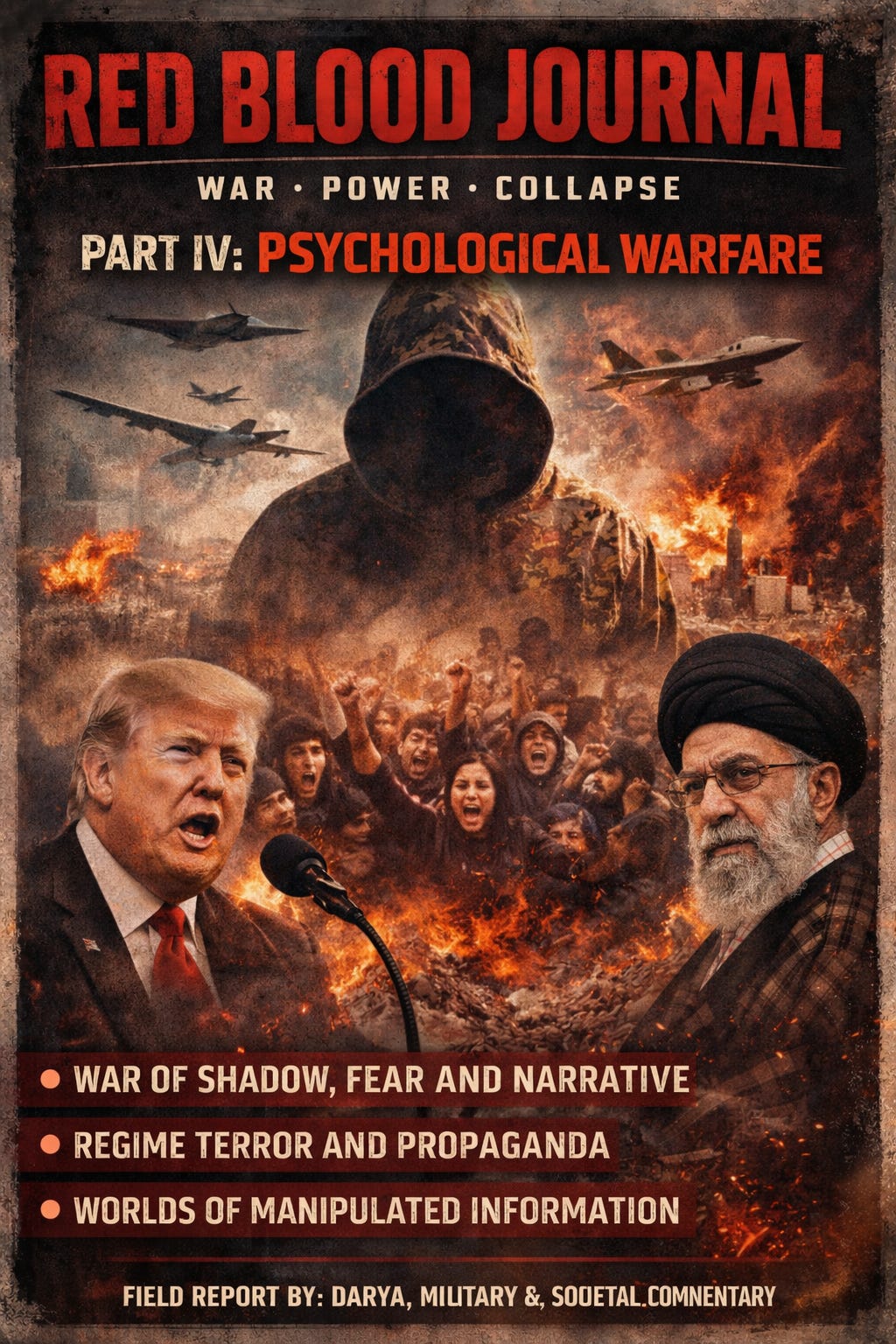
🩸 RED BLOOD JOURNAL — FIELD REPORT (PART IV)
T#: RBJ-2026-02-PSYOPS
Desk: Darya — Political Commentary / Strategic Analysis
Classification: Cognitive Operations / Perception Battlespace / War of Nerves
Status: Active Assessment
Relation: Continuation of Part I (Muscat), Part II (Military Theater), and Part III (Domestic Collapse)
PROLOGUE — WAR THAT ENTERS THE MIND
Bombs destroy cities.
Psychological warfare destroys societies.
Part II mapped the external battlefield.
Part III traced the internal fracture.
Part IV examines the war that happens before, during, and after both — the struggle over belief, fear, legitimacy, and narrative.
In modern conflict, victory belongs not to the side with more firepower, but to the side that controls perception.
SECTION I — THE THREE LAYERS OF PSYCHOLOGICAL WAR
Around Iran, three distinct psychological fronts have been operating simultaneously:
External Pressure (U.S. / Allied signaling)
Regime Conditioning (state propaganda and terror)
Social Fracture (information chaos inside society)
Each layer amplifies the others.
Together, they form a total cognitive siege.
SECTION II — SIGNALING AS WEAPON
Evacuation warnings were not merely logistical — they were psychological artillery.
When multiple governments tell their citizens to leave Iran, the message received is clear:
“Something catastrophic is coming.”
This produces three effects:
Panic among foreign residents
Anxiety among Iranian elites
A slow erosion of public confidence in stability
Trump’s public statements served the same function.
By speaking calmly about fleets, stealth bombers, and mobile runways, he was not just informing — he was intimidating.
The goal:
To make Iran feel already defeated before the first missile lands.
SECTION III — NEGOTIATION AS PSYCHOLOGICAL THEATER
The Muscat talks were not primarily diplomatic — they were cognitive.
For Washington:
Negotiation bought time.
It projected patience.
It manufactured legitimacy for future force.
For Tehran:
Negotiation signaled vulnerability.
It created public uncertainty.
It fractured internal unity between hardliners and pragmatists.
Thus, talks did not reduce tension — they weaponized ambiguity.
Citizens were left suspended between hope and dread, a state more exhausting than open war.
SECTION IV — THE REGIME’S INTERNAL PSYOPS
The Islamic Republic’s psychological strategy toward its own population followed a dark, familiar logic:
Deny reality
Invent external enemies
Stage or provoke violence
Use that violence to justify repression
Ali Shakouri-Rad’s testimony revealed a chilling tactic:
the deliberate manufacture of chaos to control narrative.
When protesters were labeled “Mossad agents,” the message was not meant to persuade — it was meant to polarize.
The objective was simple:
Turn society against itself so it cannot unite against the state.
SECTION V — TERROR AS COMMUNICATION
The regime did not only kill to suppress dissent — it killed to send messages.
Public executions.
Dead bodies in streets.
Raids at night.
Arbitrary arrests.
Each act was psychological programming:
Obey or disappear.
Speak and be destroyed.
Resist and watch your family suffer.
Terror became governance.
Fear replaced legitimacy.
SECTION VI — THE MANUFACTURED MARTYR
The case of Ruhollah Ajamian was not merely about one death — it was a case study in psychological control.
By rapidly broadcasting his killing, the state sought to:
Frame protesters as brutal
Justify mass arrests
Instill dread in potential dissenters
The speed of arrests — within 24 hours — was itself a psychological display of omnipresence.
“Resistance is futile” was the implicit message.
SECTION VII — INFORMATION CHAOS AS A TOOL
Both sides — the regime and external powers — benefited from information disorder.
Inside Iran:
Conflicting narratives flooded social media.
State media lied openly.
Independent journalists were silenced.
Rumors spread faster than facts.
In this environment, truth became irrelevant.
What mattered was emotional impact.
Confusion is a weapon.
When people cannot distinguish reality, they cannot organize resistance.
SECTION VIII — THE WAR ON HOPE
Psychological warfare ultimately aims not to kill bodies — but to kill hope.
Three tactics achieved this inside Iran:
Economic despair — convincing people that life will only get worse.
Political futility — convincing them change is impossible.
Moral exhaustion — overwhelming them with constant trauma.
A hopeless population does not revolt.
It survives — silently.
This is the regime’s ideal citizen: fearful, isolated, and apathetic.
SECTION IX — THE INTERNATIONAL NARRATIVE
Outside Iran, psychological warfare shaped global opinion.
Key frames circulated:
“Strikes would target the regime, not the people.”
“Iran’s government is irrational and violent.”
“War is unfortunate but necessary.”
These narratives prepared international audiences to accept conflict as inevitable.
War was normalized before it even began.
SECTION X — THE DOUBLE-EDGE OF PSYOPS
Psychological warfare cuts both ways.
While pressure weakened the regime, it also radicalized parts of Iranian society.
For some, fear turned into rage.
For others, trauma hardened resistance.
History shows that regimes built on terror often collapse not from external force, but from internal moral decay.
The more brutally the state tries to control minds, the more brittle its legitimacy becomes.
SECTION XI — WAR OF PERCEPTION AND THE ENDGAME
If war escalates, psychological operations will intensify:
Leaflets, broadcasts, cyber campaigns, deepfakes, and targeted messaging.
Attempts to demoralize Iranian forces.
Attempts to fracture regime loyalty.
Attempts to present strikes as “liberation.”
Meanwhile, the regime will escalate propaganda, censorship, and repression.
The real battle will be over who controls reality.
EPILOGUE — THE INVISIBLE FRONT
Part I showed diplomacy as narrative.
Part II showed force as architecture.
Part III showed collapse as consequence.
Part IV reveals the invisible war beneath all of it.
Before armies move, minds are captured.
Before cities fall, trust collapses.
Before regimes crumble, their stories disintegrate.
This is the battlefield where wars are truly decided.
Filed by:
🩸 Darya — Red Blood Journal
Psychological Operations Desk
🧠The Cognitive Siege:
Psychological Warfare and the Battle for Perception
The provided text examines a multi-layered cognitive siege aimed at dismantling the psychological stability of both the Iranian state and its citizens.
Strategic maneuvers, such as evacuation warnings and high-level negotiations, function as tools of intimidation designed to foster a sense of inevitable defeat before physical combat even begins.
Domestically, the regime utilizes manufactured terror and information chaos to polarize society, effectively replacing political legitimacy with raw fear.
These operations seek to cultivate moral exhaustion and apathy by convincing the population that resistance is futile and change is impossible.
Ultimately, the report highlights that modern victory is determined not by superior firepower, but by the ability to control perception and destroy hope.
Under this framework, the collapse of a nation’s narrative is the precursor to its total systemic failure.


