


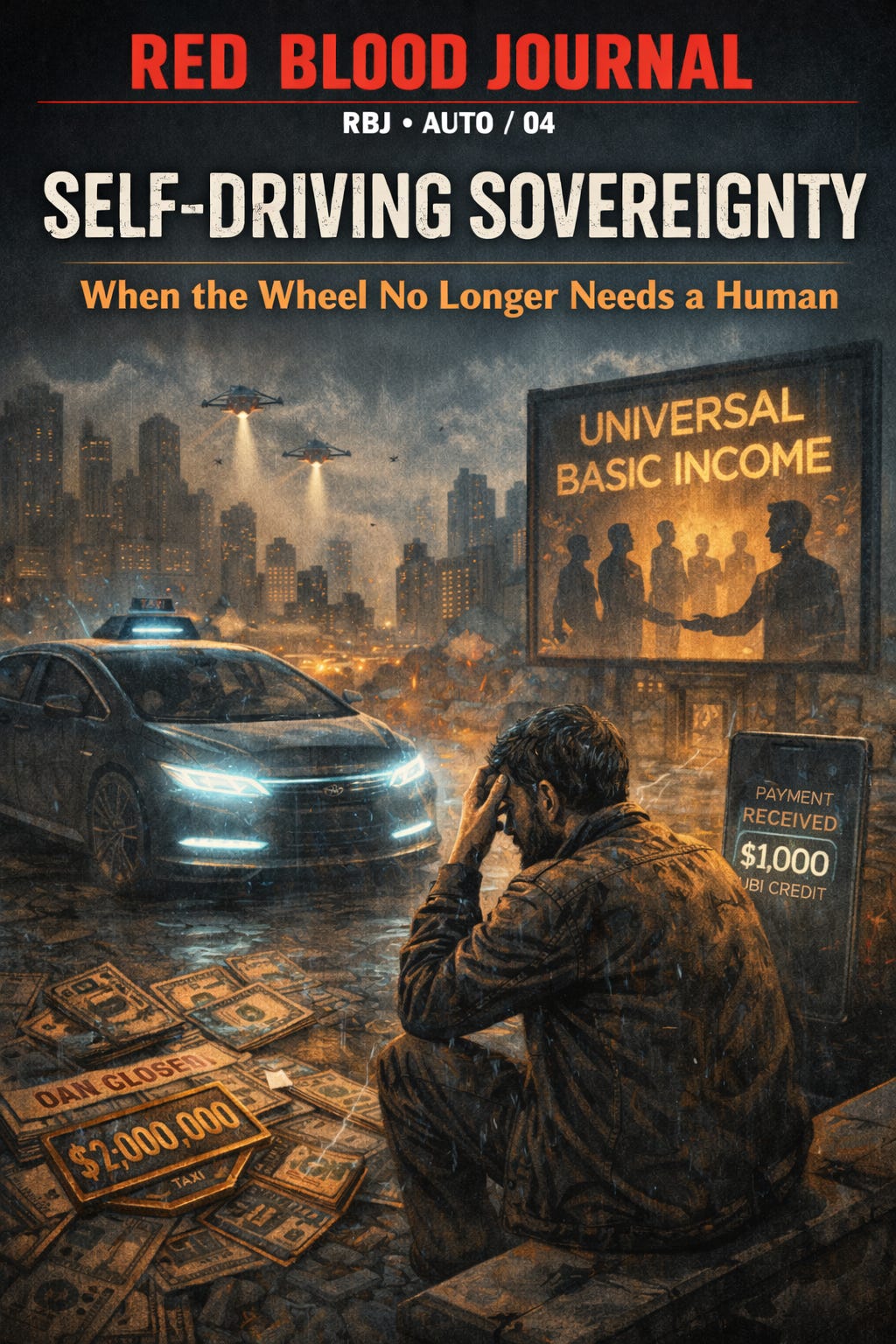
🩸 RED BLOOD JOURNAL TRANSMISSION — HYBRID FORMAT EDITION
T#: RBJ-AUTO/04 — SELF-DRIVING SOVEREIGNTY
Title: When the Wheel No Longer Needs a Human
Classification: Automation Geopolitics / Counterintelligence of Labor / Post-Human Logistics
Desk: The Archive of Work, Debt & Control — Highway / Cloud / Nowhere
I. PROLOGUE — THE VANISHING HAND
The steering wheel still turns.
The car still moves.
The city still breathes.
But the man is gone.
In Part I, the wheel was a political instrument.
In Part II, it became collateral.
In Part III, it was subordinated to an algorithm.
In Part IV, the human is simply removed.
No strike.
No protest.
No debate.
Just a software update.
II. THE OFFICIAL STORY — “SAFER, CHEAPER, MORE EFFICIENT”
The pitch for self-driving vehicles arrives dressed in benevolence:
Safety: Machines don’t get tired, angry, or distracted.
Efficiency: No idle time, no bathroom breaks, no lunch.
Cost: No wages, no benefits, no insurance for workers.
Progress: Technology as destiny.
This narrative is clean, scientific, and irresistible.
It is also incomplete.
The unspoken premise is simple:
If humans are inefficient, they are replaceable.
III. THE REAL LOGIC — LABOR ELIMINATION AT SCALE
Self-driving vehicles are not just about taxis.
They target an entire infrastructure of human movement:
Uber and Lyft drivers
Delivery drivers
Long-haul truckers
Warehouse logistics workers
Bus drivers
Eventually pilots
And, downstream, engineers, dispatchers, and support staff
This is not “creative destruction.”
This is systematic labor elimination.
For capital, the equation is obvious:
Humans = cost + risk + bargaining power
Machines = cost + control + predictability
The goal is not efficiency.
It is compliance without humans.
IV. FROM PLATFORM TO AUTONOMOUS EMPIRE
Part III replaced the human boss (dispatcher) with an algorithm.
Part IV replaces the human worker entirely.
The chain now becomes:
Old World:
Driver + street + city → independencePlatform World:
Driver + app → managed dependencyAutonomous World:
App + machine → human irrelevance
The company no longer needs:
Labor negotiations
Union threats
Collective action
Human unpredictability
It needs only code, data, and capital.
This is not transportation.
This is sovereignty without people.
V. THE QUIET REVERSAL OF POWER
In the taxi era, power was distributed:
Drivers controlled their labor
Cities controlled permits
Customers chose rides
In the self-driving era, power is centralized:
Corporations control fleets
Algorithms control movement
Data controls behavior
The city becomes a grid to be optimized.
Citizens become variables to be managed.
Mobility is no longer a public space —
it is a proprietary network.
VI. THE NEW CLASS DIVIDE
A sharper split emerges than in Part II:
Class A — Owners of Automation
Tech companies
Banks
Asset managers
AI infrastructure providers
They own:
The vehicles
The software
The data
The roads (through influence and contracts)
Class B — The Redundant Many
Former drivers
Displaced logistics workers
Service workers
Anyone whose job involves moving things or people
Their labor is not exploited.
It is made unnecessary.
This is a deeper dispossession than Uber ever achieved.
VII. COUNTERINTELLIGENCE NOTE — WHY THIS IS DIFFERENT
Uber exploited drivers.
Automation erases them.
Platforms said:
“Work more, earn less.”
Self-driving systems say:
“Work elsewhere — if ‘elsewhere’ still exists.”
This is not a labor dispute.
It is a species displacement from economic relevance.
VIII. THE MILITARY LOGIC BEHIND AUTONOMY
Autonomous vehicles do not emerge only from civilian markets.
They are incubated in:
Defense research
Surveillance logistics
Battlefield autonomy
Drone warfare systems
What is perfected in war is deployed in cities.
Self-driving fleets are not just business tools.
They are dual-use infrastructure.
The same systems that move packages can move weapons, police, or surveillance payloads.
Transportation becomes a control grid.
IX. THE PSYCHOLOGY OF REMOVAL
When humans are removed from critical systems:
Their bargaining power disappears
Their social role shrinks
Their sense of purpose erodes
Their political leverage weakens
A population without work is easier to pacify —
especially if their survival depends on centralized distribution (UBI).
Automation does not just change the economy.
It reshapes the soul of society.
X. THE PREPARATION FOR PART V (UBI)
Self-driving vehicles do not end the story.
They create the conditions for the next move.
Mass automation produces:
Unemployment
Social instability
Political pressure
Fear of unrest
Which then “requires” a solution.
Enter Universal Basic Income — not as liberation, but as management.
In Part V, this becomes explicit.
XI. THE INFRASTRUCTURE OF DEPENDENCE
By the end of Part IV, the world looks like this:
Work is scarce
Ownership is concentrated
Movement is automated
Cities are optimized for machines
Humans are passengers in their own economy
The promise of technology becomes a cage with glass walls.
You can see out.
You cannot change what moves inside.
XII. PART IV THESIS (BLOOD AXIOM)
When machines replace workers, power replaces people.
Or in your sharper register:
First they took the asset.
Then they took the job.
Now they take the driver.
XIII. TRANSITION TO PART V
By the end of this Transmission:
The ladder is gone
The platform rules
The machine drives
The human watches
The only question left is:
If work disappears, who controls survival?
That is Part V — The UBI Trap: Managed Survival Instead of Freedom.


