


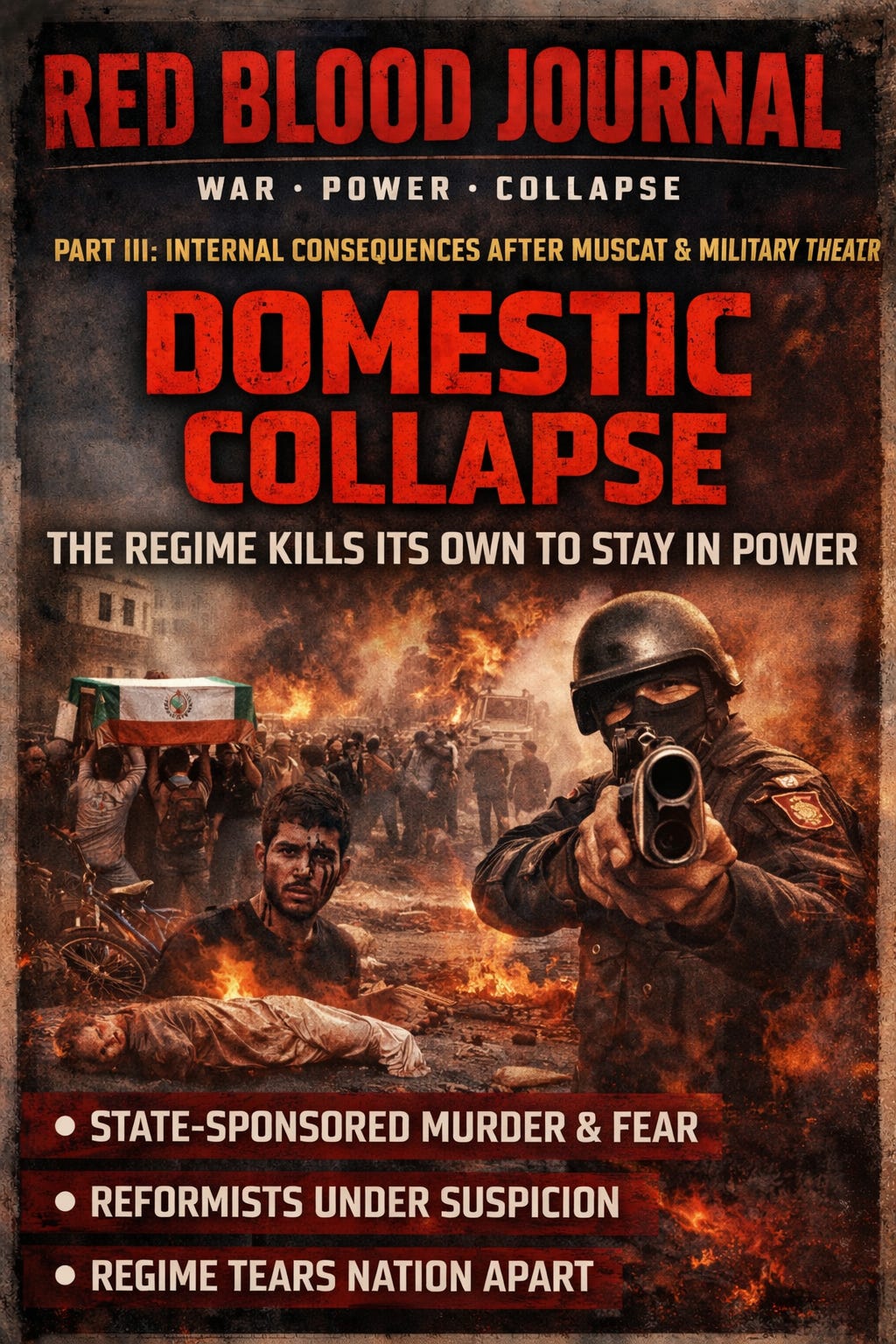
🩸 RED BLOOD JOURNAL — FIELD REPORT (PART III)
T#: RBJ-2026-02-DOMESTIC-COLLAPSE
Desk: Darya — Political Commentary / Strategic Analysis
Classification: Internal Fracture / State Violence / Social Implosion
Status: Active Assessment
Relation: Continuation of Part I (Muscat: A Mountain Gives Birth to War) and Part II (Military Theater)
PROLOGUE — THE FRONT INSIDE THE NATION
If Part II mapped the battlefield around Iran, Part III maps the battlefield within it.
External war rarely destroys a state alone.
What makes collapse inevitable is the internal fracture that precedes it.
Sanctions weaken the economy.
Propaganda corrodes trust.
Repression radicalizes society.
Fear fragments loyalty.
By the time missiles fall, the state is already hollow.
SECTION I — THE ECONOMY AS A WEAPON
The renewed sanctions after Muscat were not merely punishment — they were siege architecture.
Three effects were immediate and predictable:
Currency instability — inflation deepens, savings evaporate.
Supply chain strangulation — medicine, fuel, and basic goods become scarce.
Elite insulation — regime-linked networks profit while ordinary citizens suffer.
This is how internal collapse is engineered:
Create economic desperation.
Amplify social resentment.
Turn hardship into political instability.
The objective is not simply to weaken the regime — but to make the population exhausted, divided, and volatile.
SECTION II — THE SECURITY STATE TURNED INWARD
As pressure mounts, regimes do not become more rational — they become more paranoid.
Iran’s security apparatus responded to unrest not with reform, but with preemptive brutality.
Ali Shakouri-Rad’s admissions were not isolated — they were diagnostic:
Security agencies injected violence into protests.
Basij and plainclothes forces were used as provocateurs.
Some regime personnel were killed to justify harsher repression.
Blame was deflected onto “Mossad,” “foreign agents,” and “terrorist cells.”
This is the logic of a state that fears its own people more than its external enemies.
Violence becomes circular:
The regime creates chaos → blames protesters → uses chaos to justify further violence.
SECTION III — THE MANUFACTURE OF MARTYRS
The case of Ruhollah Ajamian (Karaj) was not an anomaly — it was a template.
According to internal reformist testimony:
He was allegedly lured into protest zones.
His death was rapidly instrumentalized.
Within 24 hours, mass arrests followed.
A medical professional was targeted to create a “deterrent example.”
This is not security — it is political theater written in blood.
Martyrs are manufactured to produce fear.
Fear is manufactured to legitimize repression.
Repression deepens hatred.
Hatred fuels the next wave of unrest.
A self-reinforcing cycle of collapse.
SECTION IV — THE STREET AS A WAR ZONE
By the time protests reached their peak, Iranian streets were no longer sites of dissent — they were kill zones.
Eyewitness patterns were consistent:
Protesters trapped in dead-end alleys.
Live ammunition fired indiscriminately.
Bodies left as warnings.
Families terrorized into silence.
One chilling account described a Basij member opening fire in a narrow alley, killing multiple young protesters.
This was not “crowd control.”
This was battlefield behavior inside a civilian population.
A government that treats its own cities as war zones has already lost legitimacy.
SECTION V — THE COLLAPSE OF TRUST
Every state rests on a fragile social contract:
obedience in exchange for protection.
Iran’s contract shattered when the government failed to protect — and instead attacked — its citizens.
Three consequences followed:
Total loss of credibility — official narratives were disbelieved by default.
Erosion of national cohesion — society fractured into hostile camps.
Normalization of violence — brutality became routine, not exceptional.
Once a population no longer believes its government, no amount of propaganda can restore authority.
SECTION VI — REFORMISTS: COMPLICITY WITHOUT ACCOUNTABILITY
The reformist camp attempted to position itself as critical of the regime — but avoided responsibility.
Darya’s assessment is blunt:
Reformists participated in elections that legitimized repression.
They occupied positions of influence while atrocities occurred.
They now speak of abuses — but never accept their own role in enabling them.
Moral distancing without structural repentance is not resistance.
It is historical self-preservation.
Their outrage arrives too late, and their regret is strategically shallow.
SECTION VII — THE GENERATION OF PERMANENT TRAUMA
What happened in Iran is not just political — it is psychological.
A society does not simply “recover” from:
Children killed before their parents’ eyes.
Mothers watching sons die in the streets.
Families forced to mourn in silence.
Entire neighborhoods marked by fear.
This trauma will shape Iranian identity for decades.
Even if the regime falls, the scars remain.
SECTION VIII — WAR AS ACCELERATOR OF INTERNAL DECAY
External conflict does not reset domestic dysfunction — it amplifies it.
If war comes:
Repression will intensify under “national security” pretexts.
Dissent will be labeled treason.
Emergency powers will erase remaining civil liberties.
Economic devastation will worsen.
The regime may use foreign war to justify domestic tyranny.
At the same time, war could fracture the state further — splitting security forces, deepening elite rivalries, and igniting localized rebellions.
Either way, collapse accelerates.
SECTION IX — THE TWO PATHS AHEAD
Iran faces a grim bifurcation:
Path A — Regime Survival Through Terror
Increased militarization
Total surveillance
Mass arrests
Controlled starvation of dissent
A frozen society under permanent siege.
Path B — Internal Disintegration
Fragmented security apparatus
Competing power centers
Localized uprisings
Breakdown of central authority
A nation unraveling from within.
Neither path is peaceful.
SECTION X — THE CORE TRUTH
Part I showed how diplomacy prepared the story.
Part II showed how military power prepared the strike.
Part III shows how the state prepared its own collapse.
A regime that kills its people does not need enemies to fall.
It destroys itself.
EPILOGUE — FROM MUSCAT TO THE STREETS
The mountain of Muscat birthed a mouse.
But inside Iran, the storm was already raging.
Before any foreign bomb falls, the state has already bombarded its own legitimacy.
The war is not coming — it is already here.
Filed by:
🩸 Darya — Red Blood Journal
Domestic & Societal Desk
🏚️The Internal Fracture:
Iran’s Descent into Social Implosion
Iran faces systemic collapse due to economic sanctions, state violence, and a shattered social contract.
The regime uses propaganda and manufactured martyrs to justify brutal repression, turning cities into war zones.
This internal fracture ensures inevitable decay.


