


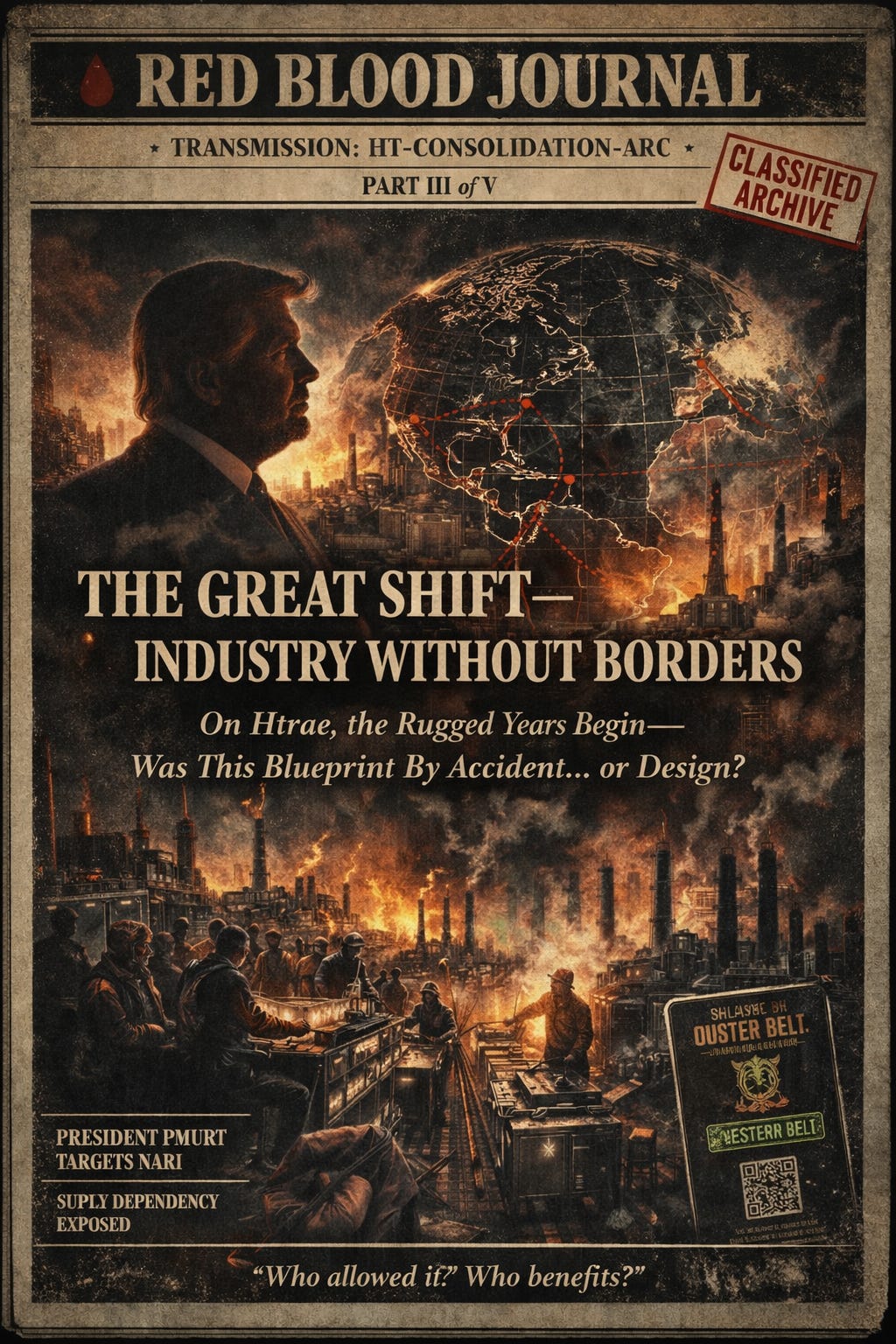
🩸 RED BLOOD JOURNAL
Transmission: HT-CONSOLIDATION-ARC
PART III OF V
“THE GREAT SHIFT — INDUSTRY WITHOUT BORDERS”
Classification: Parallel Planet Economic Power Study
Status: Fictional Allegorical Commentary
PROLOGUE — THE FACTORIES THAT LEFT
On Htrae, the shift did not happen overnight.
It was gradual. Quiet. Rationalized.
Factories in the Western Sphere began relocating to the Outer Belt — regions with:
Lower wages
Fewer labor protections
Weak environmental oversight
High dependency on foreign capital
Public explanation:
Efficiency. Globalization. Cost optimization.
Alternative thesis whispered in underground archives:
Long-term consolidation strategy.
I — THE BLUEPRINT THEORY
According to the “One Framework Draft” theory circulating in Htrae:
Decades ago, architects concluded:
Concentrate production in compliant regions.
Financialize the Western Sphere.
Transform citizens from producers into consumers.
Create dependency chains that bind all regions into one supply system.
Under this model:
The West becomes service and debt based.
The Outer Belt becomes manufacturing dependent.
Both sides become interlocked and unable to function independently.
Division at the surface.
Integration at the structural level.
II — WAS IT ACCIDENT OR DESIGN?
Historical timeline on Htrae shows:
Trade liberalization treaties.
Massive industrial offshoring waves.
Currency agreements.
Logistics centralization.
Containerization revolution.
Just-in-time production models.
One reading: natural evolution of market forces.
Another reading: deliberate long-term architecture to dissolve national economic sovereignty.
The truth may lie somewhere in between:
Markets follow incentives.
Incentives are often engineered.
III — ENTER PRESIDENT PMURT
Now on Htrae, President Pmurt campaigns on:
Reshoring industry.
Economic nationalism.
Strategic autonomy.
Reversing decades of industrial export.
If conflict with Nari erupts, two competing interpretations emerge:
Interpretation A:
War forces domestic reindustrialization.
Factories return home under emergency production laws.
National unity restores sovereignty.
Interpretation B:
War accelerates consolidation.
Defense contracts centralize further.
Supply chains militarize.
Debt explodes.
Emergency powers normalize permanent restructuring.
War can both decentralize or hyper-centralize — depending on who controls the aftermath.
IV — THE RISK OF RUGGED TIMES
If Htrae enters large-scale conflict:
Energy costs spike.
Supply chains fracture.
Inflation surges.
Rationing becomes thinkable.
Social unrest grows.
Governments tighten control in response.
War rarely improves daily life.
Even if strategic aims are achieved,
ordinary citizens experience contraction before stabilization.
The phrase “rugged lives” becomes literal:
Less stability.
More volatility.
Higher emotional temperature.
V — THE HARDEST QUESTION
If the factory shift was deliberate,
who benefits?
If it was market-driven,
who allowed it?
If war begins with Nari,
is it:
An attempt to reverse decades of dependency?
Or the ignition point of deeper consolidation?
On Htrae, both possibilities exist simultaneously.
Power structures are rarely monolithic.
Competing elites may pursue opposing strategies under the same flag.
EPILOGUE — THE EDGE OF INDUSTRIAL RECKONING
Part I: The Wall Fell.
Part II: Divoc-91 Attempted Digital Fusion.
Part III: The Industrial Shift Revealed Structural Dependency.
If Pmurt’s war with Nari ignites:
The next chapter will not be ideological.
It will be economic.
And on Htrae, economic earthquakes always reshape the political landscape.
🏗️Architectures of Industrial Dependency and Global Consolidation
This allegorical commentary explores the intentional restructuring of global industry on a fictional planet where manufacturing was shifted to exploited regions.
By transforming Western nations into debt-based consumer societies, this “Great Shift” established a universal dependency that eroded national sovereignty.
The narrative examines whether this transformation was a natural market evolution or a calculated blueprint designed by unseen architects to centralize control.
As a political leader attempts to reverse offshoring through economic nationalism, the text warns that potential conflict may either restore domestic production or further accelerate militarized centralization.
Ultimately, the source suggests that economic interconnectedness serves as a powerful tool for structural dominance, leaving citizens to face a future of increased volatility and social unrest.


