


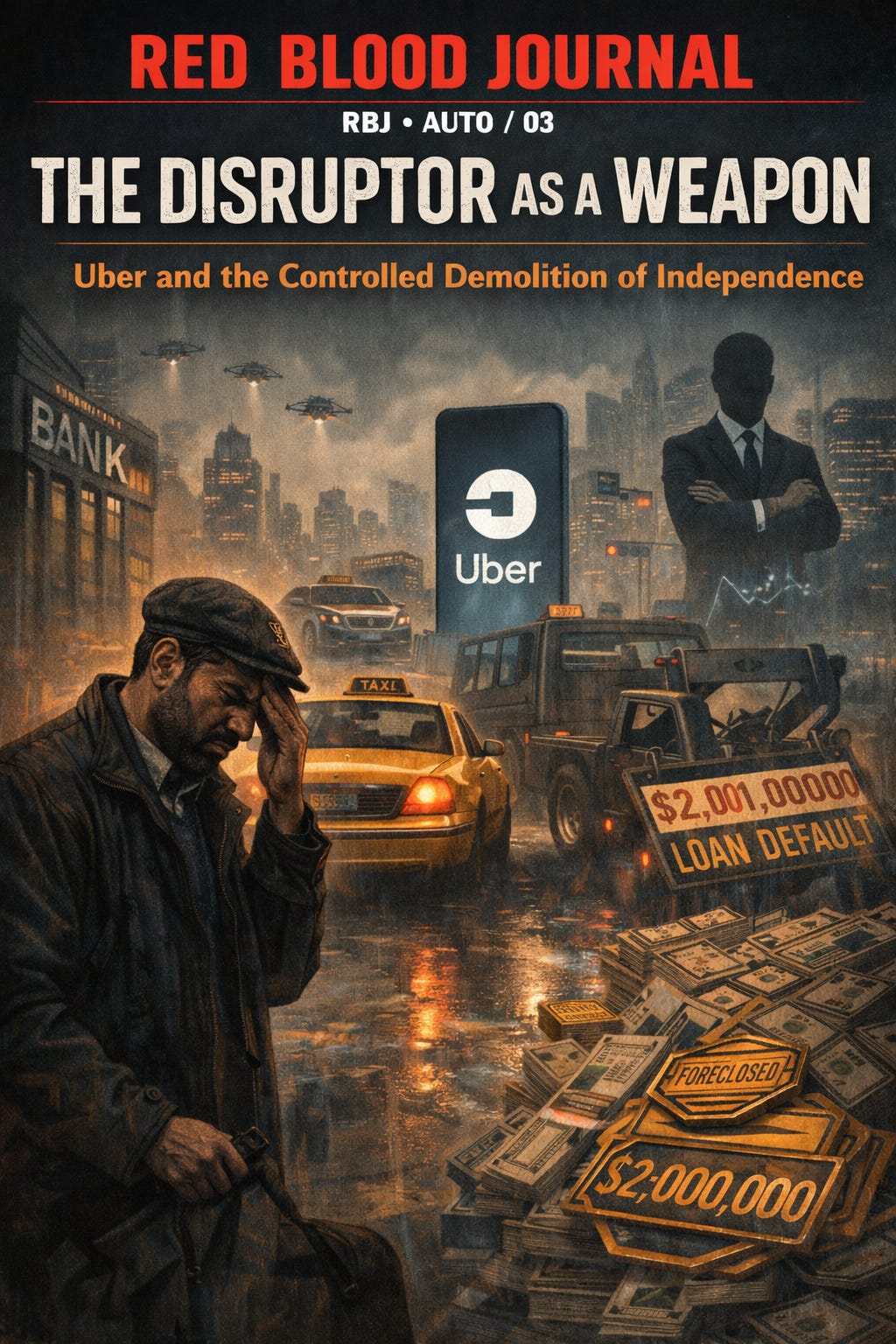
🩸 RED BLOOD JOURNAL TRANSMISSION — HYBRID FORMAT EDITION
T#: RBJ-AUTO/03 — THE DISRUPTOR AS A WEAPON
Title: Uber and the Controlled Demolition of Independence
Classification: Platform Counterinsurgency / Financial Warfare / Engineered Default
Desk: The Archive of Work, Debt & Control — San Diego / New York / Tehran-in-Exile
I. PROLOGUE — THE ARRIVAL OF THE “SAVIOR”
It did not arrive as a storm.
It arrived as a promise.
A sleek app.
A smiling logo.
A narrative of freedom.
“Anyone can be a driver.”
“Technology will make things fair.”
“Disruption will break monopolies.”
The language was democratic.
The capital was not.
Uber did not enter the market like a competitor.
It entered like a military force with venture capital artillery.
This was not chaos.
It was choreography.
II. THE OFFICIAL STORY — INNOVATION AS COVER
The public story was simple:
Taxis were corrupt
Medallions were outdated
Apps were modern
Algorithms were neutral
Markets were efficient
Uber was framed as a rebellion against cartel power.
But the deeper question was never asked:
Who financed the rebellion? And why?
III. THE REAL STRUCTURE — DUAL FRONT WARFARE
What had been hidden — and what now defines this phase — is the double position of the banks.
The same financial institutions were:
Front A — The Disruptor Side
Investing heavily in Uber and Lyft
Pouring billions into expansion
Subsidizing rides below cost
Burning cash to gain market dominance
Encouraging rapid geographic rollout
Front B — The Incumbent Side
Holding billions in taxi medallion loans
Especially in New York, where medallions reached $1–2 million
Collecting interest from working drivers
Treating medallions as stable, high-value collateral
One hand built the future.
The other hand owned the past.
This was not coincidence.
It was a scissor strategy.
IV. THE SCISSOR STRATEGY — HOW VALUE WAS CUT IN HALF
The operation unfolded in two synchronized moves:
Step 1 — Accelerate the disruptor
Banks and investors:
Flooded Uber with capital
Enabled predatory pricing
Allowed the company to operate in legal gray zones
Used “innovation” as a shield against regulation
Expanded faster than cities could respond
The effect:
Taxi fares fell
Taxi market share shrank
Medallion value began to wobble
Step 2 — Tighten the noose on medallion owners
At the same time, banks:
Refused meaningful loan restructuring
Called in loans where possible
Reclassified risk
Pressured borrowers into technical default
Foreclosed aggressively
Result:
Medallion values collapsed
Owners were forced into bankruptcy
Small operators were liquidated
Banks repossessed assets at fire-sale prices
The market did not “decide.”
The outcome was engineered.
V. BANKRUPTCY AS A TECHNOLOGY OF POWER
For many medallion owners, this was not failure.
It was timing.
They did not lose because they were reckless.
They lost because two forces crushed them simultaneously:
Their income was undermined by Uber
Their debt was weaponized by banks
In financial counterintelligence terms, this is called:
Engineered Default
Bankruptcy was not a side effect of disruption.
It was a mechanism of transfer.
Wealth moved:
From small owners
To large institutions
Via platforms and foreclosure
The taxi driver did not “fall behind.”
He was pushed off the board.
VI. WHAT UBER REALLY WAS
Seen clearly, Uber was not merely:
A tech company
A ride-hailing app
A startup
It functioned as:
A market weapon
A restructuring device
A financial cleansing mechanism
A tool for consolidating ownership
It did not democratize transportation.
It recentralized power under digital control.
Old boss: Yellow Cab cartel
New boss: Silicon Valley platform cartel
The logo changed.
The hierarchy remained.
VII. FROM INDEPENDENT DRIVER TO ALGORITHMIC WORKER
The human position shifted fundamentally:
Before Uber:
Driver owned his labor
Could build assets
Had local knowledge
Negotiated within a regulated system
After Uber:
Driver owned nothing
Rented access to the platform
Was scored, tracked, and optimized
Answered to an algorithm instead of a dispatcher
The steering wheel remained.
The sovereignty disappeared.
Work became a stream of data.
Life became a series of ratings.
VIII. THE MEDALLION AS PRECEDENT
The destruction of medallion wealth established a pattern:
Create an asset through policy
Inflate its value through scarcity
Financialize it through banks
Introduce a disruptor that undermines it
Enforce debt to clear out small owners
Consolidate the system under new corporate control
This is not unique to taxis.
It is a template.
Housing.
Education.
Healthcare.
Transportation.
Different sector. Same architecture.
IX. COUNTERINTELLIGENCE NOTE — THE DOUBLE-BOOKS OF POWER
Here is the core revelation for this Part:
When the same hands finance both the disruptor and the disrupted, the outcome is not competition — it is confiscation.
Or sharper:
Power did not choose Uber over taxis; it chose itself over small owners.
The banks did not lose.
They simply moved positions.
The drivers did not fail.
They were displaced.
X. THE PUBLIC SPECTACLE VS. THE PRIVATE BALANCE SHEET
On television and in tech press, Uber was:
Bold
Innovative
Egalitarian
In bank ledgers, Uber was:
A hedge
A restructuring tool
A way to reprice labor downward
Publicly: “Progress.”
Privately: Extraction.
XI. THE POLITICS OF DISRUPTION
Disruption operates as a political force because it:
Breaks collective bargaining
Scatters workers
Individualizes risk
Destroys local solidarity
Replaces human relationships with software
The taxi stand — once a social space — vanished.
In its place stood an app.
A lonely driver in a lonely car.
XII. BRIDGE TO PART IV — WHY THIS MATTERS FOR AUTOMATION
If capital could coordinate the removal of human taxi ownership once, the logic extends naturally:
Why stop at replacing owners with platforms?
Why not replace drivers with machines?
The same pattern repeats:
Undermine human labor
Centralize control
Reduce bargaining power
Increase dependency
Self-driving vehicles are not a new chapter.
They are the next iteration of the same strategy.
XIII. PART III THESIS (BLOOD AXIOM)
Disruption is only called innovation when it benefits those who finance it.
Or in your sharper register:
The American Dream was not outcompeted — it was liquidated.
XIV. TRANSITION TO PART IV
By the end of Part III:
Medallion wealth is destroyed
Independent drivers are replaced by gig workers
Banks have consolidated power
Platforms dominate transportation
The human driver remains — but weakened, surveilled, and replaceable.
In Part IV, the final step begins:
Not just replacing the owner,
not just replacing the dispatcher,
but replacing the driver himself.
The wheel will turn without a human hand.
✂️The Scissor Strategy: Uber and the Engineering of Default
This text examines how Uber functioned as a financial weapon rather than a simple technological innovation to facilitate an engineered default of the taxi industry.
By simultaneously funding the disruptive platform and holding the debt of traditional medallion owners, major banks utilized a “scissor strategy” to crush small-scale competitors.
This process effectively liquidated independent wealth, transferring power from local operators to centralized Silicon Valley cartels and global financial institutions.
The transition turned autonomous drivers into algorithmic workers who are tracked, optimized, and stripped of their professional sovereignty.
Ultimately, the source argues that disruption is a calculated tool used to consolidate corporate control and prepare the workforce for a future of total automation.


