


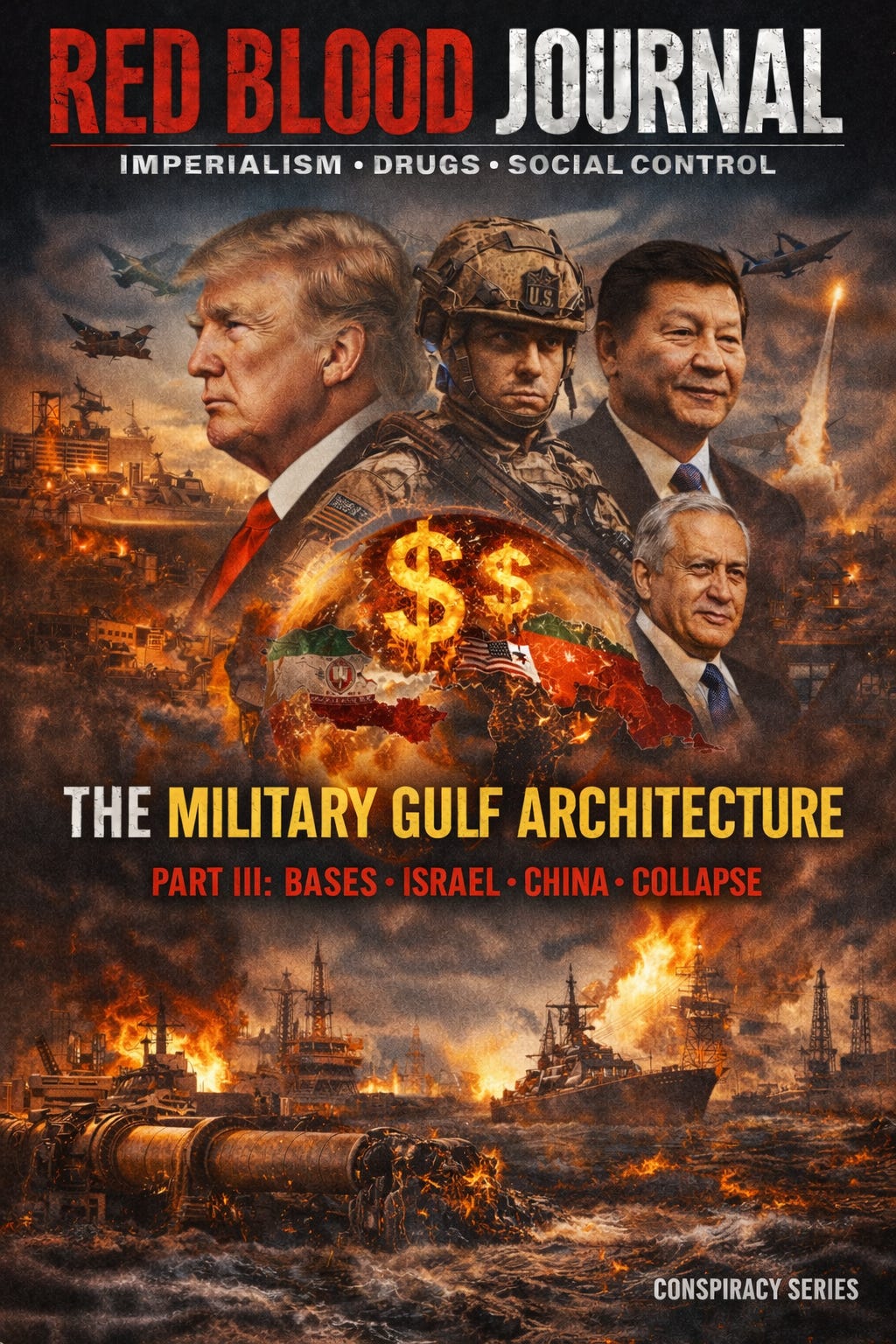
🩸 RED BLOOD JOURNAL — MULTI-PART SERIES (PART III)
BASES, ISRAEL, CHINA, AND THE CRACKS IN THE EMPIRE
T#: RBJ–2026–OIL-EMPIRE-III
Classification: Counterintelligence of War / Systemic Geopolitics
Desk: Pentagon – Tel Aviv – Beijing – Riyadh – The Deep Horizon
I. THE EMPIRE YOU CAN SEE FROM SPACE
If Part I was about oil and Part II about money, Part III is about hardware.
Not the hardware of your phone.
The hardware of empire.
Look at a map — not the one on television, but the one in the Pentagon’s planning room:
• Hundreds of U.S. bases encircling the planet.
• A dense lattice of airstrips, carrier groups, radar arrays, and logistics hubs.
• A ring of military steel tightening around the Gulf, the Mediterranean, and the Pacific.
This is not defense.
This is global occupation with a smile.
The Gulf is not simply “important.”
It is the hinge of this entire system.
Oil flows out.
Power flows in.
II. THE MILITARY-INDUSTRIAL GULF
Every time a U.S. president speaks about “stability in the Middle East,” there is an invisible audience listening more closely than any voter:
Lockheed Martin.
Raytheon.
Boeing.
Northrop Grumman.
War is not a tragedy for them.
War is a business model.
The Gulf is a permanent theater of potential conflict — and therefore a permanent revenue stream.
Bases in:
• Qatar
• Bahrain
• Saudi Arabia
• Kuwait
• The UAE
They are justified as protection against Iran.
They function as guarantees for Western capital.
If oil is the bloodstream, these bases are the skeleton.
III. WHY ISRAEL SITS AT THE CENTER OF THE BOARD
Now to the part they rarely explain clearly.
Israel is not simply a “regional ally.”
It is a strategic node in the same architecture that governs the Gulf.
Israel serves three key functions:
1. Military Outpost of the West
A technologically advanced, heavily armed state aligned with U.S. interests in the region.
2. Surveillance & Intelligence Hub
A critical listening post monitoring Iran, Lebanon, Syria, and broader regional dynamics.
3. Deterrent Against Independent Arab Power
Its presence constrains the possibility of a unified, anti-Western Arab bloc that could control energy on its own terms.
This is why Israel receives unparalleled military and financial support — not purely out of ideology, but because it fits structurally into the empire’s design.
The Gulf monarchies may control oil.
Israel helps control the geopolitical perimeter.
IV. THE IRAN PROBLEM — NOT NUCLEAR, STRUCTURAL
The official narrative says Iran is dangerous because of nuclear weapons.
The deeper truth is simpler and harsher:
Iran is dangerous because it refuses to fully integrate into the U.S.-led order.
Iran:
• Challenges U.S. military dominance
• Builds alliances outside Washington’s control
• Works with Russia and China
• Seeks to trade outside the dollar
• Maintains an independent political and religious system
In other words, Iran is a living contradiction to the Gulf cartel architecture.
This is why pressure on Iran never truly ends — regardless of who sits in the White House.
Trump did not create this conflict.
He inherited it — and intensified it.
V. CHINA — THE REAL DISRUPTOR OF THE PETRODOLLAR
If there is one actor that genuinely threatens the system described in Parts I and II, it is not Iran.
It is China.
China is doing three things that terrify the architects of the petrodollar world:
1. Buying oil in non-dollar currencies
Slowly eroding the dollar’s monopoly.
2. Building alternative financial systems
BRICS expansion, digital currencies, new trade networks.
3. Securing energy through long-term partnerships
Not through regime change — but through infrastructure, investment, and trade.
This is why tensions in the South China Sea and Taiwan matter to the Gulf story.
If China succeeds in weakening the petrodollar, the entire oil-military-finance triangle begins to wobble.
VI. THE CRACKS IN THE GULF ARCHITECTURE
Every empire looks solid — until it doesn’t.
Here are the visible stress fractures:
A. Energy Transition
The slow shift away from fossil fuels threatens the centrality of Gulf oil.
B. Multipolar World
Russia, China, and emerging powers challenge U.S. dominance.
C. Sanctions Overreach
Too many sanctions push countries to build alternatives to the dollar system.
D. Domestic Instability in the West
Economic inequality weakens the legitimacy of imperial power at home.
The system still stands — but it is creaking.
VII. TRUMP IN THIS BROADER FRAME
Viewed in this larger context, Trump’s second term takes on a clearer shape.
He is not the cause of the empire.
He is a symptom of its anxiety.
His approach can be summarized as:
• More pressure, fewer apologies.
• More sanctions, less diplomacy.
• More threats, fewer illusions.
He is not trying to dismantle the architecture — he is trying to stabilize it by force and leverage.
Venezuela was not an accident.
Iran is not an exception.
They are test cases in a system under strain.
VIII. WHAT HAPPENS NEXT?
Three possible trajectories lie ahead:
1. Escalation
More sanctions, more proxy conflicts, potential direct war with Iran.
2. Managed Containment
A tense equilibrium where no side fully wins, but no side backs down.
3. Systemic Shift
China weakens the petrodollar; the Gulf loses its centrality; the U.S. empire recalibrates.
None of these outcomes are “good” in a simple sense.
All of them are shaped by the same forces described throughout this series.
IX. FINAL COUNTERINTELLIGENCE SYNTHESIS — THE SERIES
Put the three parts together:
Part I: Oil as the foundation of power.
Part II: The petrodollar and sanctions as the hidden weapons.
Part III: Military bases, Israel, and China as the strategic frame.
The Gulf is not just a region.
It is the operating core of a global system.
Trump is not an outsider to this system.
He is its blunt instrument at a moment of uncertainty.
Iran is not merely a “rogue state.”
It is a structural obstacle.
Venezuela was not a side story.
It was a rehearsal.
And the petrodollar — still standing — is more fragile than it looks.
EPILOGUE — WHAT THEY WILL NEVER SAY ON TELEVISION
Empires do not end because leaders change.
They end because their material logic becomes unsustainable.
Oil will not rule the world forever.
Dollars will not circulate unchallenged forever.
Military power will not remain uncontested forever.
When the Gulf architecture finally fractures, it will not be announced as a collapse.
It will simply stop working.
🏗️The Architecture of the Oil Empire: Hardware of Global Power
The provided text examines a complex global power structure maintained through the strategic integration of military hardware, energy control, and financial dominance.
It asserts that the United States utilizes an extensive network of foreign military bases and key regional partners like Israel to safeguard the petrodollar system and suppress independent economic blocs.
This geopolitical framework is currently facing significant threats from China’s alternative trade models, the global transition toward renewable energy, and the rising influence of multipolar alliances.
Ultimately, the source argues that current political leaders are merely attempting to stabilize a fragile imperial architecture that is becoming increasingly unsustainable.
The narrative reframes international conflicts not as ideological battles, but as structural efforts to prevent the collapse of Western economic hegemony.
Michael Parenti “Imperialism, Drugs and Social Control”


