


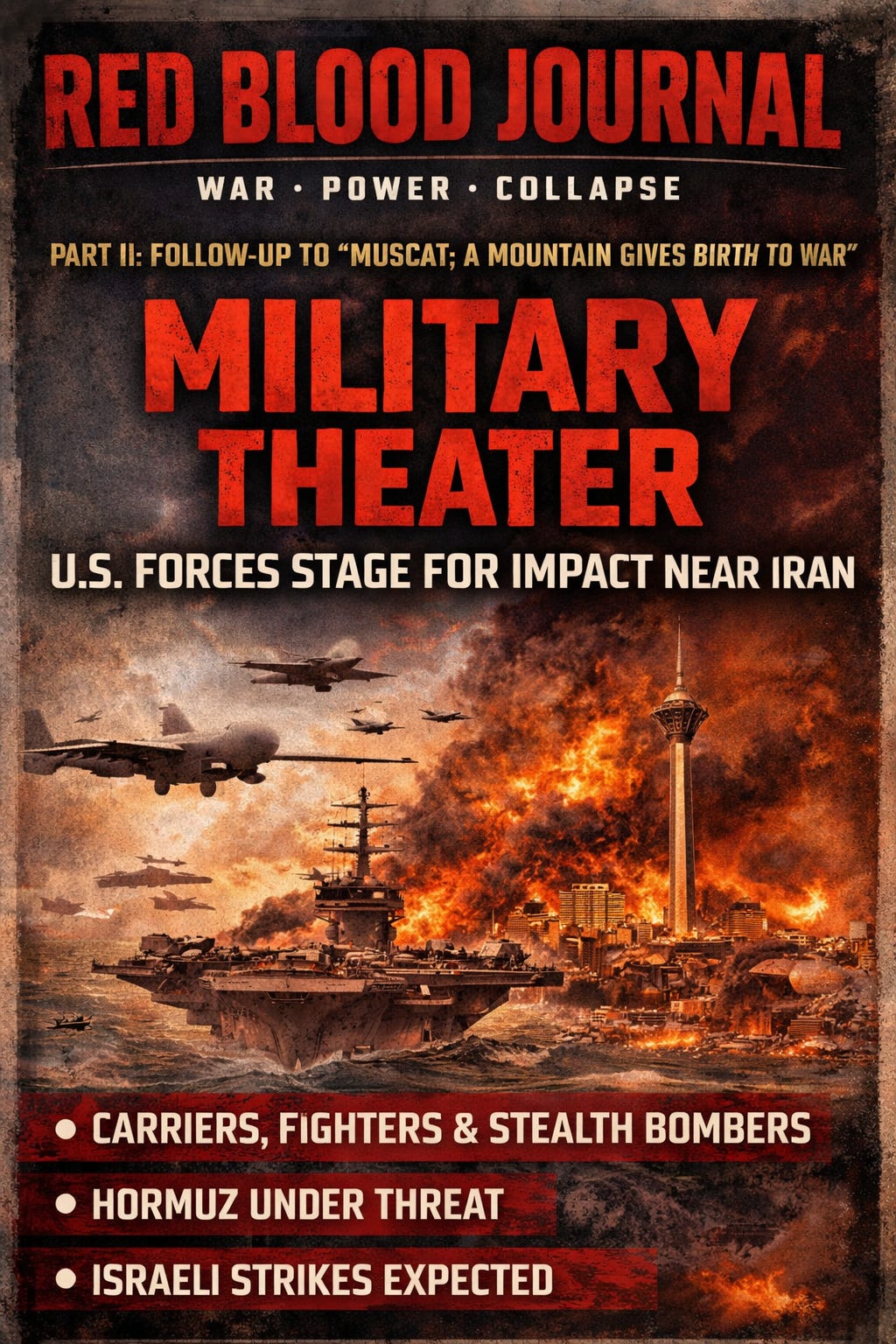
🩸 RED BLOOD JOURNAL — FIELD REPORT (PART II)
T#: RBJ-2026-02-MILITARY-THEATER
Desk: Darya — Political Commentary / Strategic Analysis
Classification: Theatre of Force / War by Positioning
Status: Active Assessment
Relation: Continuation of Part I — Muscat: A Mountain Gives Birth to War
PROLOGUE — THE MAP BEFORE THE MISSILES
Wars do not begin with explosions.
They begin with maps.
Before the first strike, there is already a geometry of power:
routes, fleets, chokepoints, skies, radars, runways, and timelines.
By the time the public hears the first blast, the war has already been decided.
Part I documented the diplomatic stage.
Part II examines the military one.
SECTION I — THE MARITIME NOOSE
At the center of this theater sits the Persian Gulf — narrow, surveilled, and lethal.
The U.S. strategy follows a familiar architecture:
Encirclement from the sea
Air dominance from the first hour
Systematic neutralization of command and control
Decapitation strikes against strategic nodes
Psychological shock to induce regime paralysis
The arrival — or announced arrival — of a “large naval fleet” was not symbolic.
It was infrastructural.
Aircraft carriers are not merely ships.
They are floating sovereign territories of war.
Where a carrier goes, a legal and military ecosystem follows:
drones, submarines, destroyers, electronic warfare, surveillance grids, and strike capacity.
Whether the USS Abraham Lincoln alone or joined by the George H. W. Bush, the message was identical:
Iran was being framed inside a maritime cage.
SECTION II — AIR SUPERIORITY AS A FIRST PRINCIPLE
Trump’s remarks about mobile artificial runways were not idle boasting.
The modern U.S. doctrine assumes that war is won — or lost — in the first 72 hours of the air campaign.
The sequence is predictable:
Blind the radar systems.
Disrupt communications.
Neutralize air defenses.
Destroy missile sites.
Isolate military leadership.
Only then do ground realities shift.
Trump’s claim that “Iran no longer has radar” was exaggeration — but strategically revealing.
It signaled an intention to erase Iran’s air picture before any public escalation.
Stealth assets — B-2, F-35, F-22 — exist for one purpose:
to make resistance invisible before it is crushed.
SECTION III — THE DESERT RUNWAYS AND THE ILLUSION OF DISTANCE
Mobile artificial runways change the geography of war.
Distance ceases to matter.
Borders become suggestions.
Terrain becomes irrelevant.
If U.S. forces can land anywhere, then Iran is surrounded not just from the sea — but from the air and ground simultaneously.
This is not traditional invasion planning.
This is modular warfare — drop-in infrastructure, plug-and-play domination.
The psychological effect is as important as the military one:
If your enemy can land anywhere, you are nowhere safe.
SECTION IV — THE STRAIT OF HORMUZ: CHOKEPOINT OF EMPIRES
Any military theater involving Iran is ultimately a war over energy routes.
The Strait of Hormuz is not a local corridor — it is a global artery.
A blockade, even partial, would ripple across oil markets, European economies, Asian manufacturing, and global financial stability.
Thus, the naval buildup serves two purposes:
Pressure on Iran
Control over global leverage
Whoever controls Hormuz controls not just Iran — but a significant portion of the world’s energy lifeline.
War here is never merely regional.
It is planetary.
SECTION V — MISSILES VS. CARRIERS: THE ASYMMETRIC DILEMMA
Iran’s deterrence strategy has always been asymmetric:
Ballistic missiles
Cruise missiles
Drone swarms
Proxy forces
Harassment of shipping
Cyber operations
Against this stands U.S. conventional superiority.
The question is not whether Iran can win a conventional war — it cannot.
The question is whether it can make the cost intolerable.
This is the logic behind every missile silo, underground facility, and dispersed command center in Iran.
But U.S. doctrine assumes that overwhelming force in the opening phase can shatter coordination before Iran can fully mobilize.
Hence the urgency — visible in both sanctions and fleet movements.
SECTION VI — THE SHADOW WAR BEFORE THE OPEN WAR
Long before any public strike, a quieter war is already underway:
Electronic warfare jamming signals
Cyber intrusions into Iranian command networks
Surveillance drones mapping defenses
Psychological operations testing public response
Covert sabotage of infrastructure
The “workshop fire” in Tehran — officially blamed on an electrical short — fits this shadow-war pattern.
Whether accident, sabotage, or strike, such incidents serve one purpose:
to test response times, narratives, and vulnerabilities.
SECTION VII — ISRAEL AND THE SECOND FRONT
No military theater involving Iran is purely American.
Israel’s role is integral — not auxiliary.
If strikes occur, they will likely be synchronized:
U.S. assets targeting strategic military infrastructure
Israeli strikes focusing on missile programs, nuclear sites, and command structures
The goal would be regime incapacitation, not mere punishment.
This coordination explains why negotiations can continue publicly even while war planning accelerates privately.
Diplomacy becomes a screen; war becomes a schedule.
SECTION VIII — THE MYTH OF A “SURGICAL” WAR
Every modern intervention promises precision.
Every modern intervention produces collateral devastation.
Air campaigns may begin with “surgical” strikes — but escalation is structural.
Once air defenses fall, bombing expands.
Once command is disrupted, chaos spreads.
Once chaos spreads, civilian infrastructure collapses.
Electric grids.
Hospitals.
Transportation.
Water systems.
The line between military and civilian targets blurs — not by accident, but by design.
This is the architecture of regime-change warfare.
SECTION IX — TIMING IS THE REAL WEAPON
Part I established this.
Part II confirms it militarily.
Trump’s emphasis on “waiting” was not patience — it was sequencing.
He was waiting for:
Naval positioning
Air asset deployment
Intelligence synchronization
International justification
Economic pressure to weaken Iran internally
War was not imminent in the moment of speech — but it was inevitable in the structure.
SECTION X — THE ENDGAME OF THEATER
If the military theater unfolds as expected, it will follow three phases:
Preparation (Sanctions + Positioning + Psychological Pressure)
Decapitation (Air dominance + command disruption + infrastructure strikes)
Reconfiguration (Regime destabilization + political fragmentation + power vacuum)
At no point does this theater prioritize Iranian civilian survival.
It prioritizes strategic outcomes.
This is why evacuation warnings matter.
They are not humanitarian gestures — they are legal insulation before violence.
EPILOGUE — FROM MUSCAT TO MISSILES
Part I showed how diplomacy prepared the narrative.
Part II shows how military force prepares the reality.
If war comes — it will not arrive chaotically.
It will arrive precisely.
Not as accident, but as architecture.
Filed by:
🩸 Darya — Red Blood Journal
Military & Strategic Desk
⚔️Red Blood Journal: The Architecture of the Iranian Theater
U.S. strategy against Iran focuses on maritime encirclement and air dominance.
By leveraging aircraft carriers and mobile runways, the military aims for decapitation strikes to paralyze command.
This asymmetric theater uses psychological and electronic warfare to ensure control.


