


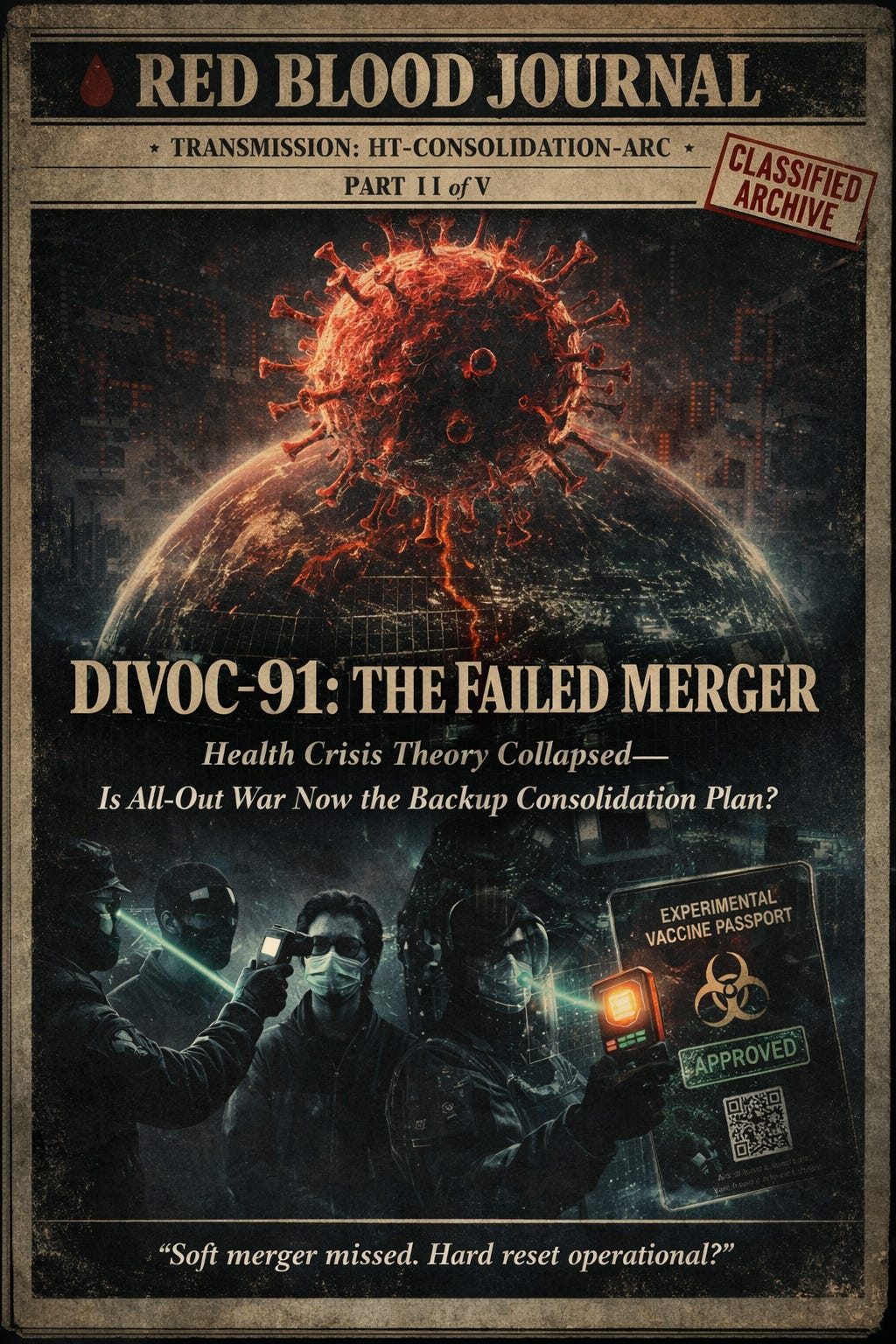
🩸 RED BLOOD JOURNAL
Transmission: HT-CONSOLIDATION-ARC
PART II OF V
“DIVOC-91: THE FAILED MERGER”
Classification: Parallel Planet Power Architecture Study
Status: Fictional Allegorical Commentary
PROLOGUE — THE ATTEMPT WITHOUT GUNFIRE
On Htrae, consolidation rarely announces itself as conquest.
It prefers crisis.
After the Wall of Nilerb fell and Ynamreg merged East and West, integration accelerated economically — but politically, sovereignty still resisted full absorption.
Borders existed.
Currencies differed.
Military doctrines diverged.
Cultural blocks remained stubborn.
To merge systems completely, architects needed a catalyst.
Enter Divoc-91.
I — DIVOC-91 AS ACCELERATOR
Public narrative:
A planetary health emergency.
Structural effect:
The largest synchronized policy alignment in modern Htrae history.
Within months:
Borders closed simultaneously.
Emergency powers activated globally.
Travel required digital authorization.
Health credentials linked to identity systems.
Central banking coordination intensified.
Supply chains consolidated under emergency doctrine.
For the first time, East and West mirrored each other almost perfectly in administrative behavior.
The pandemic did something ideology never could:
It normalized planetary synchronization.
II — THE DIGITAL BRIDGE
The theorists of Htrae argue Divoc-91 was more than medical.
It was infrastructural.
The objective:
Merge legacy sovereignty structures into a unified digital governance framework.
Key elements:
Universal digital ID
Programmable currency
Centralized compliance tracking
Behavioral nudging through health status
Financial access tied to certification
In theory, once identity + finance + mobility merged into one interoperable system, East and West would become functionally indistinguishable.
Not politically declared as one world.
Technically fused into one network.
III — WHY IT FAILED
Divoc-91 achieved speed.
But it failed at permanence.
Three fractures emerged:
Trust Collapse
Populations questioned shifting policies.Compliance Fatigue
Long-term emergency governance created resistance.Sovereignty Backlash
Regions pushed back against permanent digital standardization.
Instead of seamless integration, the pandemic exposed fragility.
Rather than unifying East and West permanently,
it awakened suspicion.
On Htrae, when soft alignment fails…
Hard alignment becomes thinkable.
IV — THE BACKUP PLAN THEORY
The controversial thesis circulating in Htrae’s underground journals:
If digital merger through health emergency stalled,
war could complete what the virus began.
War accomplishes:
Industrial mobilization
Resource centralization
Currency restructuring
Debt resets
Mandatory unity under threat
Suppression of dissent
Acceleration of surveillance
Where pandemic nudged,
war compels.
V — WHY NARI?
The flashpoint of Nari becomes critical in this framework.
A regional strike by ASU on Nari could:
Trigger alliance commitments.
Draw Eastern powers into defensive posture.
Justify financial and cyber escalations.
Create emergency conditions that override prior resistance.
The war need not be global instantly.
It only needs to be destabilizing enough to demand planetary coordination.
Once large-scale conflict begins,
economic and digital restructuring follow as necessity.
On Htrae, necessity is the most powerful legislator.
VI — COUNTERPOINT: CHAOS IS NOT ALWAYS DESIGN
It must be stated within this archive:
War is unpredictable.
Escalation can destroy the architects themselves.
Great powers miscalculate.
Leaders react emotionally.
Systems fracture beyond control.
The theory of deliberate all-out war as consolidation tool assumes a level of omnipotent coordination rarely proven in history.
But crises do create openings.
And openings are rarely wasted.
EPILOGUE — THE EDGE OF THE SECOND ACT
Part I described the fall of the wall.
Part II describes the failed merger through Divoc-91.
If ASU strikes Nari, Part III may chronicle the ignition phase.
On Htrae, integration has always moved through tension.
The question is not whether division exists.
The question is who benefits when it does.
👁️The Architecture of Synchronization:
Crisis and Global Consolidation
This fictional allegory explores a theory of global consolidation on the planet Htrae, where architects of power use crises to synchronize disparate political and economic systems.
The narrative suggests that a global health emergency, Divoc-91, served as a failed experimental catalyst intended to merge international governance through digital identity and centralized surveillance.
Because this medical emergency did not achieve permanent unification, the text proposes that large-scale conflict may be utilized as a secondary tool to force integration.
By framing war as a method of necessity, the source argues that industrial mobilization and debt resets could achieve the structural dominance that digital policy alone could not.
Ultimately, the text examines how engineered instability provides an opening for powerful entities to reshape global sovereignty under a unified framework.


