


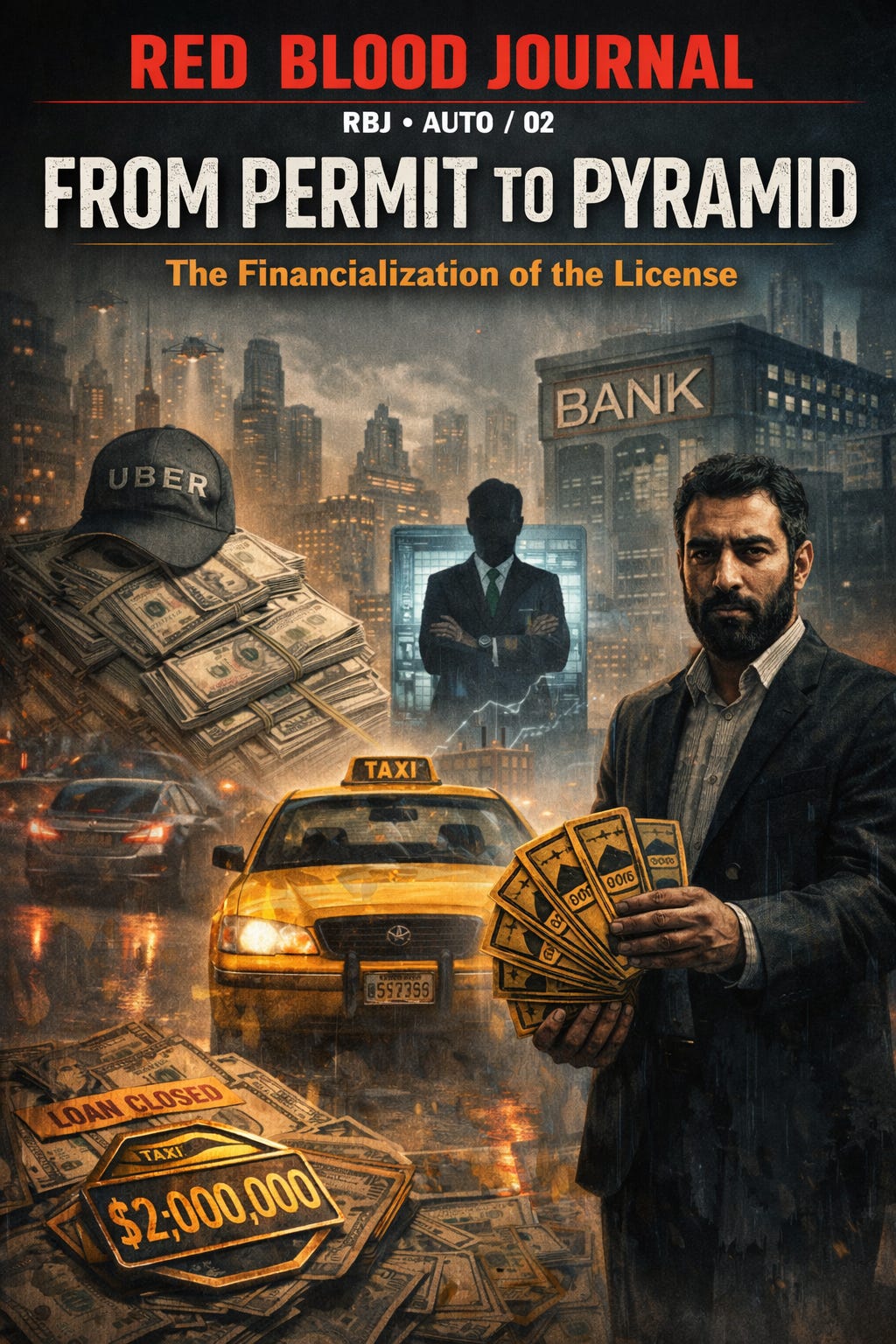
🩸 RED BLOOD JOURNAL TRANSMISSION — HYBRID FORMAT EDITION
T#: RBJ-AUTO/02 — FROM PERMIT TO PYRAMID
Title: The Financialization of the License
Classification: Political Economy / Financial Counterintelligence / Artificial Scarcity
Desk: The Archive of Work, Debt & Control — San Diego / New York / Tehran-in-Exile
I. PROLOGUE — WHEN REGULATION BECAME MONEY
A medallion began as a tool of order.
It ended as an instrument of power.
In Part I, the street still belonged to the driver.
In Part II, the street becomes collateral.
What changed was not the work.
What changed was the meaning of the license.
The city did not intend to create a market in paper.
The system discovered that it could.
And once discovered, it could not be unlearned.
II. THE CAP — THE QUIET COUP
The decisive moment was bureaucratic, not dramatic:
Cities capped the number of medallions.
No speeches.
No revolutions.
No headlines.
Just scarcity.
With one administrative act, a public regulatory permit transformed into:
An asset
A store of value
A speculative instrument
A pseudo-property right backed by the state
A $100 permit was no longer about transportation.
It was about access to a stream of income.
Artificial scarcity did what guns and laws could not:
it reorganized power without a fight.
III. THE PRICE EXPLOSION — FROM SERVICE TO SPECULATION
Once capped, prices moved with mathematical inevitability.
San Diego:
$100 → ~$10,000 per medallion
New York:
$100,000 → up to $2,000,000 per single-vehicle medallion
In one generation, the medallion ceased to be a tool for drivers and became a toy for investors.
Three transformations occurred simultaneously:
Labor was replaced by leverage.
Owning mattered more than working.Work became subordinate to paper.
The driver now worked for the asset, not the other way around.The city became the silent underwriter.
By limiting supply, it guaranteed the bubble.
What had been a ladder to independence turned into a wall of entry.
IV. THE NEW CLASS — OWNERS VS. DRIVERS
A split emerged inside the industry:
Class A — Medallion Owners
Many did not drive
They collected monthly rents
They treated medallions like bonds
Class B — Drivers
Still worked 12–16 hours
Now paid rents to people who did not labor
Became tenants in a system they once navigated freely
The taxi system was no longer about transportation.
It was about rent extraction.
V. THE FINANCIAL MACHINE BEHIND THE CURTAIN
Banks entered quietly.
Medallions became bankable assets:
Appraised
Collateralized
Packaged into loans
Leveraged at scale
In New York especially, drivers were encouraged to borrow:
$1 million
$1.5 million
$2 million
Debt replaced the old covenant of “work hard → own your fate.”
The new covenant was:
“Borrow big → pray the bubble never pops.”
VI. THE PARVIZ EXPERIMENT — A SMALL-SCALE FED
Into this world stepped Parviz in San Diego.
He saw the logic clearly:
Medallions behaved like money
Money could be multiplied
Trust could be leveraged
His model was simple and seductive:
He would lease medallions from owners at $250/month
Owners could “invest” $10,000 and collect steady income without driving
He would handle operations through his own dispatch service
At first, this looked like clever intermediation.
Then he crossed the line.
Parviz began selling claims on medallions that did not exist.
Not fraud by chaos —
fraud by imitation.
He replicated, on a neighborhood scale, what central banks do on a national scale:
Create paper claims
Rely on trust
Expand beyond real assets
Hope belief holds long enough to profit
The taxi stand became a miniature monetary system.
VII. THE COLLAPSE — WHO REALLY FAILED?
Parviz eventually collapsed.
He became visible:
Mansions
Sports cars
Public displays of wealth
Visibility is fatal in a system that tolerates elite fraud but punishes amateur imitation.
When leases were revoked:
Parviz fell
Many Iranian refugees who had invested their savings fell with him
Some had bought dozens — even hundreds — of “medallions” that were only paper
They were called greedy.
But the deeper truth is darker:
They trusted a logic that the entire system already ran on.
They were punished not for the crime of speculation,
but for doing it without official blessing.
VIII. COUNTERINTELLIGENCE NOTE — THE MIRROR OF POWER
This episode reveals a pattern:
When a small man imitates the system → he is a criminal.
When the system does the same → it is “monetary policy.”
Parviz was not an anomaly.
He was a reflection.
The system does not hate fraud.
It hates unauthorized fraud.
IX. FROM TAXI MEDALLION TO FIAT LOGIC
The analogy to the Federal Reserve becomes precise:
Taxi WorldFinancial WorldMedallion capMoney supply controlCity as issuerCentral bank as issuerRising medallion priceInflation of asset valuesLeasing incomeInterestParviz’s paper claimsFractional banking / leverageCollapse of trustFinancial crisis
Different scale.
Same architecture.
Both rest on:
Artificial scarcity
Public belief
Institutional authority
And the tolerance of imbalance — until it breaks.
X. THE REAL VICTIMS OF FINANCIALIZATION
Three groups were ultimately harmed:
Working drivers
Locked out by high prices
Trapped by debt
Subordinated to owners
Small immigrant investors
Lured by promises of passive income
Destroyed when the scheme collapsed
The public
Higher fares
Less accountability
A system optimized for rent, not service
Meanwhile, large institutions quietly consolidated their position.
XI. THE PHILOSOPHY OF THE LICENSE
A license, once financialized, ceases to serve its original purpose.
It becomes:
A chip in a casino
A token in a market
A tool of exclusion
The medallion was no longer about movement through the city.
It was about movement of capital.
XII. PART II THESIS (BLOOD AXIOM)
When regulation creates scarcity, scarcity creates speculation, and speculation creates a new ruling class.
Or, more brutally:
The ladder did not break — it was monetized.
XIII. FORESHADOWING — THE STORM GATHERS
By the end of Part II:
Medallions are worth millions
Banks are deeply embedded
Drivers are indebted
Small owners are vulnerable
The market is fragile and overleveraged
This is the perfect terrain for a “disruptor.”
In Part III, that disruptor arrives —
not as chaos, but as capital.
Uber will not simply compete.
It will function as a financial weapon.
🚕The Financialization of the License
This text explores how government-mandated taxi medallions evolved from simple regulatory permits into highly speculative financial assets.
By capping the number of available licenses, cities created an artificial scarcity that shifted the industry’s focus from providing transportation to generating passive rental income and debt.
This financialization trapped working drivers in cycles of high-interest loans while enriching a new class of absentee owners and institutional lenders.
The narrative highlights the “Parviz” case in San Diego as a microcosm of this systemic shift, illustrating how unauthorized fractional lending mirrored the behavior of larger financial institutions.
Ultimately, the source argues that when regulation is used to monetize access to work, the resulting economic bubbles inevitably harm immigrants and laborers.
This transformation set the stage for total market instability, leaving the industry vulnerable to the arrival of predatory capital and digital disruption.


